
Audit reconsideration: how to reopen a closed IRS audit
Short answer
Audit reconsideration is the IRS process for reopening a finished audit, or a return the IRS prepared for you, when you have information it never considered. You can ask at any time after the assessment while the tax is still unpaid, in writing, with copies of new documents. If you already paid in full, you file a refund claim on Form 1040-X instead.
- 01Governing publication
- Publication 3598, The Audit Reconsideration Process
- 02When you can ask
- Any time after assessment while the tax remains unpaid
- 03Recommended form
- Form 12661, Disputed Issue Verification (optional)
- 04Expected first response
- Within about 30 days, sometimes several months
- 05If already paid
- File Form 1040-X as a refund claim instead
What is audit reconsideration?
Audit reconsideration is an IRS procedure that reopens a closed examination, or a substitute return the IRS prepared under Internal Revenue Code section 6020(b), so the IRS can look at evidence it did not consider before. It is described in Publication 3598, What You Should Know About the Audit Reconsideration Process.
It is not an appeal and it is not a court case. There is no filing fee, no special form is required, and it does not depend on meeting the 30-day or 90-day deadlines from the original audit. That is its main value: people who missed every letter can still get the numbers corrected.
The trade-off is that it is discretionary and paper-driven. The IRS reconsiders only what you prove with documents, one issue at a time. For where reconsideration fits among other audit remedies, see the IRS audit guide. If your balance came from an IRS substitute for return rather than an audit, the same process applies, and our guide on how to respond to an IRS notice covers the letters that usually come first.
When can I request audit reconsideration?
You can request audit reconsideration any time after the IRS has made an examination assessment and while the tax remains unpaid, according to Publication 3598. There is no fixed deadline, though the IRS still collects in the meantime unless it agrees to hold off.
Situations where the IRS accepts a request
- You did not attend the audit or did not answer the audit letters.
- You moved and never received the audit correspondence or the report.
- You have information the IRS has not considered before.
- You filed your own return after the IRS prepared a substitute return for you.
- You believe the IRS made a computation or processing error in the assessment.
- The liability is unpaid, or credits were denied.
Situations where the IRS will not reconsider
- You already agreed to the tax in a Form 906 closing agreement, an accepted compromise, or a Form 870-AD agreement with Appeals.
- The US Tax Court or another court has issued a final decision on the liability.
- The tax comes from final partnership item adjustments under the TEFRA partnership rules.
What counts as new information?
New information means documents for the tax year in question that the examiner never saw, not the same papers sent again or a stronger argument about the same evidence. Publication 3598 tells you to confirm your documentation is new and for the right year before you send it.
| Disallowed item | Likely enough | Likely not enough |
|---|---|---|
| Dependent and related credits | School or medical records and a lease showing the child lived with you | A letter restating that the child lived with you |
| Business expenses | Invoices, bank or card statements tied to each expense | A summary total with no backup |
| Unreported income from a Form 1099 | A corrected Form 1099 or proof the income belongs to someone else | A statement that you never got the form |
| Substitute return figures | Your own signed original return with filing status, deductions and credits | A request to lower the balance |
If the examiner already reviewed a document and rejected it, sending it again rarely changes the result. Publication 3598 notes that the IRS's explanation lists what you submitted and whether each item was accepted, so check that list first.
How to file an audit reconsideration request
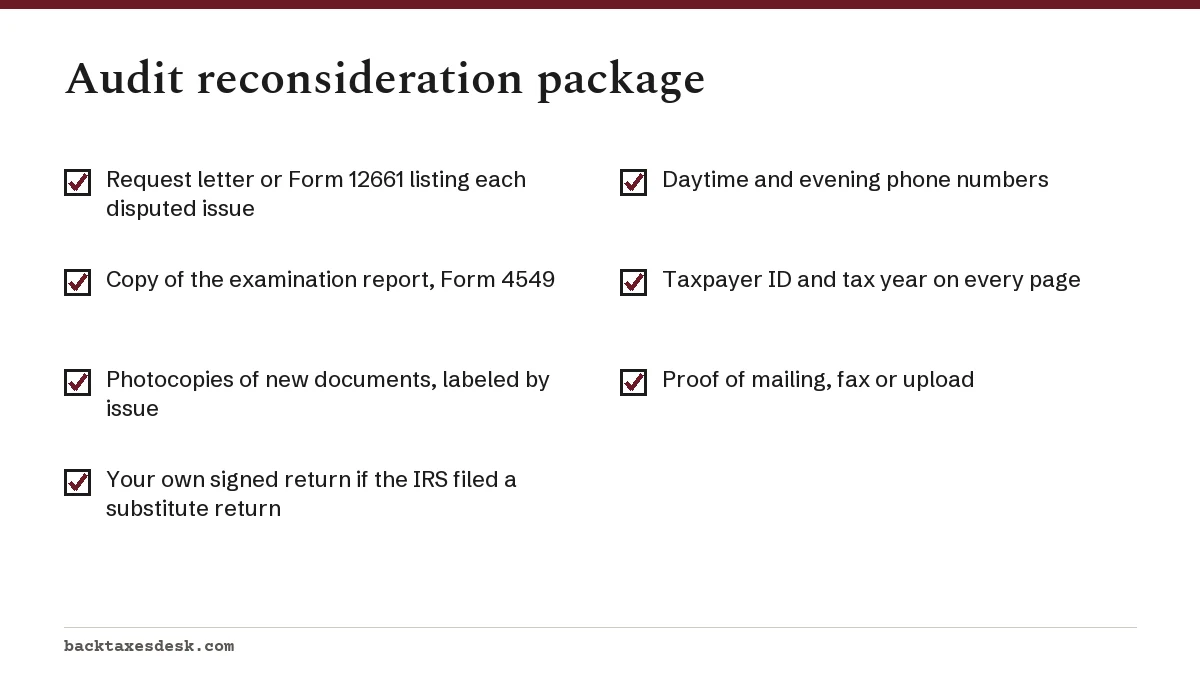
An audit reconsideration request is a written letter, with copies of new documents and the examination report, sent to the IRS campus that did the audit or uploaded as your IRS notice directs. The steps below follow Publication 3598 and the IRS page on reconsideration of mail audits.
- Get the examination report. Find the Form 4549 and explanation from the audit. If you never received it, request your account transcript for the year or ask the IRS for a copy.
- Pick the issues. Mark each adjustment you dispute. Leave alone the ones you cannot support.
- Gather new documents for each disputed issue and make photocopies. The IRS does not return originals.
- Write the request letter, or use Form 12661, Disputed Issue Verification, to list each issue and why the adjustment is wrong.
- Attach a copy of Form 4549 if you have it, and add daytime and evening phone numbers with the best time to call.
- Send it to the campus address on your examination report, or use the Documents Upload Tool if your notice offers it. If you fax, put your taxpayer ID and tax year on every page.
- Keep a complete copy and proof of sending, such as a certified mail receipt.
Audit reconsideration letter sample outline
There is no required wording. A clear request letter follows this structure, with one short paragraph per section:
- Heading: your name, address, taxpayer ID, tax year and the phrase Request for Audit Reconsideration.
- Reason: one sentence on why you qualify, for example that you moved and never received the audit letters.
- Issue list: each disputed adjustment, the amount the IRS changed and the amount you believe is correct.
- Evidence: which attached exhibit supports each issue, labeled Exhibit A, B, C.
- Request: ask the IRS to abate the tax, penalties and interest tied to the corrected items.
- Contact and signature: phone numbers, the best time to call and your signature and date.
Worked example: an audit disallowed $9,000 of dependent-related credits for 2023 because the taxpayer never answered. The request lists that one issue, attaches the child's school enrollment letter and pediatric records showing the taxpayer's address, and asks for abatement of the $9,000 and the related penalty and interest.
What happens after you submit it
Publication 3598 says to expect to hear from the IRS within 30 days of submitting the request, though the IRS page cautions it can take several months. You can check progress in your IRS online account or by calling the number on your letters.
- Collection may pause while the IRS reviews your documents, but it can restart if your records fall short and you miss a follow-up request by 30 calendar days.
- If you have an installment agreement, keep making the payments during review.
- The result is one of three letters: the tax is abated in full, reduced in part, or left unchanged.
If the tax is reduced, penalties and interest tied to that tax come down with it. If the answer leaves a balance you cannot pay, see the options to set up an IRS payment plan.
What if the IRS denies audit reconsideration?
If the IRS rejects the request or you disagree with the result, you can request a conference with the IRS Independent Office of Appeals, pay in full and file a formal refund claim, or do nothing and receive a bill. Reconsideration does not give you a new notice of deficiency, so it does not reopen the door to a Tax Court petition.
If reconsideration is closed to you and the balance is genuinely wrong, an Offer in Compromise based on doubt as to liability (Form 656-L) is another route Publication 3498 mentions.
What if I already paid the tax?
If you already paid the assessed tax in full, audit reconsideration is not available and you must file a formal refund claim on Form 1040-X, Amended U.S. Individual Income Tax Return. Publication 3498 says the same applies when reconsideration would produce a refund of payments you made.
Watch the refund deadline. The IRS says a claim is generally due by the later of three years from when you filed the return or two years from when you paid the tax, and the refund is limited to amounts paid within the matching look-back period. Someone who paid an audit bill in March 2025 generally has until March 2027 to claim that payment back.
If the IRS denies the refund claim, the next steps are an Appeals conference or a refund suit in a US District Court or the Court of Federal Claims, which both require payment first.
Step by step
Confirm you qualify
Check that the tax from the audit or substitute return is still unpaid and that no closing agreement, Form 870-AD or court decision covers it.
Get the examination report
Find Form 4549 and the explanation of items, or request a copy or your account transcript.
Collect new documents
For each disputed adjustment, gather records the examiner never saw, for the correct tax year, and make copies.
Write the request
Use a letter or Form 12661 listing each issue, the correct amount and the supporting exhibits.
Send and track
Mail or upload to the office on your report, keep proof, and expect contact in about 30 days.
Respond to follow-ups
Answer any IRS request for more information within 30 calendar days so collection does not resume.
Common questions
Is there a deadline for audit reconsideration?
No fixed deadline. Publication 3598 says you can ask any time after the examination assessment while the tax remains unpaid; once it is paid in full, the refund claim deadlines apply instead.
Does audit reconsideration stop IRS collection?
The IRS may delay collection while it reviews your documents, but it is not automatic. Collection can resume if your documents are not enough and you do not answer a follow-up request within 30 calendar days.
Can I request audit reconsideration on a substitute for return?
Yes. Filing your own return after the IRS prepared a substitute return is one of the listed reasons, and it is often the fastest way to lower an inflated SFR balance.
Do I need a special form for an audit reconsideration request?
No. A signed letter with documents is enough, though the IRS recommends Form 12661, Disputed Issue Verification, to lay out each disputed issue.
How many times can I request audit reconsideration?
The IRS does not publish a limit, but each request must bring information it has not considered. Repeating the same documents is likely to be rejected.
Can a Taxpayer Advocate help with audit reconsideration?
Yes, if the problem causes financial hardship or the IRS has not resolved it through normal channels. The Taxpayer Advocate Service is an independent office within the IRS.
Sources
- Publication 3598, What You Should Know About the Audit Reconsideration Process irs.gov
- Audit reconsideration process for correspondence examination audits by mail irs.gov
- Publication 3498, The Examination Process irs.gov
- Time you can claim a credit or refund irs.gov
We check figures against these official pages. Rules change; confirm anything that affects a deadline or payment with the agency before you act.
Tell us what happened
Describe your situation and our editors will use it to improve this guide. If you leave your email, we may reply with a pointer to the right page or official contact. We never share your details.
Related guides
 IRS Audit Guide: Types, Letters, Timelines and Appeals
An IRS audit is a review of a filed tax return to check that income, deductions and credits were reported correctly, and the IRS…
IRS Appeals Process: How to Dispute an IRS Decision
The IRS appeals process lets you ask the IRS Independent Office of Appeals, which is separate from the office that audited or bil…
How to Respond to an IRS Notice (and What If You Ignore It)
To respond to an IRS notice, reply by the due date printed on it, using the upload, fax or mail method it names. If you agree, do…
 How to File a Tax Court Petition: Deadline, Fee and Steps
A Tax Court petition asks the US Tax Court to review an IRS determination before you pay. For a notice of deficiency it must be f…
IRS Substitute for Return (SFR): What It Is and What to Do
A substitute for return is the IRS's own calculation of your tax for a year you did not file, built from W-2, 1099 and other repo…