
Responding to an IRS notice: agree, dispute or ask for time
Short answer
To respond to an IRS notice, reply by the due date printed on it, using the upload, fax or mail method it names. If you agree, do what the letter asks, usually pay, and reply only if asked. If you disagree, send a signed explanation with copies of documents. If you need time, ask before the deadline. Ignoring the letter lets the IRS assess tax and start collection.
- 01Fastest reply method for many notices
- IRS Documents Upload Tool
- 02CP2000 reply window
- 30 days from notice date (60 outside the US)
- 03Mail audit extension
- One automatic 30-day extension
- 04Form to name a representative
- Form 2848
Responding to an IRS notice: the three choices
Responding to an IRS notice is simpler once you decide which of three positions you are in. Each leads to a different kind of reply, and choosing early keeps the most options open.
| Your position | What to do | What to send |
|---|---|---|
| I agree | Take the action the notice asks, such as paying | Nothing, unless the notice asks for a signed response form |
| I disagree (all or part) | Dispute by the method on the notice | Signed statement explaining why, plus copies of documents |
| I need more time | Ask before the deadline | A request by phone, fax or letter, or use the extension the notice offers |
The IRS says that if you agree, you do not need to reply unless the letter specifically asks you to. A CP2000 is different: the IRS asks you to sign and return the response form even if you agree, with both spouses signing for a joint return, so read the instructions line by line. If you are still unsure what the letter is, see why you got an IRS letter first.
How long do you have to respond to an IRS notice?
There is no single answer, because each notice sets its own clock. Many print an exact date; others count days from the notice date, not from when the envelope reached you. The IRS says that replying by the due date protects your appeal rights.
| Notice | Window | What is at stake |
|---|---|---|
| CP14 | Due date printed on the notice | Avoiding further interest on the billed amount |
| CP161 | Contact within 10 days if you disagree | Correcting the balance before collection moves on |
| CP2000 | 30 days from notice date; 60 if you live outside the US | A statutory notice of deficiency if you do not reply |
| CP504 | 30 days from notice date | Levy of state refunds; the next step is a final levy notice |
| CP523 | 30 days from notice date | Keeping your installment agreement |
| LT11 or Letter 1058 | 30 days from notice date | Your Collection Due Process hearing right |
| CP3219A | 90 days (150 outside the US); cannot be extended | Your right to go to Tax Court before paying |
Mail audits come with a built-in extension option: you can take one automatic 30-day extension by fax or mail. For other notices, ask for more time before the deadline and write down the date, the name or ID number of the IRS employee and what was agreed.
How to reply: upload, fax or mail
Use the method printed on your notice. Each notice names the address, fax number or upload route for that type of reply, and using it helps your response reach the unit handling your case.
Can I respond to an IRS notice online
For many notices, yes. The IRS calls its Documents Upload Tool the fastest way to send a CP2000 reply, and the notice explains how to reach it. You upload the signed response form and supporting documents as files instead of mailing them.
Your IRS online account handles other replies. You can pay a balance, set up a payment plan through the Online Payment Agreement, and view and download certain notices there. If your notice is not eligible for upload, use fax or mail.
Fax
Some notices list a fax number specific to the processing center. Fax only to the number on your notice, put your name, the last four digits of your taxpayer ID and the notice code on every page, and keep the transmission report.
Mail to the address listed on the notice. Send copies, not originals, and use a mailing method that gives you proof of the send date. The postmark matters when a deadline is close.
Writing a response to an IRS notice that gets processed
A good response is short and matched to the notice. The IRS employee who opens it needs to connect it to your account in seconds and see exactly which item you dispute and why.
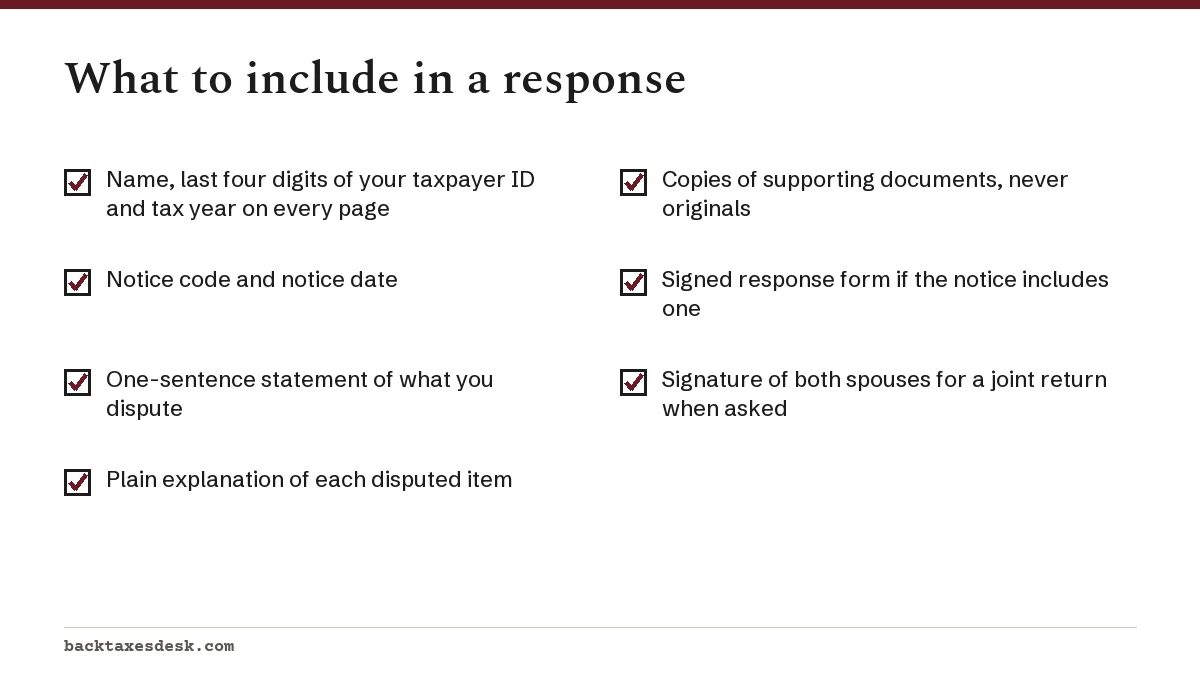
A structure that works
- Header. Your name as it appears on the notice, taxpayer ID (last four digits on each page), tax year, notice code and notice date.
- Your position in one sentence. For example: I disagree with the proposed increase of $2,850 in nonemployee compensation for 2024.
- The reason. Explain what happened in plain terms, one item per paragraph. If income was reported on another line of your return, give the line number.
- The evidence. List each attached document and what it proves: a corrected 1099, a bank statement, a canceled check or a payment confirmation.
- What you are asking for. Remove the adjustment, correct the balance, apply a payment or grant 30 more days.
- Signature and date. Both spouses sign if the notice covers a joint return and asks for a signature.
What happens if you ignore an IRS letter
Silence does not make an IRS notice go away; it lets the IRS decide without you. What happens next depends on the kind of letter.
- Ignored bills move through reminders CP501 and CP503 to a CP504 notice of intent to levy and then a final notice. Interest compounds daily at 7% a year through December 2026, and the late payment penalty adds 0.5% a month, rising to 1% a month if the tax is not paid within 10 days of a notice of intent to levy.
- Ignored adjustment notices such as a CP2000 lead to a statutory notice of deficiency. If that 90-day window also passes, the proposed tax can be assessed and billed, and your chance to dispute it in Tax Court before paying is gone.
- Ignored missing-return letters can lead the IRS to prepare a substitute for return from third-party income data, which may leave out deductions and credits you could have claimed.
- Ignored final levy notices end your right to a Collection Due Process hearing. You can still ask for an equivalent hearing within one year, but it does not stop a levy or give you a path to court.
Follow the balance path in detail on our CP14 notice page and CP504 notice page.
What happens if you ignore the IRS for years
Long silence tends to stack problems: a federal tax lien, levies on wages or bank accounts, and certification to the State Department once seriously delinquent debt passes the threshold ($66,000 for 2026; the 2027 figure is not yet announced). The IRS generally has 10 years from assessment to collect, but many events pause that clock.
Getting help with an IRS reply
You can handle most notices yourself. Consider help when the amount is large, a deadline has passed, or the notice leads to an audit or a hearing.
- Form 2848 authorizes a representative to act for you before the IRS. Enrolled agents, CPAs and attorneys have unlimited representation rights; preparers with only a PTIN generally cannot represent you.
- Form 8821 lets someone receive and inspect your tax information without representing you.
- Low Income Taxpayer Clinics help for free or a small fee if income is generally at or below 250% of the federal poverty guidelines.
- The Taxpayer Advocate Service is an independent office within the IRS for cases where normal channels have failed.
For an audit letter the steps differ; see our guide to the IRS correspondence audit. For a final levy notice, the Collection Due Process hearing page covers Form 12153. Our help with IRS problems hub compares every free and paid option.
Keeping proof of your response to an IRS notice
Proof that you answered on time is your best protection if a reply is lost. Build a small file for each notice and keep it until the issue is closed and the balance or adjustment shows correctly in your online account.
- A copy of the notice, front and back
- A copy of everything you sent, in the order you sent it
- Upload confirmation, fax transmission report or mailing receipt with the date
- Notes of each call: date, time, employee name or ID number and what was said
- Any follow-up letter the IRS sends in reply
If the IRS has not answered after the time its reply letter states, call the number on the notice with your file in front of you. Our IRS notices hub links to the page for each specific notice code.
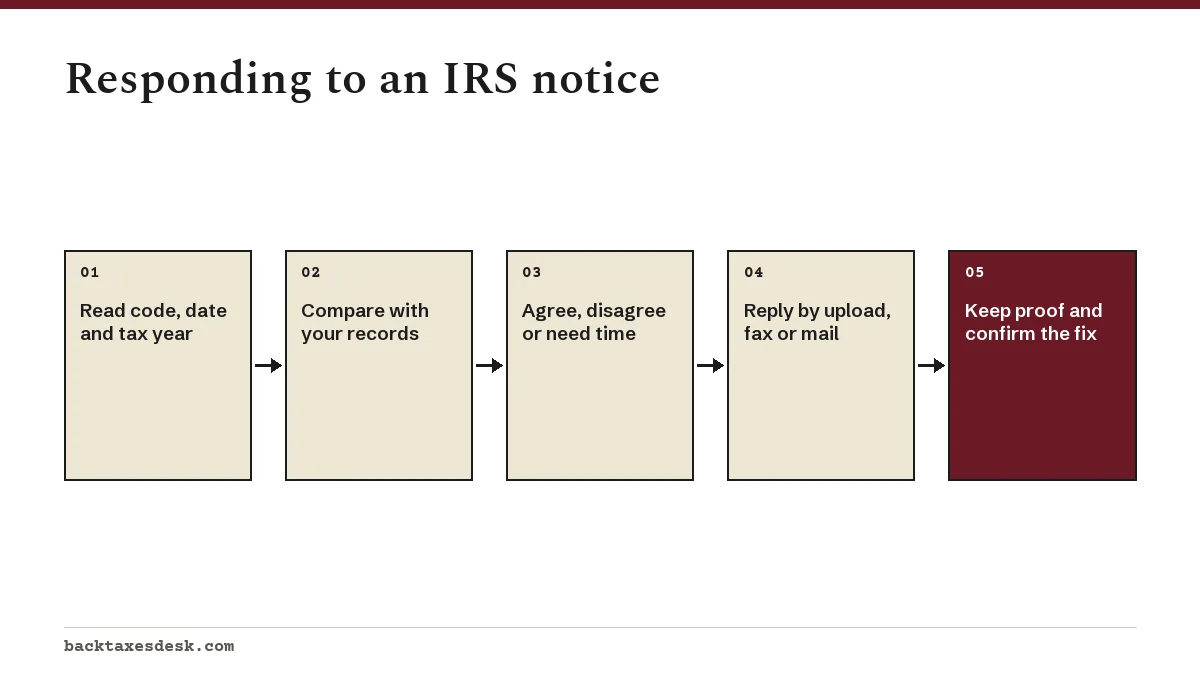
Step by step
Identify the notice
Find the notice code and date in the top or bottom right corner and the tax year it covers.
Check it against your records
Compare the notice with your return, your documents and your IRS online account.
Choose your position
Decide whether you agree, disagree in whole or in part, or need more time.
Prepare the reply
Complete any response form, write a signed statement if you disagree and attach copies of supporting documents.
Send it by the method on the notice
Upload, fax or mail before the deadline, and pay or set up a plan for any amount you accept.
Keep proof and follow up
Save confirmations and call notes, and check your online account until the issue shows as resolved.
Common questions
How do I respond to an IRS notice?
Decide whether you agree, disagree or need more time, then use the reply method printed on the notice: the Documents Upload Tool, fax or mail. Include the notice code, tax year and copies of any documents, and keep proof of the date you sent it.
What happens if you ignore an IRS letter?
Interest and penalties keep growing and the IRS moves to its next step without your input. Bills escalate toward liens and levies, adjustment notices become assessed tax, and missed hearing deadlines remove appeal rights.
Can I respond to an IRS notice online?
Often. The IRS Documents Upload Tool accepts replies to many notices, including the CP2000, and your IRS online account lets you pay or set up a payment plan. If your notice does not offer upload, use the fax number or address it lists.
Should I call the IRS or write back?
Call when you need a quick answer or a short extension, and write when you are disputing something. A written reply with documents creates a record the IRS must process, while a call depends on notes you take yourself.
Do I need to respond if I already paid the amount on the notice?
Check your IRS online account first. If the payment shows, no reply is usually needed; if it does not, the IRS asks you to contact it using the number on the notice and have your payment confirmation ready so it can be applied correctly.
What if I missed the deadline on my IRS notice?
Reply anyway, as soon as possible. Some rights have hard limits, such as the 90-day Tax Court window after a notice of deficiency, but many issues can still be fixed later through audit reconsideration, an equivalent hearing within one year of a levy notice, or a payment plan.
Sources
- Understanding your IRS notice or letter irs.gov
- Understanding your CP2000 notice irs.gov
- About Form 2848, Power of Attorney and Declaration of Representative irs.gov
- IRS audits irs.gov
- Topic no. 652, Notice of underreported income, CP2000 irs.gov
- Failure to pay penalty irs.gov
We check figures against these official pages. Rules change; confirm anything that affects a deadline or payment with the agency before you act.
Tell us what happened
Describe your situation and our editors will use it to improve this guide. If you leave your email, we may reply with a pointer to the right page or official contact. We never share your details.
Related guides
 IRS Notices and Letters: What Each One Means and Next Steps
An IRS notice is a letter the IRS mails when it needs something from you: payment of a balance, a reply to a proposed change, a m…
Why Did I Get a Letter From the IRS? 7 Common Reasons
You got a letter from the IRS because it needs something about your account: most often you owe a balance, it changed or has a qu…
IRS Notice CP14: Your Balance Due and What to Do Next
IRS notice CP14 is the first bill the IRS sends when a tax return shows a balance that was not paid in full. It lists the tax, pe…
IRS Notice CP504: Intent to Levy and What to Do Right Now
IRS notice CP504 is a Notice of Intent to Levy under Internal Revenue Code section 6331(d), sent when earlier bills went unpaid.…
Collection Due Process Hearing: Form 12153 Step by Step
A collection due process hearing is an independent review by the IRS Independent Office of Appeals of a proposed levy or a filed…
 Help With IRS Problems: Who Can Represent You and How
Help with IRS problems comes from three places: tools you can use yourself on IRS.gov, free help from the Taxpayer Advocate Servi…