
IRS final notice of intent to levy: LT11 and Letter 1058
Short answer
An IRS final notice of intent to levy, sent as LT11 or Letter 1058, is the last letter before the IRS can take wages, bank accounts or other property. It also gives you the right to a Collection Due Process hearing. You have 30 days from the notice date to request one on Form 12153; a timely request generally stops levies while the hearing runs.
- 01Full name
- Final Notice of Intent to Levy and Notice of Your Right to a Hearing
- 02Hearing request deadline
- 30 days from the notice date
- 03Form to request a hearing
- Form 12153
- 04Late request option
- Equivalent hearing within one year
What does an IRS final notice of intent to levy mean?
An IRS final notice of intent to levy is the formal warning the law requires before most levies. The IRS must send it at least 30 days before levying wages, bank accounts or other property, and it must tell you about your right to a hearing with the IRS Independent Office of Appeals.
Two versions exist. The LT11 notice and Letter 1058 carry the same legal effect and the same 30-day hearing right, and the IRS explains both on a single page. The IRS summarizes the message in one line: it has not received payment for overdue taxes and intends to seize property or rights to property.
Unlike the earlier CP504 notice, this letter gives Collection Due Process (CDP) rights. A CP90 is another notice that does the same.
Your 30-day Collection Due Process right after an LT11 notice
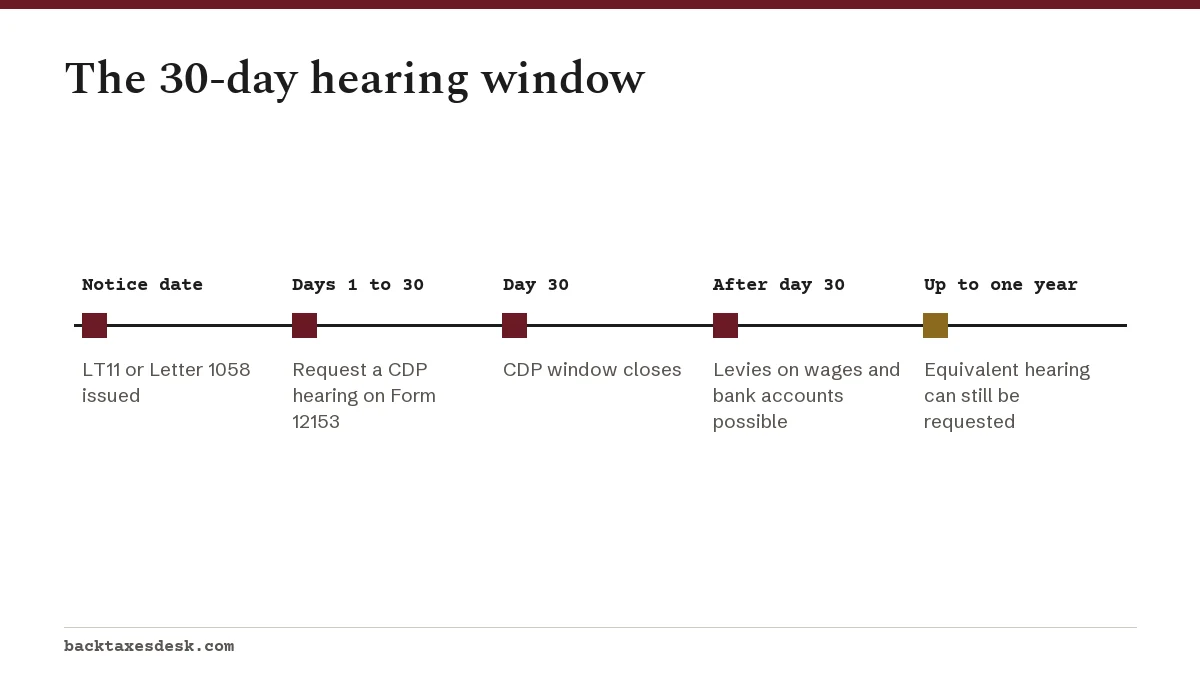
IRS Publication 1660 sets the window: you may request a CDP hearing during the 30-day period from the date of the notice. Count from the date printed on the letter, not the day it arrived, and mail or fax well before the end.
What a timely hearing request does
- Stops most levies. Levy action is not permitted for the tax periods in the hearing while a timely request is pending, with narrow exceptions such as jeopardy cases and state refund levies.
- Pauses the collection clock. The 10-year collection period is suspended until the Appeals determination becomes final or you withdraw.
- Gets an independent review. The IRS Independent Office of Appeals, not the collection staff pursuing you, reviews whether the levy is appropriate and considers collection alternatives.
- Keeps the courthouse open. If you disagree with the determination, you can petition the US Tax Court within the period stated in the determination letter.
What you can raise has limits. You can argue the levy is inappropriate, propose a payment plan or offer, show economic hardship, and raise spousal defenses. Publication 1660 says you can dispute the amount of tax only if you did not receive a notice of deficiency or otherwise have a chance to dispute it.
How to request a hearing on Form 12153
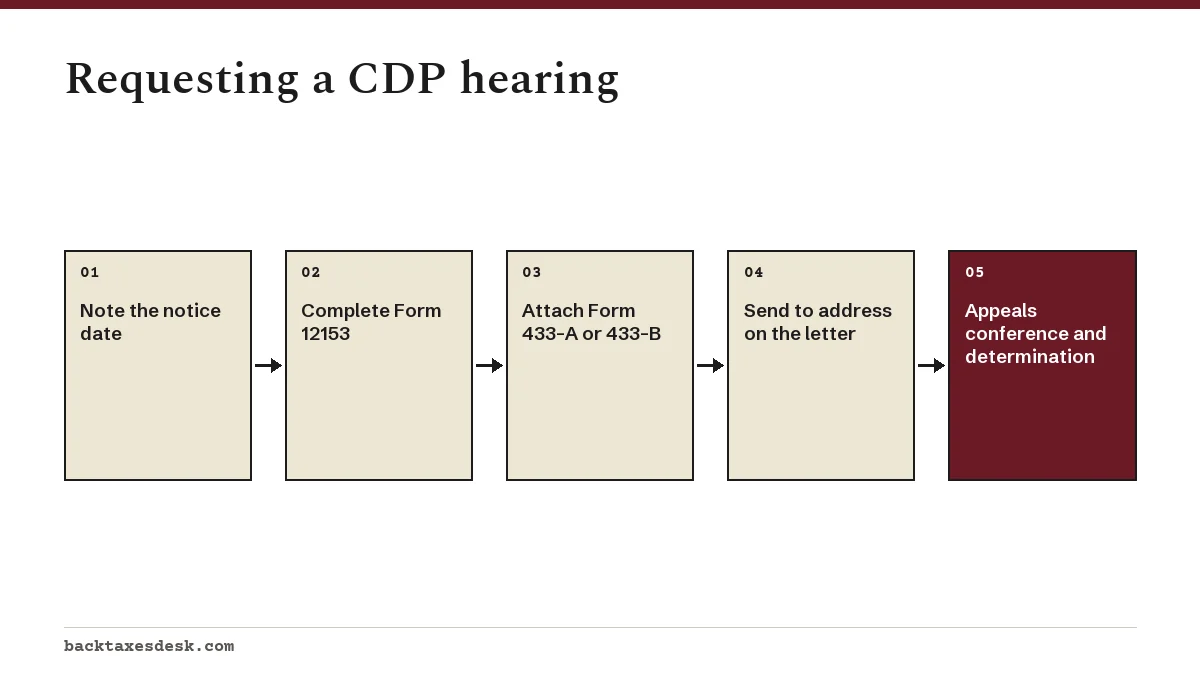
- Download Form 12153, Request for a Collection Due Process or Equivalent Hearing, from IRS.gov.
- Enter your details, the tax type and the tax periods exactly as they appear on the letter.
- Check the box for a proposed levy (and the lien box too if you also received Letter 3172).
- Identify the alternatives you want to discuss, such as an installment agreement, an offer in compromise or inability to pay.
- Explain in plain words why you disagree with the levy.
- Attach a financial statement, Form 433-A for individuals or 433-B for businesses, so Appeals can consider an alternative without delay.
- Send it to the address on your LT11 or Letter 1058 and keep proof of the date.
Our full walkthrough of the Collection Due Process hearing covers what happens at the conference and how to prepare.
How long after a final notice of intent to levy does the IRS act
If you do nothing, levies can begin once the 30-day window closes. There is no published schedule after that, but the IRS lists the likely targets: wages, bank accounts, business assets, vehicles, homes, state tax refunds, Alaska Permanent Fund Dividends and Social Security benefits.
| Levy type | How it works | What you can still do |
|---|---|---|
| Bank account | The bank holds the funds for 21 days, then sends them to the IRS | Contact the IRS inside those 21 days to resolve the debt or show hardship |
| Wages | Continuous: a set part of each paycheck until the debt is paid or released | Return the Statement of Dependents and Filing Status within three days to protect the exempt amount |
| Separately paid bonus | Can be taken in full because the exemption is per pay period | Arrange a plan before bonus season |
See how each works in detail on our pages about the IRS bank levy and IRS wage garnishment. A federal tax lien may also be filed, and seriously delinquent debt over $66,000 in 2026 can be certified for passport action.
Can I set up a payment plan after an LT11
Yes, and it is often the fastest way to stop a levy. The IRS says individuals who owe $50,000 or less can apply online through the Online Payment Agreement; larger balances can be requested on Form 9465. You must be current on filing all required returns.
If a plan is your goal, you do not have to wait for a hearing; apply directly. If you also want the protection of a hearing, request CDP within the 30 days and name the plan on Form 12153 as the alternative you want. If you cannot pay at all, Currently Not Collectible status delays collection while your finances are reviewed, though interest continues. Compare plan types on our installment agreement page.
Equivalent hearing if you miss the 30 days
Missing the CDP deadline is not the end of your appeal options. You can request an equivalent hearing on the same Form 12153 by checking the Equivalent Hearing box on line 7. The request must be postmarked within one year after the date of the levy notice.
Common questions
What is an LT11 notice?
LT11 is the IRS Final Notice of Intent to Levy and Notice of Your Right to a Hearing. It warns that the IRS can levy wages, bank accounts and other property and gives you 30 days to request a Collection Due Process hearing.
Is Letter 1058 the same as LT11?
For your rights, yes. Both are titled as a final notice of intent to levy with notice of your right to a hearing, both give 30 days to request a Collection Due Process hearing, and the IRS answers both with the same instructions.
How do I request a hearing after an IRS final notice of intent to levy?
Complete Form 12153 and send it to the address on your letter within 30 days of the notice date. Adding Form 433-A or 433-B helps Appeals consider a payment plan, offer or hardship status.
Can the IRS levy my bank account during a CDP hearing?
Generally no. When a hearing is requested on time, levy action on those tax periods is not permitted while the hearing is pending, apart from limited exceptions such as jeopardy cases and state refund levies.
What if I ignore an IRS final notice of intent to levy?
After 30 days the IRS can levy wages, bank accounts and other property, and you lose the regular CDP hearing. You can still ask for an equivalent hearing within one year, but it does not stop levies.
Sources
- Understanding your LT11 notice or Letter 1058 irs.gov
- Collection due process (CDP) FAQs irs.gov
- Publication 1660, Collection Appeal Rights irs.gov
- Levy irs.gov
- Information about wage levies irs.gov
We check figures against these official pages. Rules change; confirm anything that affects a deadline or payment with the agency before you act.
Tell us what happened
Describe your situation and our editors will use it to improve this guide. If you leave your email, we may reply with a pointer to the right page or official contact. We never share your details.
Related guides
 IRS Notices and Letters: What Each One Means and Next Steps
An IRS notice is a letter the IRS mails when it needs something from you: payment of a balance, a reply to a proposed change, a m…
Collection Due Process Hearing: Form 12153 Step by Step
A collection due process hearing is an independent review by the IRS Independent Office of Appeals of a proposed levy or a filed…
IRS Levy on a Bank Account: The 21-Day Hold and What to Do
When the IRS levies a bank account, the bank must freeze the available funds up to the amount of the levy and hold them for 21 da…
IRS Notice CP90: Final Levy Notice and Your Hearing Rights
A CP90 notice from the IRS is a final notice of intent to levy that also tells you of your right to a Collection Due Process hear…
IRS Wage Garnishment: How Much of Your Pay the IRS Can Take
In a wage garnishment, IRS rules let the agency take all of your take-home pay above an exempt amount set in Publication 1494. Fo…
IRS Notice CP504: Intent to Levy and What to Do Right Now
IRS notice CP504 is a Notice of Intent to Levy under Internal Revenue Code section 6331(d), sent when earlier bills went unpaid.…