
IRS installment agreement types and which one fits your balance
Short answer
An IRS installment agreement is a long-term monthly payment plan whose type depends mostly on how much you owe. Tax of $10,000 or less can qualify for a guaranteed agreement paid within 3 years. Balances up to $50,000 fit a streamlined agreement paid within 72 months, with no financial statement at $25,000 or less or with direct debit. Above $50,000, the IRS usually wants Form 433-F.
- 01Guaranteed agreement
- Tax of $10,000 or less, paid within 3 years
- 02Streamlined agreement
- Up to $50,000, paid within 72 months
- 03Over $50,000
- Form 433-F financial statement usually required
- 04Payroll deduction plan
- Form 2159
The main IRS installment agreement types
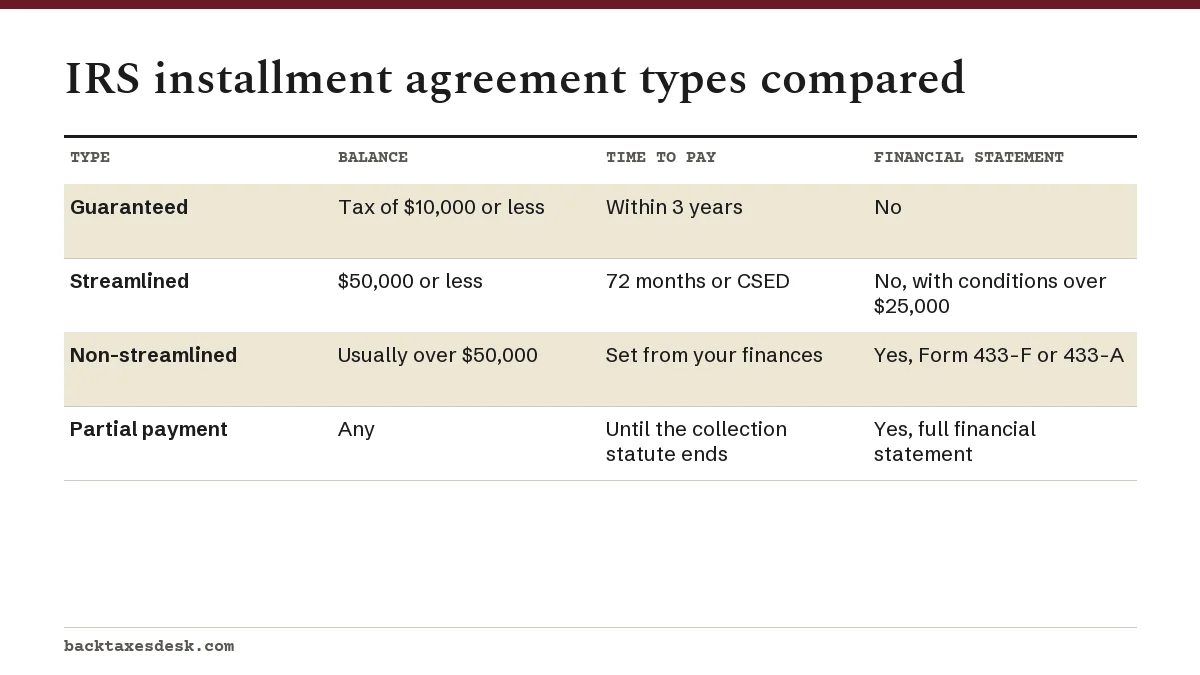
Every IRS installment agreement is a monthly payment plan, but the IRS sorts them into types with different entry rules. The type decides three practical things: whether you must disclose your finances, how long you have to pay, and how likely the IRS is to file a public tax lien.
Guaranteed installment agreement
A guaranteed installment agreement is one the IRS must accept if you meet every condition. The tax owed, not counting penalties and interest, must be $10,000 or less. You (and your spouse, on a joint return) must have filed and paid all income tax on time over the past 5 tax years, not entered into an installment agreement for income tax in that time, be unable to pay in full now, and agree to pay the whole balance within 3 years while staying compliant.
Streamlined installment agreement
The streamlined installment agreement is the plan most people get, and the one the online tool sets up. It covers assessed balances of $50,000 or less and must pay the debt within 72 months, or by the collection statute expiration date if that comes sooner. No financial statement is needed if the balance is $25,000 or less. Between $25,001 and $50,000, you must agree to direct debit or payroll deduction, or else file Form 433-F.
Non-streamlined installment agreement
A non-streamlined installment agreement covers everything that does not fit the streamlined rules, most often balances over $50,000 or monthly payments too small to finish within 72 months. The IRS sets the payment from your finances, so expect to document income, allowable living expenses and assets.
Partial payment installment agreement
If your finances show you cannot pay the full balance before the collection statute runs out, the IRS can agree to monthly payments that will not clear the debt. It requires a full financial statement. Details are in our guide to the partial payment installment agreement.
When the IRS requires financial statements
A financial statement, called a Collection Information Statement, lists what you earn, what you spend and what you own. For individuals the usual form is Form 433-F; the IRS may ask for the longer Form 433-A, and businesses use Form 433-B.
| Balance owed | Financial statement needed? | Condition |
|---|---|---|
| $25,000 or less | No | Streamlined terms, paid within 72 months |
| $25,001 to $50,000 | No, with direct debit or payroll deduction | Otherwise Form 433-F if your payment is below the calculated amount |
| Over $50,000 | Yes | Form 433-F attached to Form 9465 |
| Any amount, partial payment | Yes | Payments will not clear the balance before the statute expires |
Our walkthrough of Form 433-F covers how the IRS uses those figures and which documents to gather before you call.
Balances over $50,000
Owing more than $50,000 does not rule out an installment agreement. It rules out the online tool and the automatic streamlined terms. You request the plan by phone, in person or with Form 9465, and attach or complete Form 433-F.
Worked example: $62,000 owed
Suppose you owe $62,000 and can pay $900 a month. That clears the balance in about 69 months before interest, but because the balance is over $50,000, you still need a financial statement. A second route is to pay $12,000 or more up front to bring the balance to $50,000 or less; at that point a streamlined agreement is available online, at a minimum of about $695 a month over 72 months.
Paying down below $50,000 also lowers the setup fee, from $107 or $178 by phone to $29 or $69 online, and avoids the financial review entirely.
How each installment agreement type affects liens
The IRS generally does not file a Notice of Federal Tax Lien for guaranteed or streamlined agreements, though it can in certain situations. For non-streamlined and partial payment agreements, the Form 9465 instructions set no such general rule, so plan on a lien filing being possible.
A lien that is already filed does not go away because you enter a plan. The IRS releases a lien within 30 days after the debt is paid in full, and it can withdraw the public notice in some cases. Staying under $50,000 is therefore worth considering when deciding how much to pay up front.
Making the IRS installment agreement request
Whatever the type, the request starts the same way: file every required return, then apply online if you owe $50,000 or less, or by phone, in person or with Form 9465 if you owe more. The IRS usually answers a mailed request within 30 days. Payroll deduction agreements also need Form 2159, signed by your employer.
Step-by-step instructions for each route are in how to set up an IRS payment plan, and the full comparison of short-term and long-term plans is in our IRS payment plan guide.
Common questions
What is the difference between a guaranteed and a streamlined installment agreement?
A guaranteed agreement is for tax of $10,000 or less paid within 3 years, and the IRS must accept it if you meet all conditions. A streamlined agreement covers up to $50,000 over as long as 72 months, with no financial statement in most cases.
Can I get an IRS installment agreement if I owe $100,000?
Yes, but not online. You would apply by phone, in person or with Form 9465 and provide a financial statement such as Form 433-F. A short-term plan is also possible if you owe under $100,000 and can pay within 180 days.
How long can an IRS installment agreement last?
A streamlined agreement lasts up to 72 months or until the collection statute expires, if sooner. Non-streamlined agreements are set from your finances, and a partial payment agreement runs until the collection statute expiration date, even if a balance remains.
Does a streamlined installment agreement require Form 433-F?
Not for balances of $25,000 or less. Between $25,001 and $50,000, you avoid it by agreeing to direct debit or payroll deduction.
What is a payroll deduction installment agreement?
Your employer sends part of each paycheck to the IRS. You and your employer complete Form 2159, and it satisfies the streamlined requirement for balances between $25,001 and $50,000.
Sources
- Topic no. 202, Tax payment options irs.gov
- Instructions for Form 9465 irs.gov
- Payment plans; installment agreements irs.gov
- Form 433-F, Collection Information Statement irs.gov
- Understanding a federal tax lien irs.gov
We check figures against these official pages. Rules change; confirm anything that affects a deadline or payment with the agency before you act.
Tell us what happened
Describe your situation and our editors will use it to improve this guide. If you leave your email, we may reply with a pointer to the right page or official contact. We never share your details.
Related guides
 IRS Payment Plan: How It Works, Costs and Who Qualifies
An IRS payment plan lets you pay a tax bill over time: up to 180 days with no setup fee if you owe less than $100,000, or monthly…
Partial Payment Installment Agreement (PPIA) Explained
A partial payment installment agreement (PPIA) is an IRS payment plan for people who cannot pay their full tax debt before the 10…
Form 433-F: IRS Collection Information Statement Guide
Form 433-F is the IRS Collection Information Statement, a short financial snapshot the IRS uses to decide how much you can pay ea…
How to Set Up an IRS Payment Plan Online, by Phone or Mail
To set up an IRS payment plan, first make sure every required return is filed, then apply through the Online Payment Agreement to…
IRS Installment Agreement Default: Fixing a Missed Payment
An IRS payment plan default happens when you miss a monthly payment, fail to file a return, or leave new tax unpaid. The IRS then…