
IRS payment plan default: what a missed payment triggers and how to fix it
Short answer
An IRS payment plan default happens when you miss a monthly payment, fail to file a return, or leave new tax unpaid. The IRS then sends Notice CP523, saying it intends to end the agreement and levy. Contact the IRS no later than 30 days from the notice date; reinstating online costs $6, and new tax may have to be paid in full.
- 01Default notice
- CP523, intent to terminate and levy
- 02Time to respond
- No later than 30 days from the notice date
- 03Reinstatement fee
- $6 online; a fee may also apply offline
- 04Biggest risk after termination
- Wage and bank levies, possible tax lien
What counts as an IRS payment plan default?
An IRS payment plan default is a broken condition of your agreement. The IRS lists the conditions plainly: pay at least the minimum monthly payment when it is due, and file all required returns on time and pay all new taxes in full and on time. Breaking any one of them can put the plan into default.
- A missed or short payment. Paying less than the agreed amount, or paying late, counts.
- A bounced direct debit. If the bank rejects the withdrawal, the payment was not made.
- A new balance you do not pay. Owing on your 2026 return by April 15, 2027 and not paying it breaks the agreement, even if every monthly payment was on time.
- An unfiled return. Missing a filing deadline, without an extension, is a default in its own right.
- Skipping a payment because of a refund. The IRS applies refunds to your debt but still expects the scheduled payment that month.
The IRS does not publish a fixed number of payments you can miss before it acts. Treat any missed payment as a problem to fix that week, not a grace period.
What happens if you default on an IRS installment agreement
Default does not end the plan immediately. The IRS first sends Notice CP523, which says it intends to terminate your installment agreement and seize assets. The notice gives a termination date and asks you to contact the IRS no later than 30 days from the notice date.
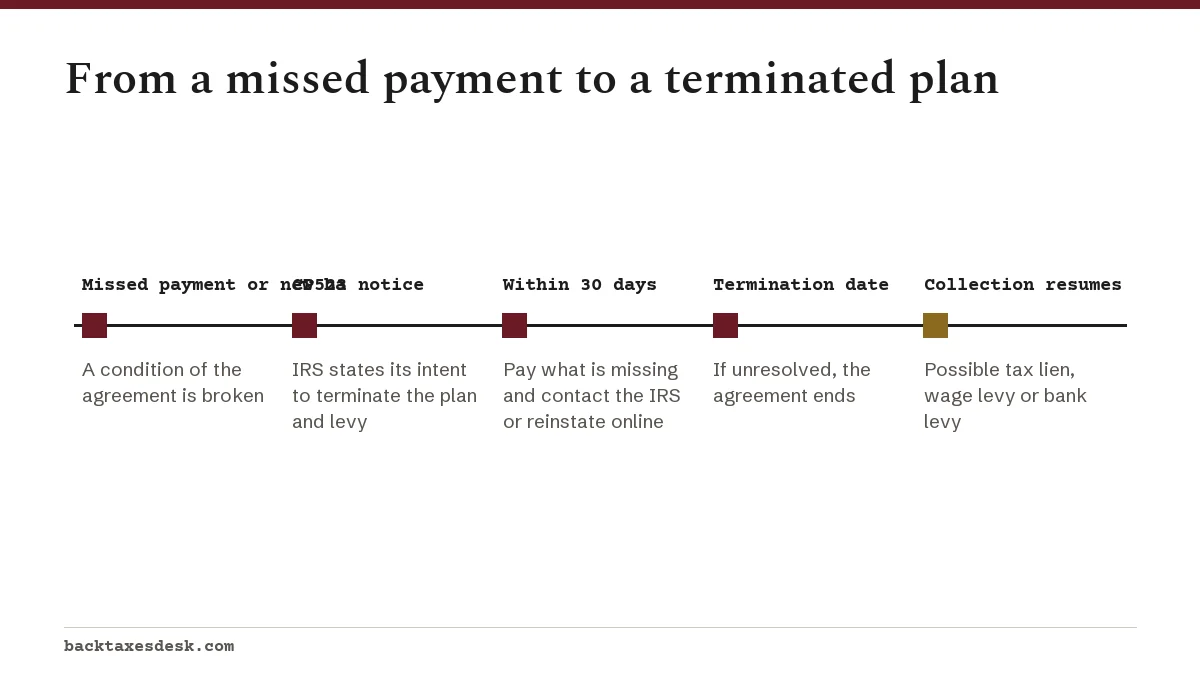
If nothing happens by the termination date, the agreement ends and normal collection resumes. That can include filing a Notice of Federal Tax Lien and levying wages or bank accounts. Termination also removes the protections the plan gave you: the reduced 0.25% failure-to-pay rate applies only during an approved plan, and a debt no longer in a timely-paid agreement can be certified for passport action if it is large enough.
What the CP523 itself says, and how to answer it line by line, is on our IRS notice CP523 page.
How to reinstate a defaulted IRS payment plan
Reinstatement means putting the same plan back in good standing, usually after you make the missed payment or pay the new balance. You can often do it yourself through the Online Payment Agreement tool, which lists reinstatement after default as an option.
- Read the CP523 and note the termination date and the reason given.
- Make the missed payment, or pay the new tax balance, through Direct Pay or your online account.
- Sign in to the Online Payment Agreement tool and choose to reinstate. The online fee is $6.
- If the tool will not reinstate, call the number on the notice before the termination date. The IRS says a reinstatement fee may apply, and the notice states what is required.
- If the old payment was too high to keep up, ask for a lower one at the same time rather than reinstating a plan you will default on again.
If you think the default is wrong, for example because a payment was made but misapplied, you can appeal and request a hearing with the IRS Independent Office of Appeals, as the notice explains.
IRS payment plan late payment: the cost of a lapse
A single late payment costs more than the payment itself. On $20,000 of unpaid tax, the failure-to-pay penalty during an approved plan is $50 a month at 0.25%. If the plan is terminated, the rate goes back to 0.5%, or $100 a month. If a notice of intent to levy follows and you do not pay within 10 days, the rate rises to 1%, or $200 a month.
| Status | Monthly rate | Monthly penalty |
|---|---|---|
| Approved plan, return filed on time | 0.25% | $50 |
| No plan in place | 0.5% | $100 |
| 10 days after a notice of intent to levy | 1% | $200 |
Interest runs on top of these amounts in every case, at 7% a year for October to December 2026. The rate for early 2027 is not yet announced.
Avoiding default in the 2027 filing season
Spring is when plans are most at risk. Your 2026 return is due April 15, 2027, and if it shows a balance you cannot pay in full, the existing agreement is in danger. Plan for it now, while there are still months of paychecks left in 2026.
- Raise your withholding on a new Form W-4 so your 2026 return breaks even or shows a refund.
- Make estimated payments if you are self-employed, so no large balance appears in April.
- File on time or extend. Form 4868 moves the filing deadline to October 15, 2027, though not the payment deadline.
- Switch to direct debit in the online tool, so a forgotten month cannot happen.
- Recheck your payment amount with our IRS payment plan calculator if your income has dropped, and revise before you miss a month.
If the underlying problem is that the plan type was wrong for your situation, compare the options in IRS installment agreement types and our IRS payment plan guide.
Common questions
How many IRS payment plan payments can I miss?
The IRS does not publish a set number. Any missed payment can put the plan in default and lead to a CP523, so contact the IRS or use the online tool as soon as you know a payment will be missed.
Will a new tax balance break my IRS installment agreement?
It can. Paying all new taxes in full and on time is a condition of the plan. If you cannot, contact the IRS before the due date to discuss revising the agreement.
How much does it cost to reinstate an IRS payment plan?
Reinstating through the Online Payment Agreement tool costs $6, which low-income taxpayers may have reimbursed. The IRS says a reinstatement fee may also apply when you reinstate by phone, and the CP523 explains what you must pay.
Can the IRS levy my wages after one missed payment?
Not straight away. The IRS first sends a CP523 with a termination date and asks you to respond no later than 30 days from the notice date. After a plan is terminated, the IRS generally waits 30 days before enforced collection.
Does defaulting reset my payment plan?
No. The balance, penalties and interest remain. Reinstating restores the plan; if it is terminated, you would need to request a new agreement.
Sources
- Understanding your CP523 notice irs.gov
- Payment plans; installment agreements irs.gov
- Additional information on payment plans irs.gov
- Failure to pay penalty irs.gov
- Instructions for Form 9465 irs.gov
We check figures against these official pages. Rules change; confirm anything that affects a deadline or payment with the agency before you act.
Tell us what happened
Describe your situation and our editors will use it to improve this guide. If you leave your email, we may reply with a pointer to the right page or official contact. We never share your details.
Related guides
 IRS Payment Plan: How It Works, Costs and Who Qualifies
An IRS payment plan lets you pay a tax bill over time: up to 180 days with no setup fee if you owe less than $100,000, or monthly…
IRS Notice CP523: Payment Plan Default and What to Do Now
A CP523 notice tells you that your IRS installment agreement is in default and that the IRS intends to terminate it and seize (le…
IRS Payment Plan Calculator: Estimate Your Monthly Payment
This IRS payment plan calculator estimates your monthly payment from your balance, the number of months and the charges that keep…
IRS Installment Agreement Types: Which One Fits Your Debt
An IRS installment agreement is a long-term monthly payment plan whose type depends mostly on how much you owe. Tax of $10,000 or…
IRS Payment Plan Not Working Online? Fixes and Alternatives
When an IRS payment plan is not working online, the cause is usually one of five things: a missing tax return, a balance above th…