
CP523 notice: your payment plan is in default
Short answer
A CP523 notice tells you that your IRS installment agreement is in default and that the IRS intends to terminate it and seize (levy) assets. Contact the IRS no later than 30 days from the notice date. Paying the missed amount, filing any missing return or asking for reinstatement within that window can keep the plan alive; a fee may apply.
- 01What it means
- Intent to terminate a defaulted installment agreement and levy
- 02Time to act
- No later than 30 days from the notice date
- 03Reinstatement
- Possible; a fee may be charged
- 04Appeal route
- Collection Appeals Program (Publication 1660)
What does a CP523 notice mean?
A CP523 notice is the IRS warning that you broke the terms of your installment agreement and that it plans to end the agreement. Once the plan ends, the IRS can go back to enforced collection, which can include a federal tax lien and levies on wages or bank accounts.
The notice is not the termination itself. It gives you a short window to fix the default, and curing it within that window can keep the plan in place.
Typical reasons a plan defaults
- A missed or late monthly payment
- A direct debit that bounced because the account was closed or short of funds
- A new tax balance that was not paid when due, such as a balance on your latest return
- A tax return that was not filed on time while the plan was active
Your notice explains what went wrong on your account. Read that part first, because the fix depends on it.
The 30-day CP523 notice window
The IRS asks you to contact it immediately and no later than 30 days from the date printed on the notice. Make any missed payment before the termination date listed on the notice, then call the number on the letter to confirm the plan is back on track.
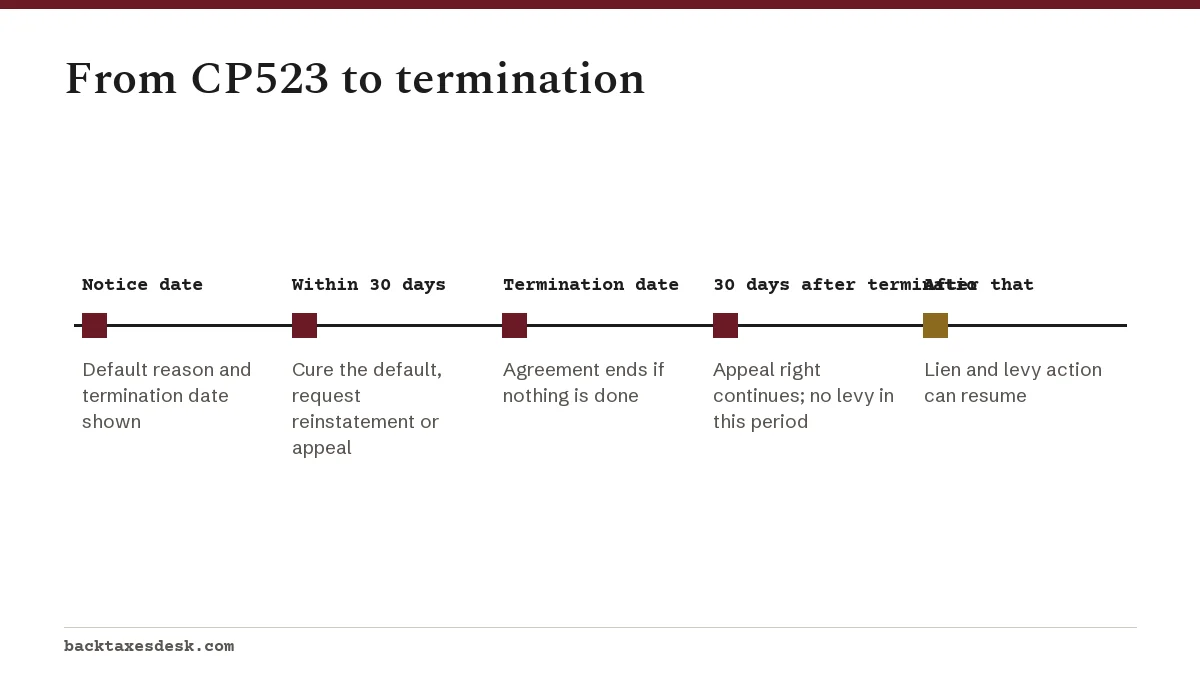
If you let the date pass, the agreement terminates. Under Publication 1660, the IRS cannot levy until 30 days after termination, and you keep a right to appeal the termination for those 30 days. After that, levy steps described in our collection process page can move ahead.
Reinstating your installment agreement
To reinstate the agreement, the IRS may require the missed payment before the termination date, a reinstatement fee, or full payment of any new tax balance. The notice and the IRS representative tell you which of these applies to your account.
- Find the default reason on the CP523 and the termination date.
- Pay the missed installment, or the new balance, through your IRS online account, IRS Direct Pay or another electronic method.
- If a return is missing, file it now, because you must be current on filing to keep a plan.
- Call the number on the notice before the deadline and ask for the agreement to be reinstated.
- Ask whether switching to direct debit is possible, which lowers the risk of another missed payment.
How to pay a CP523 notice online
Paying online is the fastest way to prove you cured the default. IRS Direct Pay takes money from a checking or savings account for free, and you can change or cancel a scheduled payment up to two business days before it goes out. Your IRS online account shows the payment and the plan status. The IRS Direct Pay guide covers the steps.
What a default costs: a worked example
Keeping the plan saves money beyond avoiding a levy. For individuals who filed on time and have an approved payment plan, the failure-to-pay penalty is 0.25% a month instead of 0.5%. If the tax is not paid within 10 days of a notice of intent to levy, it rises to 1% a month.
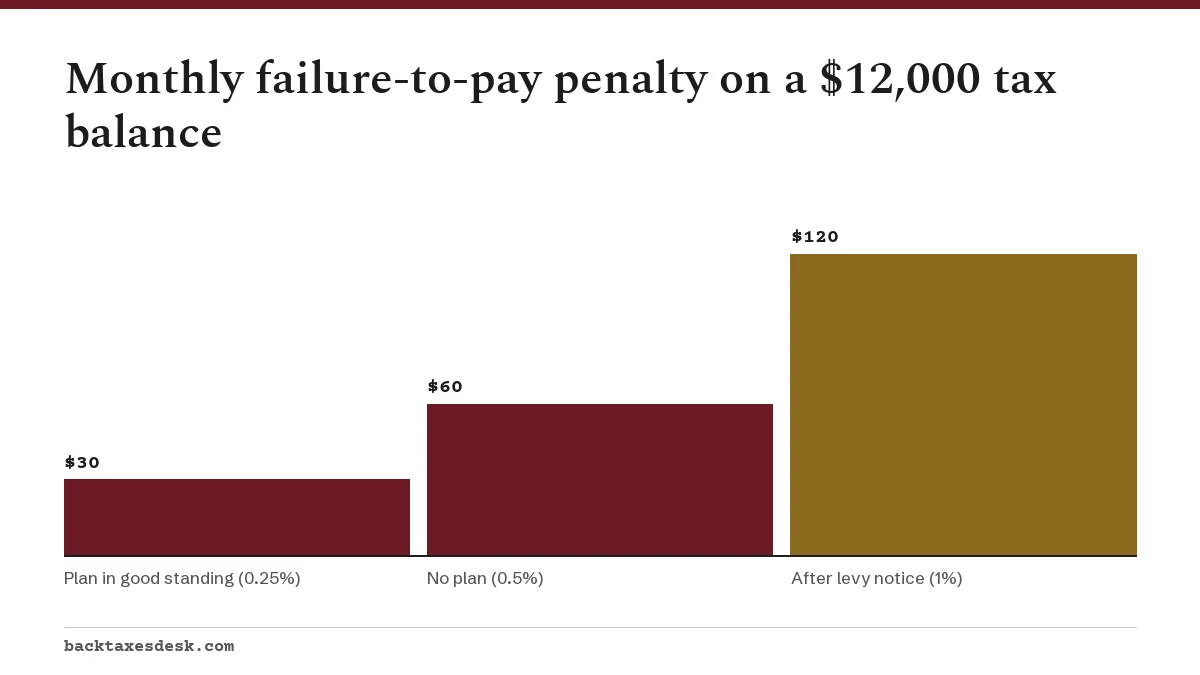
On a $12,000 unpaid tax balance, that is $30 a month in penalty while the plan is in good standing, $60 without a plan, and $120 at the levy-stage rate. Interest, currently 7% a year for individuals and compounded daily, runs on top in every case.
If the plan is terminated and you later apply for a new one, you pay a new setup fee. For a long-term plan that is $29 online with direct debit, $69 online with other payment, $107 by phone, mail or in person with direct debit, and $178 by phone, mail or in person otherwise. See IRS payment plan fees for the low-income waiver.
Appeal rights after a CP523
If you disagree with the proposed termination, you can appeal through the Collection Appeals Program. Start by calling the number on the notice; if that does not resolve it, say you want to appeal. The request can be verbal unless the notice came from a revenue officer, in which case send it in writing, preferably on Form 9423, Collection Appeal Request.
- You have 30 days from the notice date to appeal before termination.
- If the plan terminates, you can still appeal for another 30 days.
- An appeal made within the 30 days after termination blocks a levy until Appeals decides, unless collection is in jeopardy.
- If you appeal before termination, you cannot appeal again once termination takes effect.
- The Appeals decision under this program is final; you cannot take it to court.
Fixing the default is usually simpler than appealing. An appeal fits when the IRS misapplied a payment or the default reason on the notice is simply wrong. For wider context on why plans fail, read what happens when an installment agreement defaults.
Step by step
Read the default reason
Find the reason and the termination date printed on the CP523.
Cure the default
Pay the missed installment or new balance, and file any missing return.
Call before the date
Call the number on the notice within 30 days and ask for reinstatement.
Appeal if the notice is wrong
Use the Collection Appeals Program, in writing on Form 9423 if a revenue officer sent the notice.
Common questions
What does CP523 mean?
It means your installment agreement is in default and the IRS intends to terminate it and levy your assets. The notice explains the default reason and gives a termination date.
How long do I have after a CP523 notice?
Contact the IRS no later than 30 days from the notice date. Paying the missed amount and calling before the termination date can keep the agreement in place.
Can I reinstate my payment plan after a CP523?
Often yes, if you cure the default. The IRS may charge a reinstatement fee or require you to pay any new balance in full first.
Will the IRS levy after a CP523?
It can after the agreement terminates. Publication 1660 says the IRS cannot levy until 30 days after termination, and a timely appeal in that period blocks a levy until Appeals decides.
Is a CP523 notice a scam?
A real CP523 arrives by mail and matches the plan and balance in your IRS online account. Pay only through irs.gov options or the payment voucher, never by gift card or to a third party.
Will a CP523 affect my passport?
Debts in a timely-paid installment agreement are not certified as seriously delinquent. If the plan ends and the balance is above the threshold, certification becomes possible.
Sources
- Understanding your CP523 notice irs.gov
- Payment plans, installment agreements irs.gov
- Failure to pay penalty irs.gov
- Publication 1660, Collection Appeal Rights irs.gov
- Quarterly interest rates irs.gov
We check figures against these official pages. Rules change; confirm anything that affects a deadline or payment with the agency before you act.
Tell us what happened
Describe your situation and our editors will use it to improve this guide. If you leave your email, we may reply with a pointer to the right page or official contact. We never share your details.
Related guides
 IRS Payment Plan: How It Works, Costs and Who Qualifies
An IRS payment plan lets you pay a tax bill over time: up to 180 days with no setup fee if you owe less than $100,000, or monthly…
 IRS Notices and Letters: What Each One Means and Next Steps
An IRS notice is a letter the IRS mails when it needs something from you: payment of a balance, a reply to a proposed change, a m…
IRS Payment Plan Fees: Setup Costs and Low-Income Waivers
IRS installment agreement fees range from $0 to $178. A short-term plan of 180 days or less is free. A long-term plan costs $29 o…
IRS Notice CP59: No Record of Your Tax Return on File
A CP59 notice means the IRS has no record of a prior-year personal tax return from you. File that return right away, or explain w…