
CP59 notice: the IRS has no record of your return
Short answer
A CP59 notice means the IRS has no record of a prior-year personal tax return from you. File that return right away, or explain why you did not have to file, using Form 15103 if you think the notice is an error. If you filed within the last eight weeks, you do not need to do anything.
- 01What it means
- No record of your prior-year individual return
- 02Filed in the last 8 weeks
- No action needed
- 03Form to explain
- Form 15103, Form 1040 Return Delinquency
- 04Late filing penalty
- 5% of unpaid tax per month, up to 25%
What does a CP59 notice mean?
A CP59 notice is the IRS asking where your return is. Its records show no individual income tax return from you for the year printed on the letter, and it wants you to file now or tell it why you do not have to. The notice does not say you owe a specific amount, because the IRS has no return to compute one from.
The letter will not lapse on its own. The IRS receives W-2s and 1099s from employers, banks and other payers, and it can build a return from them later if you stay silent. Your answer depends on which of three situations you are in.
IRS notice CP59 but I filed: what to check
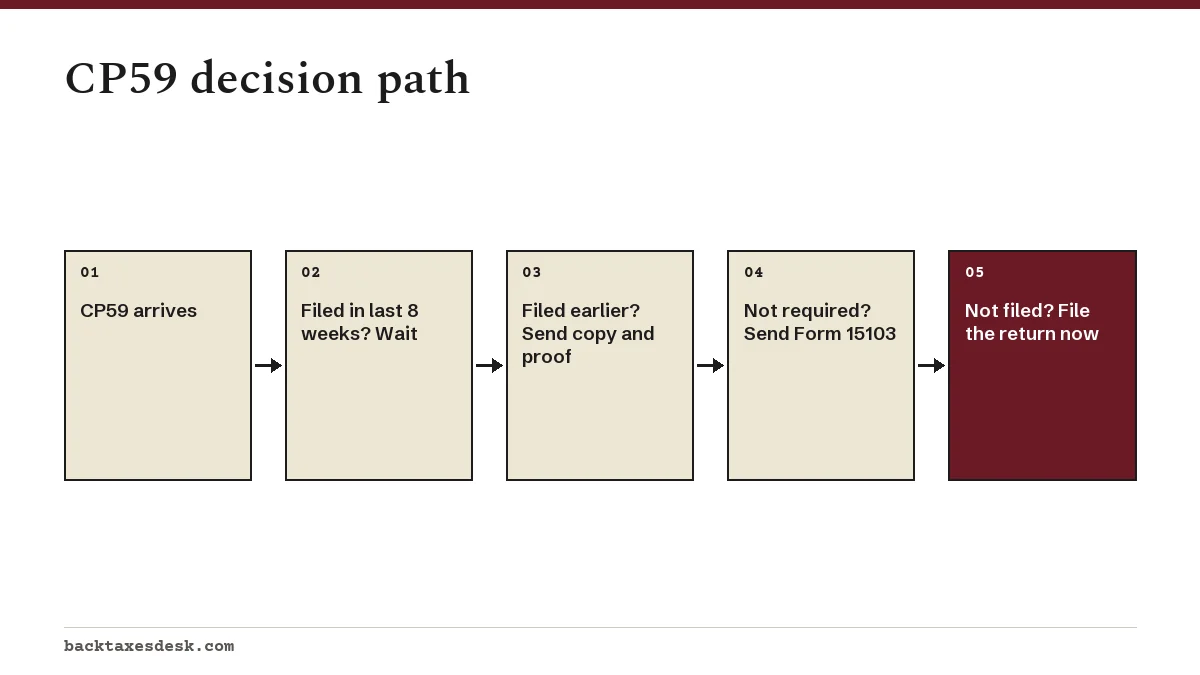
If you already filed, first look at the timing. A return filed within the last eight weeks may simply not be processed yet, and the IRS says no action is needed in that case. If it has been longer, work through these checks.
- Confirm the name, Social Security number and tax year on the notice match your return exactly.
- Check that an e-filed return was accepted, not rejected. A rejected e-file counts as not filed.
- Look at your IRS online account or an account transcript for that year to see whether a return posted.
- If it was filed, send a copy of the signed return with any proof of filing, such as an e-file acceptance or a mailing receipt, to the address or fax number on the notice.
A common trap: a paper return mailed without a signature, or an e-file that was rejected for a mismatch and never resent. Both leave the IRS with no valid return, and a CP59 is the result.
IRS notice CP59 in error: using Form 15103
If you believe you did not need to file, for example because your income was below the filing requirement that year, or you think the notice is wrong for another reason, complete Form 15103, Form 1040 Return Delinquency. It lets you explain that you already filed, that you were not required to file, or that another reason applies.
Send Form 15103 by mail or fax using the details on the notice, or submit it through your IRS online account. Keep a copy with the date sent.
If you need to file now
If you did not file, file the return for that year as soon as possible and send it to the address on the notice. Past-due returns are prepared the same way as on-time returns, using the forms for that tax year. If you were issued an identity protection PIN, include it. Our step-by-step page on how to file unfiled tax returns covers gathering old W-2s and 1099s.
What late filing costs: a worked example
Suppose your 2025 return, due April 15, 2026, shows $4,000 of unpaid tax and you file it in early October 2026, just under six months late. The failure-to-file penalty is 5% a month, reduced by the 0.5% failure-to-pay penalty for the same months, and it stops after five months: 4.5% times 5 is 22.5%, or $900. The failure-to-pay penalty adds 0.5% for each of the six months, or $120. Total penalties come to about $1,020 before interest.
Returns due after December 31, 2025 that are more than 60 days late also face a minimum failure-to-file penalty of $525 or 100% of the tax owed, whichever is less. In the example the regular penalty is higher, so the minimum does not change the result. See the failure-to-file penalty page for the full rules.
What happens if you ignore a CP59 notice
The IRS lists three results of not answering: you can lose a refund because of the three-year claim limit, penalties and interest keep adding up until you file and pay, and some credits can no longer be claimed once their deadlines pass. The IRS can also send further reminders and eventually a final one, the CP518 notice.
If the IRS still has no return after its reminders, it can prepare a substitute return from the income reports it holds. That version may leave out deductions and credits you would claim. Unpaid balances can later lead to collection, and a large enough debt can reach the passport stage described on the CP508C page.
Where to get help
You can answer a CP59 yourself, or an authorized representative can respond for you with a power of attorney. People with lower incomes may qualify for free help from a Low Income Taxpayer Clinic. The Taxpayer Advocate Service helps when a problem is causing hardship or the normal channels have not worked. For other letters in this series, use the IRS notices guide.
Step by step
Check the timing
If you filed within the last eight weeks, take no action.
Confirm your filing
Verify the return was accepted and posted using your IRS online account or a transcript.
Explain if not required
Send Form 15103 by mail, fax or online account if you did not have to file or think the notice is wrong.
File the missing return
Prepare the return for that year and send it to the address on the notice.
Common questions
What does a CP59 notice mean?
It means the IRS has no record of a prior-year individual tax return from you. You need to file it or explain why you were not required to.
What should I do if I get a CP59 but already filed?
If you filed within the last eight weeks, do nothing. If it has been longer, check that the return was accepted and send a signed copy with proof of filing to the address on the notice.
What is Form 15103?
Form 15103, Form 1040 Return Delinquency, is the form for telling the IRS you already filed, were not required to file, or have another reason the notice is wrong. You can mail, fax or submit it through your IRS online account.
What happens if I ignore a CP59?
Penalties and interest keep growing if you owe, refunds can be lost after three years, and the IRS may send a final reminder and prepare a substitute return for you.
Does a CP59 mean I owe money?
Not necessarily. The notice only says a return is missing. You may owe, be due a refund, or have had no filing requirement at all.
Can I e-file a late return after a CP59?
Often yes for recent years. The IRS accepts e-filed returns for the two most recent prior years through authorized e-file providers; older years are filed on paper.
Sources
- Understanding your CP59 notice irs.gov
- Filing past due tax returns irs.gov
- Failure to file penalty irs.gov
- Time you can claim a credit or refund irs.gov
We check figures against these official pages. Rules change; confirm anything that affects a deadline or payment with the agency before you act.
Tell us what happened
Describe your situation and our editors will use it to improve this guide. If you leave your email, we may reply with a pointer to the right page or official contact. We never share your details.
Related guides
 How to File Unfiled Tax Returns: Step-by-Step Guide
To file unfiled tax returns, confirm which years are missing, download your IRS wage and income transcripts, prepare each year on…
 IRS Notices and Letters: What Each One Means and Next Steps
An IRS notice is a letter the IRS mails when it needs something from you: payment of a balance, a reply to a proposed change, a m…
CP508C Notice: Tax Debt Certified to the State Department
CP508C is the IRS notice telling you it certified your tax debt as seriously delinquent to the US Department of State. After that…
IRS Substitute for Return (SFR): What It Is and What to Do
A substitute for return is the IRS's own calculation of your tax for a year you did not file, built from W-2, 1099 and other repo…