
Failure to file penalty: how the IRS late filing charge is figured
Short answer
The IRS failure to file penalty is 5% of the tax left unpaid on the due date for each month or part of a month your return is late, up to 25%. If the return is more than 60 days late, the minimum is $525 or 100% of the tax owed, whichever is less, for returns due after December 31, 2025.
- 01Monthly rate
- 5% of unpaid tax per month or part of a month
- 02Cap
- 25%, reached after five months
- 03Minimum if over 60 days late
- $525 or 100% of the tax, if less (returns due after 12/31/2025)
- 04Tax year 2026 deadline
- April 15, 2027, or October 15, 2027 with an extension
- 05Refund due
- No late filing penalty when no tax is owed
How does the failure to file penalty work?
The failure to file penalty charges 5% of your unpaid tax for every month or part of a month that your return is late, stopping at 25%. The IRS first takes the tax shown on the return, then subtracts withholding, estimated payments made on time and refundable credits. The 5% applies to what is left.
Part of a month counts as a full month. A return due April 15, 2027 that arrives on April 16 is one month late; one that arrives on May 16 is two months late. Because the charge is tied to unpaid tax, paying most of the balance by the deadline shrinks the penalty even if the return itself is late.
Worked example: $3,000 owed, filed seven months late
Say your tax year 2026 return shows $3,000 due after withholding, and you file and pay on November 10, 2027 with no extension. Months one to five carry 4.5% each for late filing (the 5% is reduced by the 0.5% late-payment charge for the same months), for $675. The late-filing part then stops. Seven months of late payment at 0.5% add $105, so penalties total $780 before interest.
What is the minimum penalty for filing late?
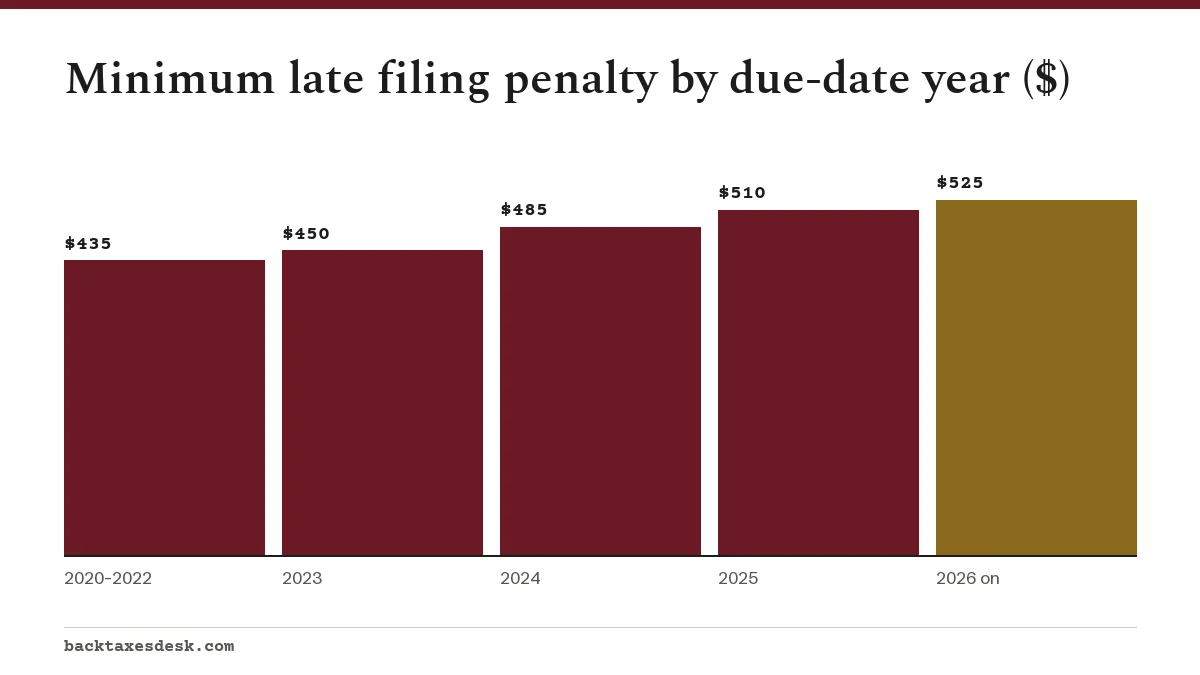
If your return is more than 60 days late, the IRS penalty for late filing cannot be less than a set dollar floor or 100% of the unpaid tax, whichever is smaller. For returns due after December 31, 2025, the floor is $525. Tax year 2026 returns, due April 15, 2027, fall under that $525 figure unless the IRS publishes a new amount.
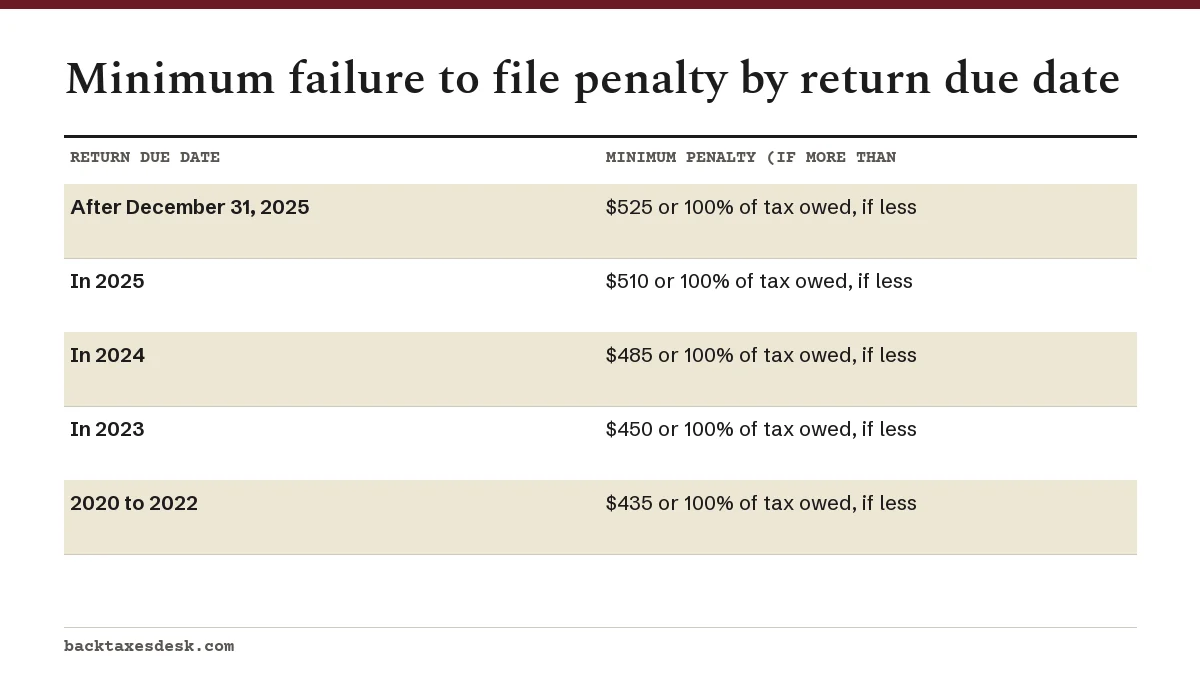
The minimum matters most on small balances. Suppose you owe $400 and file three months late. The percentage would be only about $54, but since the return is more than 60 days late, the penalty becomes $400: the lesser of $525 and 100% of the tax. On a $2,000 balance filed four months late, the floor of $525 replaces a percentage charge of about $360.
How the late filing penalty combines with the late payment penalty
When you file late and also leave tax unpaid, both penalties apply, but not in full. For any month both run, the failure to file penalty is cut by the failure to pay amount, so the total stays at 5% a month. After five months the late filing charge has reached its cap and only the 0.5% monthly late payment charge continues, up to its own 25% limit.
| Months late | Late filing (4.5% a month, max 5 months) | Late payment (0.5% a month) | Total penalties |
|---|---|---|---|
| 1 | $450 | $50 | $500 |
| 3 | $1,350 | $150 | $1,500 |
| 5 | $2,250 | $250 | $2,500 |
| 12 | $2,250 | $600 | $2,850 |
| 24 | $2,250 | $1,200 | $3,450 |
These figures exclude interest, which runs separately at 7% a year for late 2026 and is charged on penalties as well. The failure to pay penalty page covers the 0.25% and 1% variants that can change the second column.
Is there a penalty for filing late if I get a refund?
No. Because the late filing penalty is a percentage of unpaid tax, a return that shows a refund, or a zero balance, has no failure to file penalty. The same goes for the minimum: 100% of zero tax owed is zero.
The real risk with a refund return is losing the money. You must file within three years of the return's due date to claim a refund, and the refund is limited to tax paid in the three years before the claim plus any extension. A tax year 2023 refund, for example, is lost if the return is not filed by April 15, 2027. For older years, see how to file unfiled tax returns.
Does an extension stop the late filing penalty?
Yes, for filing. An extension moves the tax year 2026 filing deadline from April 15, 2027 to October 15, 2027, and a return filed by the extended date has no failure to file penalty. You can get one by filing Form 4868, through IRS Free File, or by making an electronic payment marked as an extension payment. Our Form 4868 guide covers each method.
An extension does not move the payment deadline. Tax not paid by April 15, 2027 still draws the late payment penalty and interest from that date, even if your return is filed on time under the extension. Pay what you can estimate by April 15 to keep those charges small.
How to get a failure to file penalty removed
The IRS removes or skips this penalty in three situations. Check them in this order, because the first two need no explanation from you.
- Automatic Exemption from Penalty (AEP). For eligible returns with original due dates on or after January 1, 2027, the penalty is not assessed at all if you have a clean three-year history. The IRS sends a notice confirming it. See IRS automatic penalty relief.
- First Time Abate. For older returns, or if you still get a penalty notice during the transition, call the number on the notice or write to ask for first time penalty abatement.
- Reasonable cause. If your record is not clean, explain what prevented timely filing, such as a serious illness, a disaster or records you could not get, and show you filed as soon as you could.
Separate penalties apply to people who underpaid during the year; relief for those works differently and is covered on the estimated tax penalty page. The full list of penalties and relief routes is in our IRS penalties guide.
Common questions
How much is the IRS late filing penalty per month?
It is 5% of the unpaid tax for each month or part of a month the return is late, up to 25%. When the late payment penalty applies in the same month, the late filing part is reduced to 4.5%.
What is the failure to file penalty for 2026 returns?
Tax year 2026 returns are due April 15, 2027, so they fall under the rules for returns due after December 31, 2025: 5% per month up to 25%, and a minimum of $525 or 100% of the tax, whichever is less, if the return is more than 60 days late.
Is the late filing penalty charged if I filed one day late?
Yes, if you owe tax. A single day late counts as a full month, so the penalty is 5% of the unpaid tax. The minimum penalty only applies after 60 days.
Does the failure to file penalty apply to state returns?
No. This penalty applies to federal returns. States set their own late filing penalties, so check your state revenue department.
Can I get the late filing penalty waived if I was sick?
Possibly. A serious illness that kept you from filing can support a reasonable cause request. Explain the dates, the illness and when you filed once you were able, and keep supporting records ready.
Sources
- Failure to File Penalty irs.gov
- Get an extension to file your tax return irs.gov
- Penalty relief due to First Time Abate or other administrative waiver irs.gov
- Time you can claim a credit or refund irs.gov
We check figures against these official pages. Rules change; confirm anything that affects a deadline or payment with the agency before you act.
Tell us what happened
Describe your situation and our editors will use it to improve this guide. If you leave your email, we may reply with a pointer to the right page or official contact. We never share your details.