
IRS penalty calculator: late filing and late payment penalties plus interest
Short answer
This IRS penalty calculator estimates what filing or paying late adds to your tax bill: 5% a month for filing late (up to 25%, with a $525 minimum after 60 days), 0.5% a month for paying late, and interest at 7% a year compounded daily. It works for tax year 2025 and 2026 returns. Owing $5,000 and filing four months late costs about $1,113 extra.
- 01Late filing penalty
- 5% of unpaid tax per month, max 25%
- 02Minimum if more than 60 days late
- $525 or 100% of the tax, whichever is less
- 03Late payment penalty
- 0.5% a month, max 25%
- 04Interest rate used
- 7% a year, compounded daily (Q3 and Q4 2026)
- 05Q1 2027 interest rate
- Not yet announced; usually published in late November
Calculator
- Estimated failure to file penalty
- —
- Estimated failure to pay penalty
- —
- Estimated interest on unpaid tax
- —
- Total added to the tax owed
- —
Estimates, not IRS figures. The IRS also charges interest on the penalties themselves, the interest rate can change every quarter, and the late payment rate rises to 1% a month 10 days after a notice of intent to levy.
What does the IRS penalty and interest calculator estimate?
The IRS penalty and interest calculator estimates three separate charges on a balance you did not pay or report on time: the failure to file penalty, the failure to pay penalty and underpayment interest. You enter the tax you still owed on the due date and the dates you filed and paid, and it returns each charge and the total.
It is built for individual Form 1040 filers, and its defaults match a tax year 2026 return due April 15, 2027. For a tax year 2025 return, enter April 15, 2026 as both due dates, or October 15, 2026 as the filing due date if you had an extension. The same $525 minimum applies; interest was 6% from April to June 2026 and 7% from July, so the 7% default slightly overstates interest for those first months. The Back Taxes Desk editorial team built it from the rules the IRS publishes on its failure to file penalty, failure to pay penalty and quarterly interest rates pages. It is an independent planning tool, not an IRS system, and the IRS figures its own amounts on your notice.
Inputs and assumptions behind the IRS penalty calculator
Each input maps to a rule the IRS applies. Getting the first one right matters most: the penalties are based on unpaid tax, meaning the tax on your return minus withholding, estimated payments made on time and refundable credits.
| Input | What to enter | Default |
|---|---|---|
| Unpaid tax | Balance due on your return (the amount you owe line on Form 1040), before any penalty or interest | None |
| Due date | April 15, 2027 for tax year 2026; use October 15, 2027 for filing only if you had a valid extension | 2027-04-15 |
| Date filed | Date the IRS received or you e-filed the return | None |
| Date paid in full | Date the full balance was paid | None |
| Annual interest rate | Current individual underpayment rate | 7% |
| Filed on time with an approved payment plan | Yes lowers the late payment rate to 0.25% a month | No |
Two simplifications keep the tool readable. It assumes the whole balance is paid in one amount on the payment date, and it holds the interest rate at 7% for every future quarter. The IRS sets the rate each quarter at the federal short-term rate plus 3 percentage points, and the January to March 2027 rate is not yet announced. It is usually published in late November.
How months are counted
Both penalties count each month or part of a month as a full month. A return due April 15 and filed on April 16 is one month late; filed on May 16, it is two months late. The IRS charges the full monthly amount even if you pay partway through the month, so the calculator does too.
How to calculate IRS penalties and interest by hand
You can reproduce the calculator's result in five steps. The same order is used for every scenario, including returns that are filed on time but paid late.
- Count late filing months, from the due date to the filing date, and stop at five. Multiply unpaid tax by 5% for each month.
- For each of those months in which the tax was also unpaid, subtract the late payment charge (0.5%, or 0.25% on a qualifying plan). This is why a month with both penalties costs 5% in total, not 5.5%.
- If the return was more than 60 days late, compare the late filing result with $525 or 100% of the unpaid tax, whichever is smaller, and keep the larger figure.
- Count late payment months from the due date to the payment date and multiply unpaid tax by the monthly rate. Stop at 25% of the tax.
- Figure interest as unpaid tax x ((1 + rate / 365) ^ days late - 1), which applies the IRS daily compounding. Add the three amounts.
Worked example: $5,000 owed, filed and paid August 10, 2027
The return is four months late. Late filing costs 4.5% a month for four months, or $900, which beats the $525 floor. Late payment adds four months at 0.5%, or $100. Interest on $5,000 for 117 days at 7% compounded daily is about $113. The estimate comes to about $1,113 on top of the $5,000 of tax.
How much will I owe if I file late? Sample results
The table below runs the calculator on common situations for a tax year 2026 return due April 15, 2027, with no extension and 7% interest held flat. All figures are estimates rounded to the dollar, and interest is charged on the tax only.
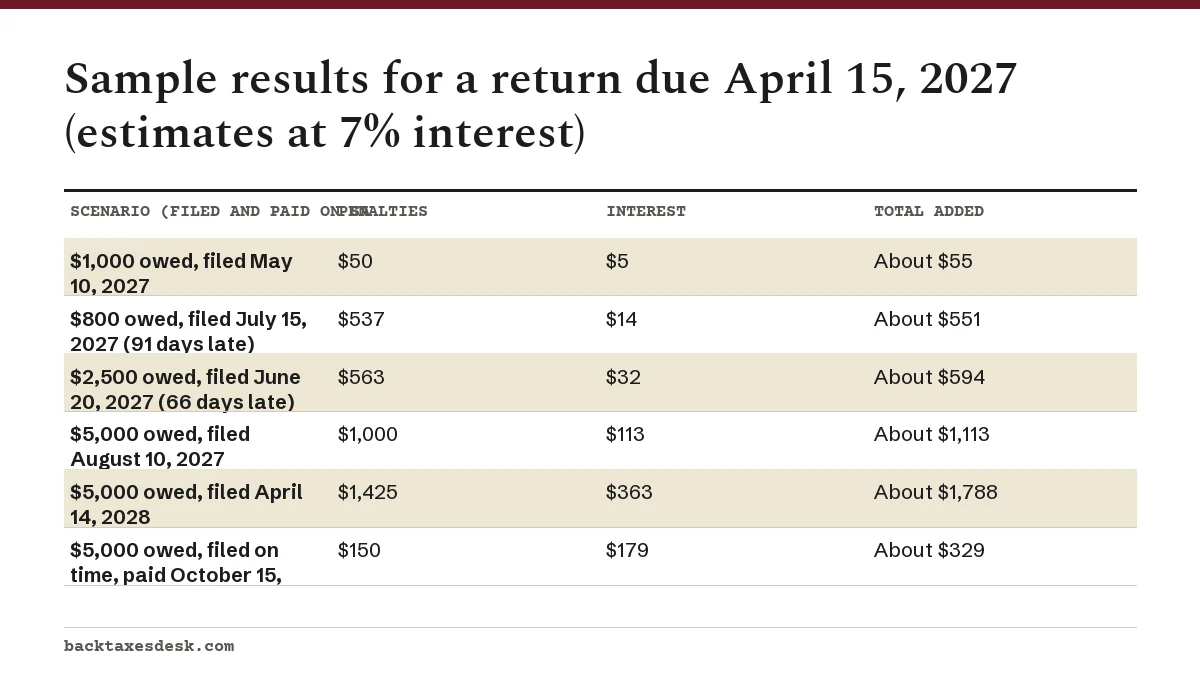
Two patterns stand out. Small balances filed more than 60 days late are hit hardest, because the $525 floor can exceed the percentage charge several times over: on $800 filed three months late, the percentage would be $108, but the penalty becomes $525. And filing on time while paying late costs far less than doing both late: $5,000 paid six months late but filed on time adds about $329, against roughly $1,113 for filing and paying four months late.
| Situation | Late filing penalty | Late payment penalty | Interest (183 days) | Estimated total added |
|---|---|---|---|---|
| Return filed April 15, 2027, paid October 15 | $0 | $600 | $714 | $1,314 |
| Return and payment both October 15, no extension | $4,500 | $600 | $714 | $5,814 |
The only difference between those two rows is whether a return or an extension was filed by April 15. An extension moves the filing date to October 15, 2027, but it does not move the payment date, so the late payment penalty and interest still run from April 15. More on that trade-off is on the failure to file penalty page.
Is the calculator result exact? Why your IRS bill may differ
No. The result is an estimate, and the IRS notice is the figure that counts. It can differ from this tool for several specific reasons, most of them adding to the bill rather than reducing it.
- Interest on penalties. The IRS also charges interest on penalties, which this tool does not include, so long delays make the gap larger.
- Rate changes. Each quarter can bring a new rate. A change from 7% for 2027 quarters will move the interest line; see IRS underpayment interest rates for the current figure.
- Partial payments. Payments made after the due date reduce the late payment penalty and interest from the day they post. This tool assumes a single payment.
- Levy notices. The late payment rate rises to 1% a month if tax stays unpaid more than 10 days after a notice of intent to levy.
- Penalty relief. If you qualify for the Automatic Exemption from Penalty, the IRS may never assess the late filing and late payment penalties at all, leaving only tax and interest.
- Changes to the tax. An IRS adjustment to your return changes the unpaid tax, and every penalty is recalculated from the new figure.
To see the IRS's own figure, check the balance in your IRS online account or the amount on your most recent notice, such as a CP14 balance due notice. Both include penalties and interest figured to a stated date.
Ways to lower the total penalty and interest
Most of the cost in the examples above comes from the late filing penalty, and that is also the easiest part to avoid. The steps below are listed from the biggest saving to the smallest.
- File the return, even if you cannot pay. Filing by the due date or within an extension removes the 5% monthly charge entirely, and filing within 60 days avoids the $525 minimum.
- Pay what you can now. Every dollar paid stops accruing the 0.5% monthly penalty and daily interest.
- Set up a payment plan after filing on time. The late payment rate falls to 0.25% a month while an approved plan is in place.
- Check whether penalty relief applies. Taxpayers with a clean three-year record may get automatic penalty relief, and others can ask for relief for reasonable cause.
- Respond to notices before a levy notice deadline passes, so the late payment rate does not rise to 1%.
Common questions
How do I calculate IRS penalties and interest?
Multiply unpaid tax by 5% for each late filing month (up to five), reduced by the 0.5% late payment charge for the same months, then add 0.5% for each late payment month and daily compounded interest at the current rate. If the return is more than 60 days late, the late filing penalty is at least $525 or the full tax, whichever is less.
How much is the IRS penalty for owing $1,000?
If you owe $1,000 and file and pay one month late, penalties are about $50 ($45 late filing plus $5 late payment) and interest about $5 at 7%. If the return is more than 60 days late, the late filing penalty jumps to $525 or the full $1,000, whichever is less, so $525.
Does the IRS charge penalties if I owe nothing?
No. Both penalties are percentages of unpaid tax, so a late return with no balance due has no failure to file or failure to pay penalty. The risk with a refund return is different: refunds are lost if the return is not filed within three years of its due date.
What interest rate does the IRS charge on unpaid taxes right now?
The individual underpayment rate is 7% a year, compounded daily, for both July to September and October to December 2026. The January to March 2027 rate is not yet announced; the IRS usually publishes it in late November.
Why is my IRS penalty higher than the calculator shows?
The most common reasons are interest charged on the penalties themselves, a missed notice of intent to levy that raised the late payment rate to 1% a month, or an IRS change to the tax on your return. Your IRS online account shows the current total.
Sources
- IRS: Failure to file penalty irs.gov
- IRS: Failure to pay penalty irs.gov
- IRS: Quarterly interest rates irs.gov
- IRS: Penalty relief due to First Time Abate or other administrative waiver irs.gov
We check figures against these official pages. Rules change; confirm anything that affects a deadline or payment with the agency before you act.
Tell us what happened
Describe your situation and our editors will use it to improve this guide. If you leave your email, we may reply with a pointer to the right page or official contact. We never share your details.