
IRS notice CP14: what your balance due means and what to do
Short answer
IRS notice CP14 is the first bill the IRS sends when a tax return shows a balance that was not paid in full. It lists the tax, penalties and interest for one tax year and a due date. Pay by that date to stop more interest on the billed amount, set up a payment plan if you cannot, or contact the IRS if the figure is wrong.
- 01What CP14 is
- First bill for an unpaid balance
- 02Deadline
- Due date printed on the notice
- 03Late payment penalty
- 0.5% of unpaid tax per month, up to 25%
- 04Short-term plan
- Up to 180 days, no setup fee, under $100,000
What does IRS notice CP14 mean?
IRS notice CP14 means the IRS has recorded a balance on your account and is asking you to pay it. It is the first bill in the collection process, sent after a return is processed without full payment. It is not an audit and it does not mean the IRS thinks you did anything wrong.
The notice shows one tax year, the amount you owe broken into tax, penalties and interest, and a due date. The IRS explains that if you pay the full amount by that date, no further interest is added to it; interest accrues on whatever remains unpaid afterward. People in a federally declared disaster area receive a CP14C instead, which gives extra time to file and pay.
Check the CP14 notice balance due against your records
Before paying, spend ten minutes confirming the number. Most CP14 balances are correct, but a missed payment credit or a math change can make the bill higher than it should be.
- Find the balance due line on your filed return for the same tax year.
- Subtract any payment you made with the return or after filing: IRS Direct Pay, card, check or estimated payments.
- Compare that result with the tax figure on the notice. Penalties and interest will make the notice total higher.
- Open your IRS online account and look at the payment history for the year.
A worked example
Say your 2025 return, filed on time, showed $2,400 owed and you paid nothing. The failure-to-pay penalty is 0.5% a month, or $12 for each month or part of a month. Interest at 7% a year, the IRS rate for July through December 2026, adds roughly $14 a month and compounds daily. Two months at those rates adds about $24 in penalty and $28 in interest to the $2,400 of tax.
| Situation | Penalty per month | Interest per month (about) |
|---|---|---|
| No plan | $12 (0.5%) | $14 |
| Approved payment plan | $6 (0.25%) | $14, falling as you pay |
| Unpaid 10 days after a notice of intent to levy | $24 (1%) | $14 |
Penalty amounts are charged for the full month even if you pay early in it, so paying a few days before a new month starts saves a small amount.
Pay, plan or dispute a CP14
Pay in full
IRS Direct Pay takes money from a checking or savings account for free, and you choose Balance due and the tax year shown on the notice. You can also mail a check with the payment stub from the bottom of the notice. Our guide on how to pay back taxes compares every method.
Set up a payment plan for a CP14
If you cannot pay by the due date, pay what you can and apply for a plan. A short-term payment plan gives up to 180 days for balances under $100,000 with no setup fee. A long-term plan is available online if you owe $50,000 or less in tax, penalties and interest; the setup fee is $29 with direct debit or $69 otherwise when you apply online. You must have filed all required returns to get one.
With an approved plan, and a return filed on time, the late payment penalty drops to 0.25% a month. Interest continues until the balance is paid.
Dispute the amount
If you think the bill is wrong, the IRS asks you to call the number in the help section of the notice and have your documents ready, such as canceled checks or an amended return. If the dispute is about the tax itself rather than a payment, you may need to file an amended return.
IRS notice CP14 but already paid
A payment made shortly before the notice date may not appear on it. Check your online account: if the payment shows and covers the balance, wait for the account to settle rather than paying twice.
- Payment shows in your account: keep your confirmation; no further action is usually needed.
- Payment does not show: call the number on the notice with the confirmation number, date, amount and bank record.
- Payment applied to the wrong year: ask the IRS to move it to the tax year on the notice.
- Check was cashed but not credited: send a copy of the front and back of the canceled check.
If only penalties remain after you pay, you may qualify for relief. Our page on first-time penalty abatement explains the three-year clean-history test. For eligible returns originally due on or after January 1, 2027, the IRS applies that relief automatically under its Automatic Exemption from Penalty.
What comes after an unpaid CP14
If the CP14 balance stays open, reminders follow. The next letter is usually the CP501 reminder, then the CP503 second reminder, each warning that a federal tax lien may be filed. After that comes a CP504 notice of intent to levy, and then a final notice that gives you 30 days to request a hearing before wages or bank accounts can be levied.
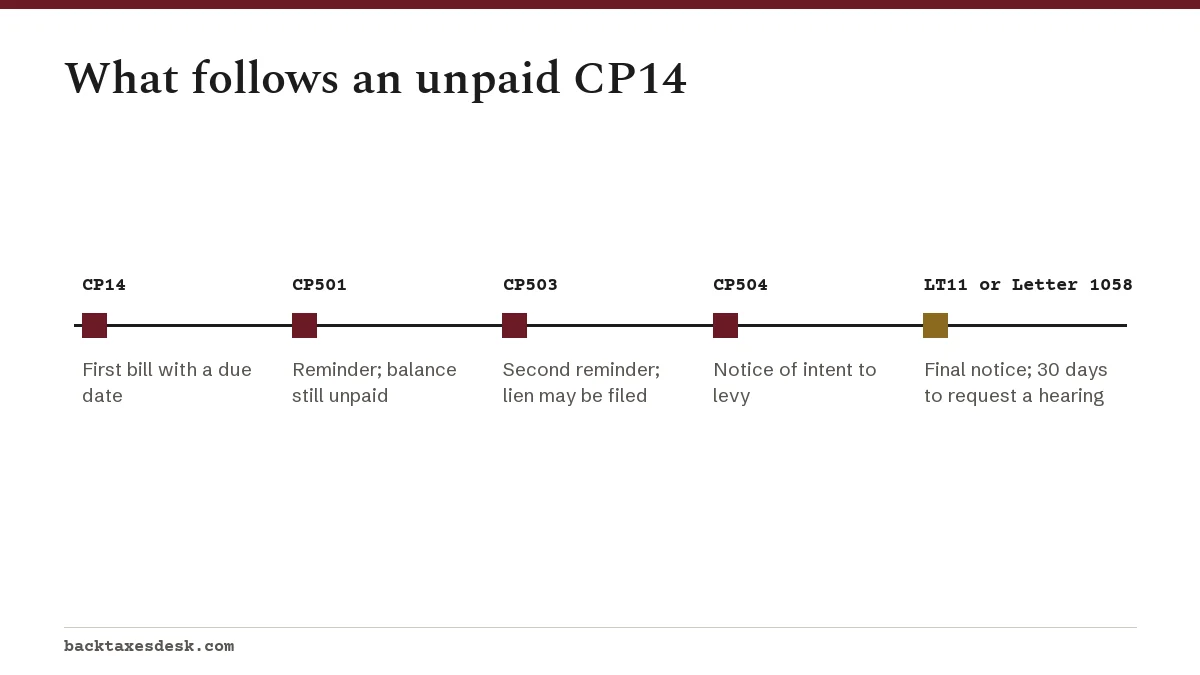
Every stage is cheaper to resolve than the one after it. For the full letter sequence and deadlines, see our IRS notices hub.
Common questions
What does a CP14 notice mean?
It means you have an unpaid balance for the tax year shown and the IRS is billing you for the first time. The notice lists the tax, penalties, interest and a due date.
How long do I have to pay a CP14?
Until the due date printed on the notice. Paying the full amount by then avoids more interest on the billed amount; after that date interest and the late payment penalty keep adding up.
Can I set up a payment plan for a CP14?
Yes. You can apply online for a short-term plan of up to 180 days with no setup fee, or a long-term monthly plan if you owe $50,000 or less. You must be current on filing all required returns.
Is a CP14 notice an audit?
No. A CP14 is a bill for a balance already on your account, usually from your own return. An audit is a separate examination that the IRS announces by mail in its own letter.
Does a CP14 affect my credit score?
The notice itself is a bill sent to you, not a public record. A federal tax lien, which can follow if the balance stays unpaid, is a public notice that can affect your ability to get credit.
Sources
- Understanding your CP14 notice irs.gov
- Topic no. 202, Tax payment options irs.gov
- Payment plans installment agreements irs.gov
- Failure to pay penalty irs.gov
- Quarterly interest rates irs.gov
We check figures against these official pages. Rules change; confirm anything that affects a deadline or payment with the agency before you act.
Tell us what happened
Describe your situation and our editors will use it to improve this guide. If you leave your email, we may reply with a pointer to the right page or official contact. We never share your details.
Related guides
 IRS Notices and Letters: What Each One Means and Next Steps
An IRS notice is a letter the IRS mails when it needs something from you: payment of a balance, a reply to a proposed change, a m…
IRS Notice CP501: Reminder of a Balance You Still Owe
IRS notice CP501 is a reminder that you still owe on a tax account after an earlier bill, usually a CP14, went unpaid. It is not…
IRS Notice CP503: Second Reminder Before Enforcement
IRS notice CP503 is the second reminder that you owe, sent because the IRS has not heard from you since earlier bills. It warns t…
How to Pay Back Taxes to the IRS: Every Payment Method
The cheapest way to pay back taxes is from a bank account through IRS Direct Pay or your IRS Individual Online Account, which are…
IRS Short-Term Payment Plan: 180 Days With No Setup Fee
An IRS short-term payment plan gives you up to 180 days to pay your full balance, with no setup fee, if you owe less than $100,00…