
IRS short-term payment plan: up to 180 days to pay, no setup fee
Short answer
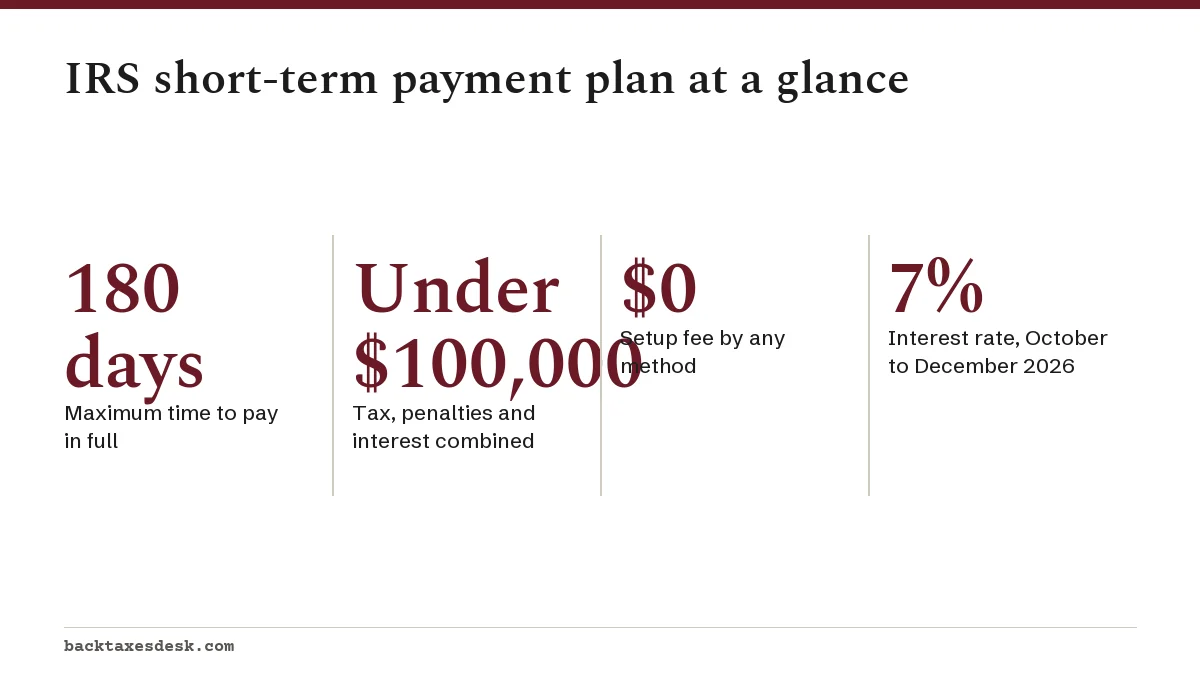
An IRS short-term payment plan gives you up to 180 days to pay your full balance, with no setup fee, if you owe less than $100,000 in combined tax, penalties and interest. Individuals can request it online; businesses and anyone who cannot use the online tool can ask by phone or in person. Interest and the late-payment penalty keep running until you pay.
- 01Time to pay
- 180 days or less
- 02Balance limit
- Less than $100,000 including penalties and interest
- 03Setup fee
- $0 by any method
- 04Interest rate, Oct to Dec 2026
- 7% a year, compounded daily
What the IRS short-term payment plan is
The IRS short-term payment plan is a promise to pay your whole balance within 180 days, in whatever amounts and on whatever schedule suits you. There is no fixed monthly payment and no setup fee. You can pay in one lump near the end, in weekly chunks, or whenever cash comes in.
It suits people who will have the money soon: a bonus in March, a house sale closing in summer, a slow season ending. It is a poor fit if you cannot see where the full amount will come from by day 180, because at that point you would need a monthly installment agreement anyway, with its fee.
Who qualifies for a 180-day payment plan?
The IRS short-term payment plan limit is less than $100,000 in combined tax, penalties and interest. That is twice the $50,000 ceiling for a long-term plan set up online, so a short-term plan is often the only self-service option for balances between $50,000 and $100,000.
- Individuals can request the plan online through the Online Payment Agreement tool, or by phone or in person.
- Businesses can get a short-term plan too, but only by phone or in person; the online tool accepts individual accounts only.
- Filing should be current. File any missing return first, then request time to pay what it shows.
How to request an IRS short-term payment plan
- Check your balance in your IRS Online Account, or use the balance due from the return you just filed.
- Open the Online Payment Agreement tool and sign in.
- Choose the option to pay in 180 days or less.
- Confirm and save the approval page. Note the date 180 days out on your calendar.
- Pay through IRS Direct Pay or your online account as money becomes available, applying each payment to the correct tax year.
By phone, call the number on your notice and ask for a short-term plan. The fee is $0 whichever route you use, so there is no penalty for asking by phone if the online tool is unavailable.
Costs during the 180 days
A short-term plan is free to set up but not free to hold. Two charges keep building on whatever is still unpaid: interest, at the quarterly underpayment rate compounded daily, and the failure-to-pay penalty, normally 0.5% of the unpaid tax for each month or part of a month.
The IRS cuts the penalty to 0.25% a month for on-time filers with an approved payment plan, but its guidance does not spell out whether a 180-day plan counts. Budget for the 0.5% rate and treat any reduction as a bonus.
Worked example: $20,000 paid at the end of 180 days
| Charge | How it is figured | Approximate cost |
|---|---|---|
| Interest | 7% a year on $20,000 for about 180 days, compounded daily | About $700 |
| Failure-to-pay penalty | 0.5% of $20,000 for 6 months | $600 |
| Setup fee | Short-term plan | $0 |
| Total added cost | If nothing is paid until day 180 | About $1,300 |
Paying $10,000 on day one would cut both charges roughly in half. The 7% rate applies through December 2026; the January to March 2027 rate is not yet announced and is usually published in late November. Penalties also accrue interest, which adds a little more.
IRS payment extension of 180 days versus a filing extension
People often search for an IRS payment extension of 180 days thinking it works like Form 4868. It does not. Form 4868 extends the time to file your return to October 15, 2027, but tax is still due April 15, 2027. The short-term plan is the closest thing to a payment extension, and it only starts once you owe.
Our page on the extension to pay taxes explains the narrow cases where more time to pay is available, and how the short-term plan compares.
If you cannot finish within 180 days
Do not let the 180 days run out quietly. Before the deadline, convert to a monthly installment agreement through the online tool if you owe $50,000 or less, or by phone if you owe more. You will pay the long-term setup fee at that point.
If even a monthly plan is out of reach, a partial payment installment agreement lets you pay what you can afford based on a financial statement. The full range of choices, including hardship status, is laid out in options when you cannot pay taxes, and every plan type is compared in our IRS payment plan guide.
Common questions
Is there a fee for an IRS short-term payment plan?
No. The setup fee is $0 whether you apply online, by phone or in person. Interest and the late-payment penalty still apply to the unpaid balance.
Do I have to make monthly payments on a 180-day plan?
No. You can pay on any schedule as long as the full balance is paid by the end of the 180 days.
Can I get a short-term payment plan if I owe $80,000?
Yes, if the total including penalties and interest is under $100,000. Individuals can request it online even though $80,000 is above the $50,000 online limit for monthly plans.
Does a short-term plan show up as an installment agreement?
No. The IRS treats the 180-day option as a short-term payment plan, separate from a long-term installment agreement, and it carries no setup fee.
Can I request a second short-term plan after the first ends?
The IRS does not publish a rule on repeat short-term plans. If you need more time, the reliable option is converting to a monthly installment agreement before the 180 days end.
Sources
- Payment plans; installment agreements irs.gov
- Topic no. 202, Tax payment options irs.gov
- Failure to pay penalty irs.gov
- Quarterly interest rates irs.gov
- Filing past due tax returns irs.gov
We check figures against these official pages. Rules change; confirm anything that affects a deadline or payment with the agency before you act.
Tell us what happened
Describe your situation and our editors will use it to improve this guide. If you leave your email, we may reply with a pointer to the right page or official contact. We never share your details.
Related guides
 IRS Payment Plan: How It Works, Costs and Who Qualifies
An IRS payment plan lets you pay a tax bill over time: up to 180 days with no setup fee if you owe less than $100,000, or monthly…
Can't Pay Taxes? Your IRS Options If You Owe Money
If you can't pay taxes by the deadline, file your return on time anyway: the late filing penalty is ten times the late payment pe…
Extension to Pay Taxes: 4 Ways to Get More Time to Pay
A tax extension on Form 4868 does not give you more time to pay, but four other routes do: a short-term payment plan of up to 180…
Partial Payment Installment Agreement (PPIA) Explained
A partial payment installment agreement (PPIA) is an IRS payment plan for people who cannot pay their full tax debt before the 10…
How to Set Up an IRS Payment Plan Online, by Phone or Mail
To set up an IRS payment plan, first make sure every required return is filed, then apply through the Online Payment Agreement to…