
Extension to pay taxes: 4 ways to get more time to pay the IRS
Short answer
A tax extension on Form 4868 does not give you more time to pay, but four other routes do: a short-term payment plan of up to 180 days, a monthly installment agreement, the 90% payment rule, or, in narrow cases, an undue hardship extension on Form 1127. Form 4868 only extends the filing date to October 15, 2027; tax on a 2026 return is still due April 15, 2027.
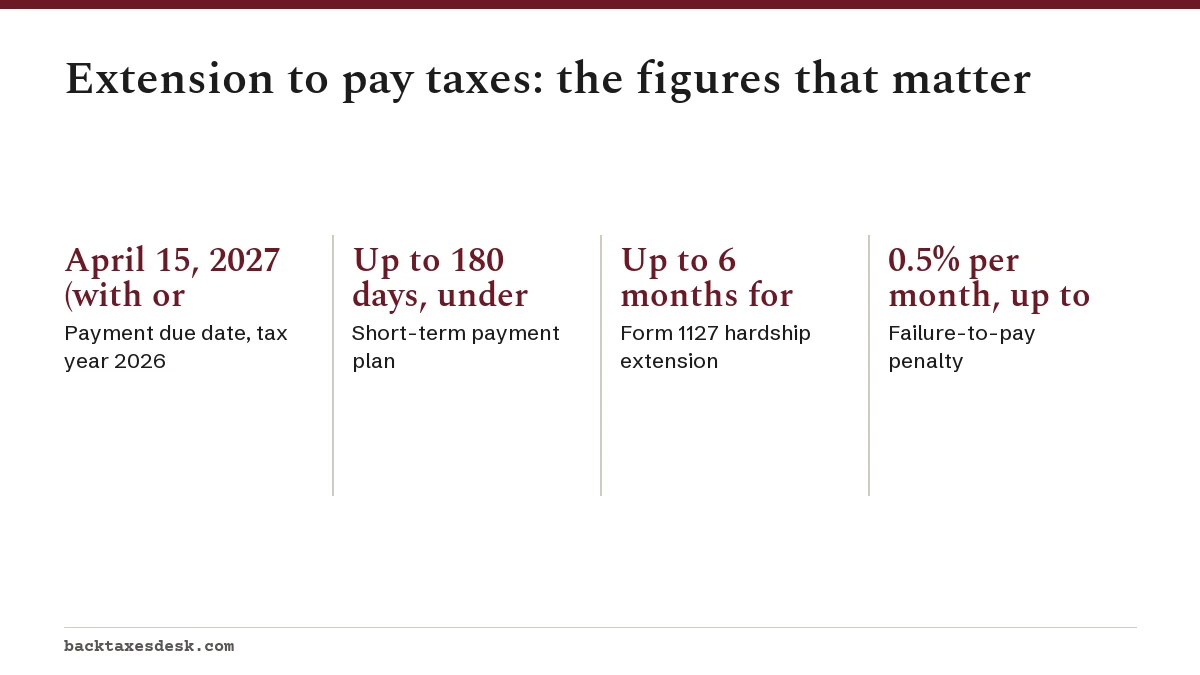
- 01Payment due date, tax year 2026
- April 15, 2027 (with or without a filing extension)
- 02Short-term payment plan
- Up to 180 days, under $100,000, no setup fee
- 03Form 1127 hardship extension
- Up to 6 months for tax shown on the return
- 04Failure-to-pay penalty
- 0.5% per month, up to 25%
- 05Interest rate, Oct to Dec 2026
- 7% per year, compounded daily
Does an extension give more time to pay?
No. The IRS extension to file, requested on Form 4868 or through an extension payment, is an extension of time to file only. The IRS says tax owed must be estimated and paid by the regular deadline, which for tax year 2026 is Thursday, April 15, 2027 (IRS, Get an extension).
Many people only learn this when a bill arrives in the fall. They filed an extension in April, sent nothing, filed in October, and found six months of interest and late-payment penalty added. The extension did its job, which was stopping the much larger failure-to-file penalty, but it never covered payment.
So the question to ask is not how to get an extension to pay taxes, but which tool fits your cash position: pay in full, pay 90% now, pay over months, or show genuine hardship.
What penalties apply if you extend but do not pay?
Two charges start on April 16, 2027 for any tax left unpaid: the failure-to-pay penalty and interest. The failure-to-pay penalty is 0.5% of unpaid tax per month or part of a month, capped at 25%, and the IRS charges a full month even if you pay partway through it (IRS, Failure to pay penalty). Interest is the federal short-term rate plus 3 percentage points, compounded daily, and it also accrues on the penalty.
Worked example: $10,000 unpaid until October 15, 2027
| Charge | How it is figured | Approximate amount |
|---|---|---|
| Failure-to-pay penalty | 0.5% x 6 months x $10,000 | $300 |
| Interest | 7% a year, compounded daily, for 183 days (2027 rates not yet announced) | About $357 |
| Failure-to-file penalty | None, because the return met the extended deadline | $0 |
| Total | About $657 |
The interest line uses the 7% rate in effect for October to December 2026. The IRS sets rates each quarter and usually announces the next quarter's rate in late November, so the 2027 figures are not yet known. For more on how late filing and late payment stack, see tax extension penalty.
Ways to get more time to pay the IRS
There are four legitimate ways to stretch payment past April 15, 2027. They differ in cost, paperwork and who qualifies.
1. Short-term payment plan
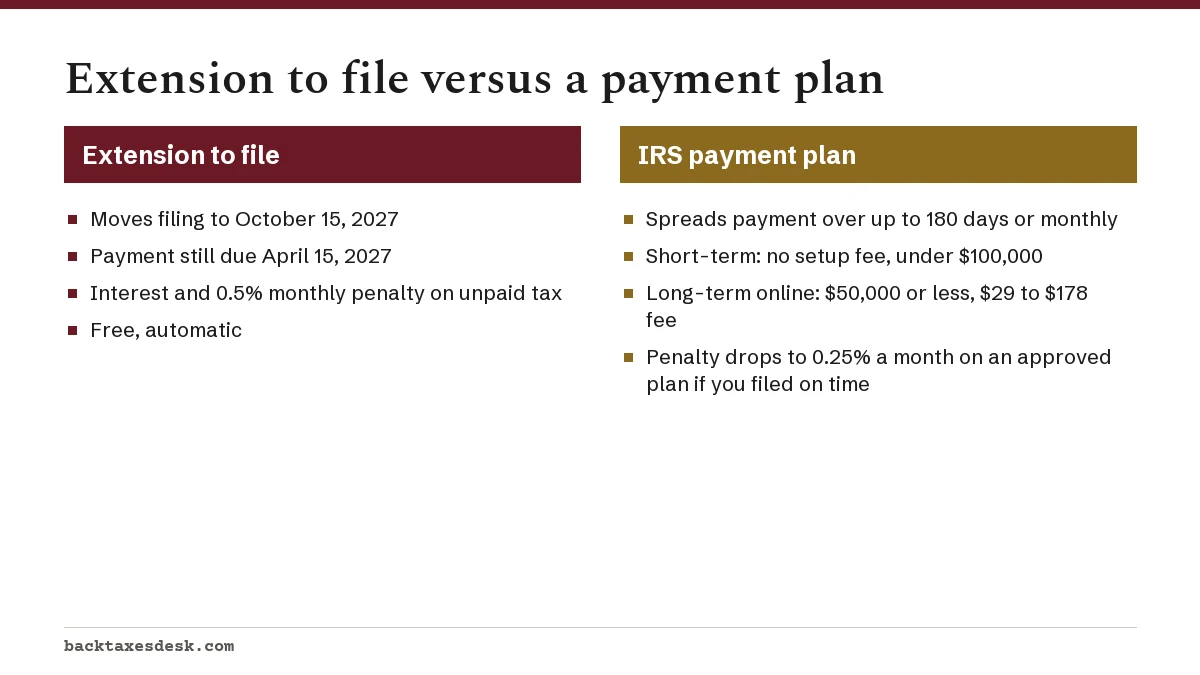
If you can pay in full within 180 days and your combined tax, penalties and interest are under $100,000, you can set up a short-term plan with no setup fee (IRS payment plans). Interest and the failure-to-pay penalty continue until the balance is gone, but there is no fee and no monthly schedule to default on. Details are in our IRS short-term payment plan page.
2. Long-term installment agreement
For balances of $50,000 or less, individuals can set up monthly payments online. Current setup fees run from $29 for an online plan with direct debit to $178 for a plan set up by phone, mail or in person without direct debit, and low-income applicants can have the fee waived or reimbursed. If you filed on time and have an approved plan, the failure-to-pay penalty drops from 0.5% to 0.25% a month. Our installment agreement page covers eligibility.
3. The 90% rule during a filing extension
The Form 4868 instructions give a built-in cushion. If at least 90% of your total tax is paid by April 15 through withholding, estimated payments or an extension payment, and you pay the rest with a return filed by the extended date, you are treated as having reasonable cause and no failure-to-pay penalty applies for the extension period. Interest still runs on the unpaid 10% or less.
4. Undue hardship extension on Form 1127
Form 1127, Application for Extension of Time for Payment of Tax Due to Undue Hardship, is the formal way for an individual to request an extension to pay taxes. It is narrow. Undue hardship means more than inconvenience: you must show a substantial financial loss, such as selling property at a sacrifice price, if forced to pay on the due date (Form 1127).
Is there an undue hardship extension to pay?
Yes, but it is rarely the right tool for an ordinary balance due. A Form 1127 request for tax shown on a return can ask for up to six months, and it must be received by the IRS on or before the return's original due date, not counting any filing extension. For a 2026 return, that means by April 15, 2027.
- Attach a statement of your assets and liabilities as of the end of the previous month.
- Attach an itemized list of income and expenses for each of the three months before the due date.
- Give a detailed explanation of the hardship; the form says a general statement will not be accepted.
- Send it to the IRS Advisory Group Manager for your area, found in Publication 4235, not to a service center.
Even if approved, interest still runs from the original due date, and penalties apply if you miss the new payment date. The Form 1127 instructions point people who want monthly payments to Form 9465 or the Online Payment Agreement instead. If you cannot pay anything at all, the better route is usually a hardship review for currently not collectible status.
Pay as much as you can by April 15, 2027
Every dollar paid by April 15 is a dollar that never collects interest or penalty. Even a partial payment made through IRS Direct Pay, which is free from a checking or savings account, cuts the base that both charges are figured on.
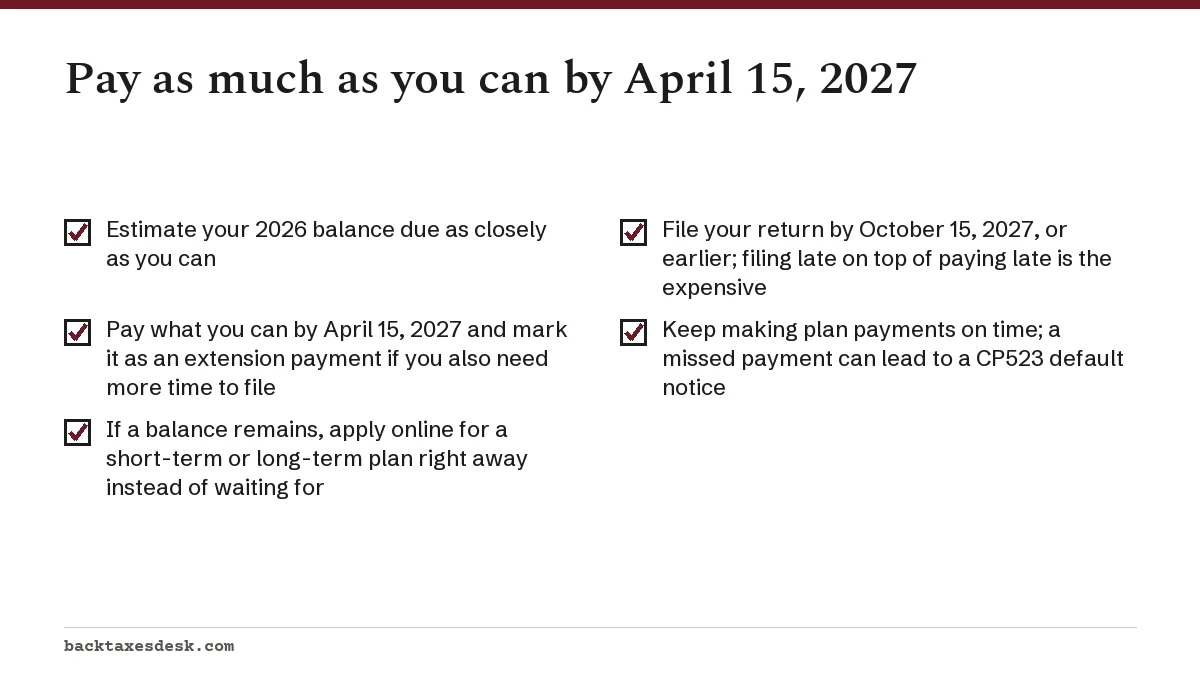
- Estimate your 2026 balance due as closely as you can.
- Pay what you can by April 15, 2027 and mark it as an extension payment if you also need more time to file.
- If a balance remains, apply online for a short-term or long-term plan right away instead of waiting for a CP14 bill.
- File your return by October 15, 2027, or earlier; filing late on top of paying late is the expensive combination.
- Keep making plan payments on time; a missed payment can lead to a CP523 default notice.
The filing side of the calendar is on our tax extension deadline 2027 page, and the tax extension guide explains the three ways to request one.
Common questions
Can I get an extension to pay taxes if I can't afford to pay?
Not through Form 4868. Your options are a short-term plan of up to 180 days, a monthly installment agreement, or, if paying would cause a substantial financial loss, a Form 1127 undue hardship request filed by April 15, 2027.
I missed the October 15, 2026 deadline for my 2025 return and can't pay. What should I do?
File the return as soon as you can anyway. Tax on a 2025 return was due April 15, 2026, so interest, and usually the 0.5% monthly failure-to-pay penalty, have been running since then. Because the extended deadline has passed, the failure-to-file penalty of 5% a month, up to 25%, now also applies to the unpaid tax until you file. Pay what you can with the return and apply for a short-term plan or installment agreement for the rest.
Do I have to pay anything to file a tax extension?
No. You can get the filing extension with no payment. But unpaid tax will accrue interest and usually the 0.5% monthly failure-to-pay penalty from April 15, 2027.
Does the IRS extension to pay stop interest?
No. Interest runs on unpaid tax from the original due date even with an approved Form 1127 extension or a payment plan. Only paying the balance stops it.
Do people living abroad get more time to pay?
U.S. citizens and residents out of the country on April 15, 2027 have until June 15, 2027 to file and pay without asking. Interest is still charged from April 15 on any tax paid after that date.
Is a payment plan better than paying with a credit card?
It depends on the card's rate. An IRS plan carries interest at the federal short-term rate plus 3 points plus the failure-to-pay penalty, while a card payment clears the IRS balance but adds the processor's fee and the card's own interest rate.
Sources
- Get an extension to file your tax return irs.gov
- Failure to pay penalty irs.gov
- Payment plans; installment agreements irs.gov
- Form 1127, Application for Extension of Time for Payment of Tax Due to Undue Hardship irs.gov
- Form 4868 (2025) and instructions irs.gov
- Quarterly interest rates irs.gov
We check figures against these official pages. Rules change; confirm anything that affects a deadline or payment with the agency before you act.
Tell us what happened
Describe your situation and our editors will use it to improve this guide. If you leave your email, we may reply with a pointer to the right page or official contact. We never share your details.