
Tax extension deadline 2027: October 15, 2027, plus what to do if you missed October 15, 2026
Short answer
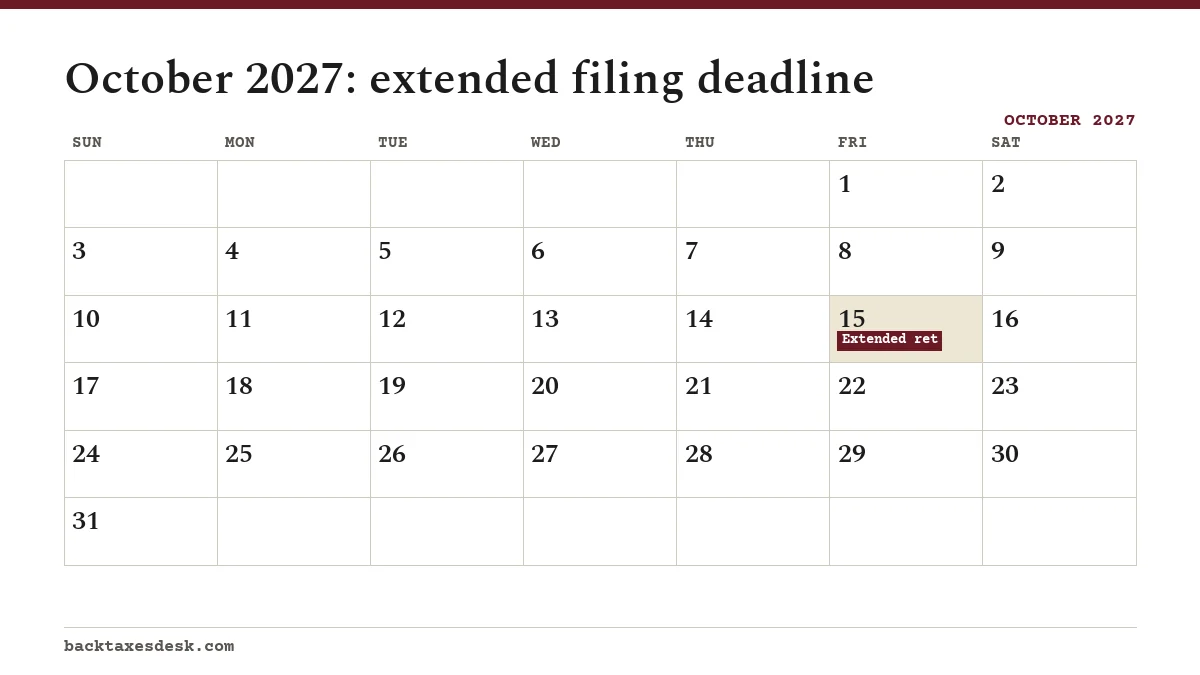
The tax extension deadline in 2027 is Friday, October 15, 2027, the last day to file a tax year 2026 federal return under an extension. The 2027 extension itself must be requested by Thursday, April 15, 2027, which is also the day any tax owed is due. The extended deadline for 2025 returns, Thursday, October 15, 2026, has passed; if you missed it, file as soon as you can to limit the late-filing penalty. Taxpayers abroad and in disaster areas can have different dates.
- 01Form 4868 due date 2027
- Thursday, April 15, 2027
- 02Extended filing deadline
- Friday, October 15, 2027
- 03Out of the country automatic date
- Tuesday, June 15, 2027
- 04Tax extension deadline 2026 (tax year 2025)
- Thursday, October 15, 2026 (passed)
- 05Second extension after October 15
- Generally not available
When is the tax extension deadline in 2027?
For most individuals, the tax extension deadline 2027 is Friday, October 15, 2027. That is the last day to file a tax year 2026 Form 1040 if you requested an extension by April 15, 2027. Because October 15 is a Friday, no weekend shift applies (IRS, Get an extension).
The Form 4868 instructions state that the IRS generally cannot extend a return's due date by more than six months. For calendar-year filers that makes October 15 a hard stop, with an exception mainly for some people living abroad.
When must I request an extension in 2027?
The Form 4868 due date in 2027 is Thursday, April 15, 2027, the regular filing deadline for tax year 2026 returns (IRS, When to file). An e-filed Form 4868, an electronic payment marked as an extension, or a paper form postmarked by that date all count.
There is no grace period. A request made on April 16 is not an extension, and the return is late from April 15 if you owe. The same date is the payment deadline: an extension only moves the filing date, so tax owed is due April 15, 2027 either way. Our extension to pay taxes page explains the separate options for paying later.
| Deadline | Date | Who it applies to |
|---|---|---|
| Request extension and pay tax owed | Thursday, April 15, 2027 | All calendar-year individual filers |
| File and pay without requesting (automatic 2 months) | Tuesday, June 15, 2027 | U.S. citizens and residents out of the country on April 15 |
| Extended filing deadline | Friday, October 15, 2027 | Anyone with a valid extension |
| Postponed dates | Set per disaster | Taxpayers in IRS-listed disaster localities |
Missed the October 15, 2026 deadline for a 2025 return?
If you searched for the tax extension deadline 2026, the date was Thursday, October 15, 2026, the last day to file a tax year 2025 return under an extension, according to the 2025 Form 4868 instructions. That deadline has passed, unless an IRS disaster postponement covers your county and sets a later date. If your extended 2025 return is still not filed, file it as soon as you can, because the late-filing penalty grows with each month or part of a month the return is late.
One rule helps if you did file on time. A 2025 return e-filed by October 15, 2026 and then rejected still counts as filed on time if it is corrected and resubmitted electronically by the fifth calendar day after the due date, which was October 20, 2026. If it cannot be fixed electronically, a paper return is treated as on time if you file it within 10 calendar days after the IRS notified you of the rejection and include an explanation of why it is late (IRS Publication 1345).
- File the 2025 return now. E-file it if your software or tax professional can still transmit it; otherwise mail a paper return. If an IRS notice about the return has arrived, send the return to the address on the notice.
- Pay what you can with it. Interest, and usually the 0.5% monthly failure-to-pay penalty, have been running on unpaid 2025 tax since April 15, 2026.
- Set up a payment plan for the rest. Filing without full payment costs far less than not filing; the IRS payment plan guide explains the options.
- Explain any reasonable cause. If a serious illness, a disaster or another event outside your control made you late, attach a statement to the return explaining why; the Form 4868 instructions say you might not owe the penalty if you have a reasonable explanation.
- Watch for automatic relief. Under the Automatic Exemption from Penalty, eligible tax year 2025 returns from people who filed and paid on time for the three prior years do not have late-filing or late-payment penalties assessed; see automatic penalty relief.
- Do not wait for missing documents. File with the best figures you have and amend later with Form 1040-X.
If you owe, the failure-to-file penalty on a return filed after October 15, 2026 is 5% of the unpaid tax for each month or part of a month it is late, up to 25%, reduced by the failure-to-pay penalty for any month in which both apply. After December 14, 2026, when the return is more than 60 days late, the minimum penalty is $525 or 100% of the tax owed, whichever is less. If the extension was not valid, for example because the tax estimate on it was not reasonable, the penalty is figured from April 15, 2026 instead. If you are owed a refund, there is no late-filing penalty. See tax extension penalty for worked numbers.
What if you are abroad or in a disaster area?
Out of the country on April 15, 2027
U.S. citizens and residents who live outside the United States and Puerto Rico with their main place of work outside both, or who are on military duty outside them, get two extra months automatically. For tax year 2026 that means filing and paying by Tuesday, June 15, 2027, with no form needed. Interest still runs from April 15 on any tax paid after that date.
Need more time than June? File Form 4868 by June 15, 2027 and check the box on line 8. That adds four more months, bringing you to October 15, 2027. People waiting to meet the bona fide residence or physical presence test for the foreign earned income exclusion use a different form, Form 2350.
Federally declared disaster areas
When the IRS grants disaster relief, it postpones deadlines for taxpayers in listed localities, and the new dates vary by disaster. You may also get extra time to file Form 4868 itself. Check the IRS disaster relief page for your county and the exact postponed date before relying on it.
What happens after October 15, 2027?
After October 15, 2027, an unfiled tax year 2026 return is late. If you owe, the failure-to-file penalty of 5% per month of unpaid tax, up to 25%, begins, and after 60 days a minimum penalty of $525 or 100% of the tax owed, whichever is less, applies for returns due after December 31, 2025 (IRS, Failure to file penalty).
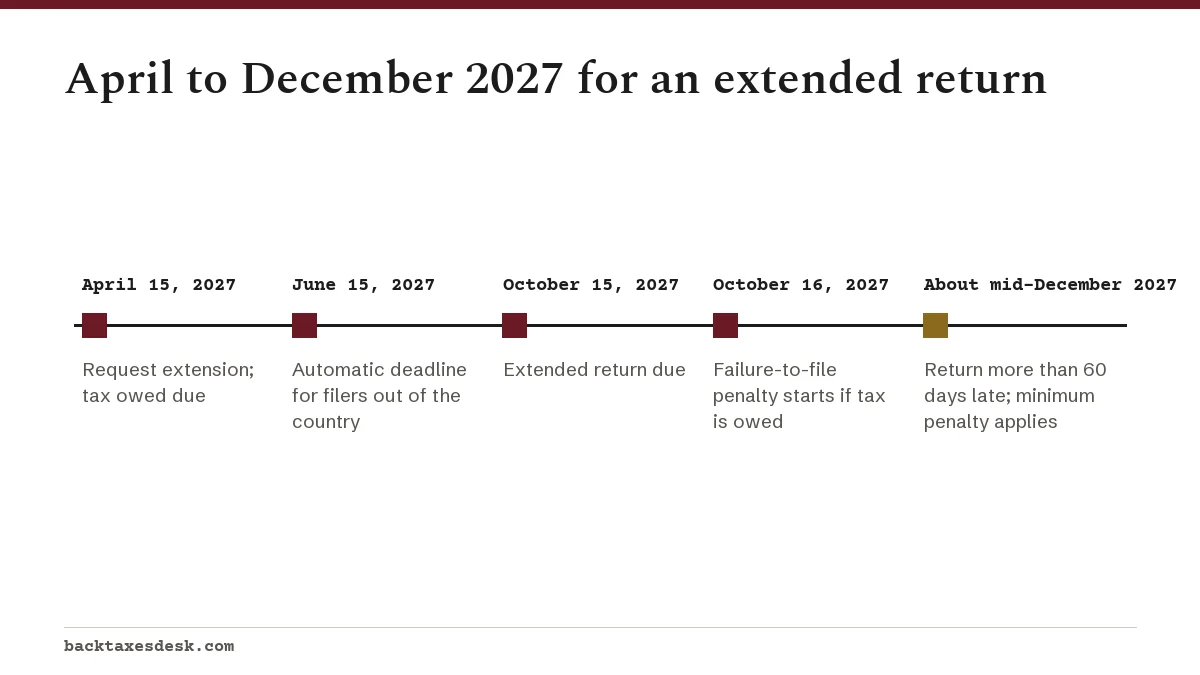
- Mid-December 2027 is roughly where the 60-day mark falls for a return that was due October 15.
- If you are owed a refund, there is no failure-to-file penalty, but you must file within three years to claim it.
- Long-unfiled returns can lead to IRS notices such as CP59 and eventually a substitute for return; see what happens if you don't file taxes.
For how to request the extension in the first place, see the Form 4868 walkthrough. The tax extension guide covers what an extension does and does not do, and the 2027 tax deadline calendar lists estimated tax and other dates for the year.
Common questions
What if October 15 falls on a weekend?
The deadline moves to the next business day. That does not happen in 2027: October 15, 2027 is a Friday, so the extended deadline stays October 15.
Is the extended tax deadline October 15 or October 16 in 2027?
October 15, 2027. The October 16 date appears only in years when October 15 falls on a weekend and the next business day is used.
Can I extend past October 15, 2027?
Generally no. The IRS cannot extend an individual return by more than six months. The exceptions are mainly for some taxpayers living abroad and for postponements in IRS-declared disaster areas.
What if I missed the October 15, 2026 extension deadline?
File the 2025 return as soon as you can and pay what you can with it. If you owe, the failure-to-file penalty of 5% of the unpaid tax per month, up to 25%, runs from October 16, 2026 until you file, and a return filed after December 14, 2026 faces a minimum penalty of $525 or 100% of the tax owed, whichever is less. If you are owed a refund, there is no penalty, but you generally must file within three years of the due date to claim it.
Is the 2027 extension deadline the same for state returns?
Not always. Many states follow October 15, but each state sets its own rules and some need a separate extension request. Check your state tax agency.
When is tax season 2027?
The IRS has not announced it yet. The filing season usually opens in late January, when the IRS starts accepting tax year 2026 returns, and the opening date is usually announced in early January. Returns are due Thursday, April 15, 2027.
Sources
- Get an extension to file your tax return irs.gov
- When to file irs.gov
- Form 4868 (2025) and instructions irs.gov
- Failure to file penalty irs.gov
- Tax relief in disaster situations irs.gov
- Publication 1345, Handbook for Authorized IRS e-file Providers irs.gov
We check figures against these official pages. Rules change; confirm anything that affects a deadline or payment with the agency before you act.
Tell us what happened
Describe your situation and our editors will use it to improve this guide. If you leave your email, we may reply with a pointer to the right page or official contact. We never share your details.