
Can't pay taxes? Compare your IRS options by cost
Short answer
If you can't pay taxes by the deadline, file your return on time anyway: the late filing penalty is ten times the late payment penalty. Then pay what you can and choose the least costly IRS arrangement for the rest, usually a free short-term plan (up to 180 days) or a $29 online installment agreement, with an Offer in Compromise or hardship status for people who truly cannot pay.
- 01Late filing penalty
- 5% per month, up to 25%
- 02Late payment penalty
- 0.5% per month, up to 25%
- 03Penalty on an approved plan (filed on time)
- 0.25% per month
- 04Offer in Compromise fee
- $205, waived for low-income certification
Can't pay taxes? File on time anyway
The single biggest money saver when you can't pay taxes is to send the return by the deadline. For tax year 2026 that is Thursday, April 15, 2027, or October 15, 2027 with an extension. The penalty for filing late is 5% of the unpaid tax per month, while the penalty for paying late is 0.5% per month.
When both apply in the same month, the IRS reduces the filing penalty by the payment penalty, so the combined charge is 5% a month for the first five months. After five months the filing penalty is maxed out, but the payment penalty keeps going until it hits its own 25% cap.
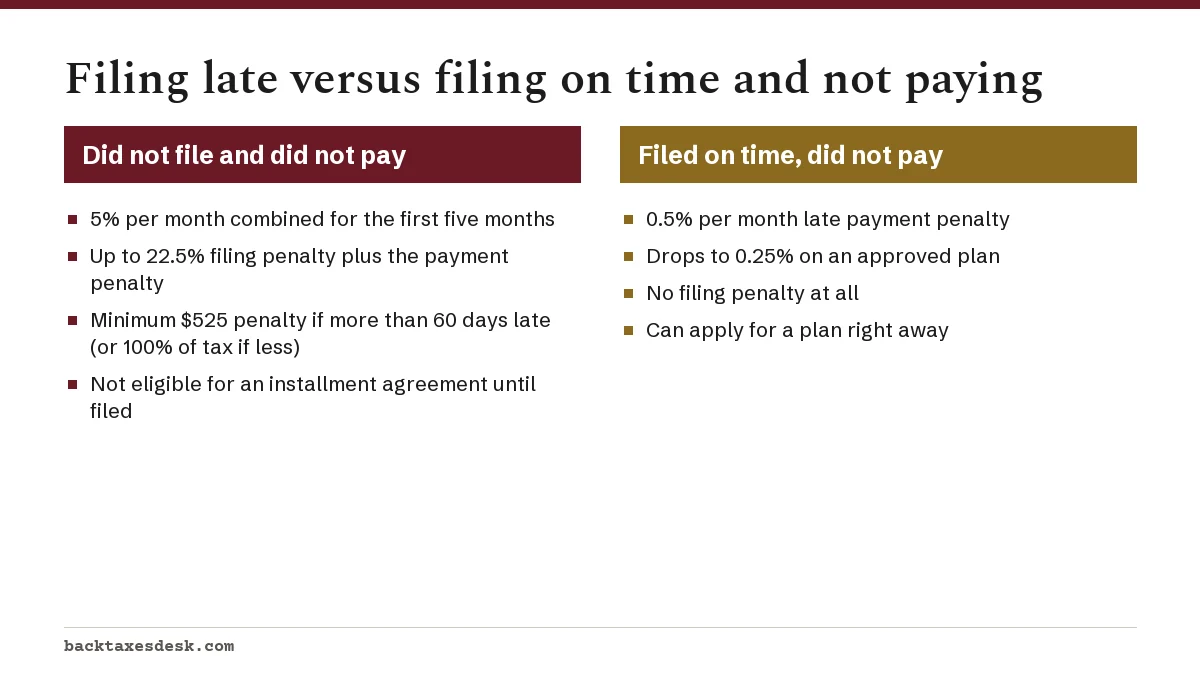
Worked example: $10,000 you can't pay by the deadline
| Scenario | Filing penalty | Payment penalty | Total penalties |
|---|---|---|---|
| Filed on time, nothing paid | $0 | $300 (0.5% x 6) | $300 |
| Filed on time, approved plan from month one | $0 | Up to $150 (0.25% x 6, lower as you pay down) | Up to $150 |
| Not filed, nothing paid | $2,250 (4.5% x 5) | $300 (0.5% x 6) | $2,550 |
Interest comes on top in every row, at about 7% a year compounded daily for late 2026, so roughly $350 over six months on $10,000. The gap between the first and last rows is about $2,250, and it comes purely from not filing.
Pay part now to cut what you owe later
Both the penalty and the interest are figured on the unpaid balance. Every dollar you send by the due date is a dollar that never collects either charge. If you can pay $4,000 of a $10,000 bill on April 15, the monthly payment penalty falls from $50 to $30.
Partial payments through IRS Direct Pay or your online account are free and post to the tax year you choose. Keep the confirmation number. Our back taxes guide explains how partial payments fit into the overall plan.
Read the video transcript
When you cannot pay the bill
File on time anyway. The late filing penalty is 5% a month, ten times the late payment penalty.
Late payment costs 0.5% a month, up to 25% of the unpaid tax.
Pay whatever you can by the deadline. Every dollar paid cuts both the penalty and the daily interest.
A short-term plan gives up to 180 days with no setup fee, for balances under $100,000.
On an approved plan, with the return filed on time, the penalty drops to 0.25% a month.
An Offer in Compromise costs $205 to apply, waived if you qualify as low income. It is not for everyone.
No legitimate service can make a real tax debt disappear. Be careful with anyone who promises that.
Short-term plan versus installment agreement
These are the two arrangements most people use when they are unable to pay taxes in one go. The deciding question is whether you can clear the balance within 180 days.
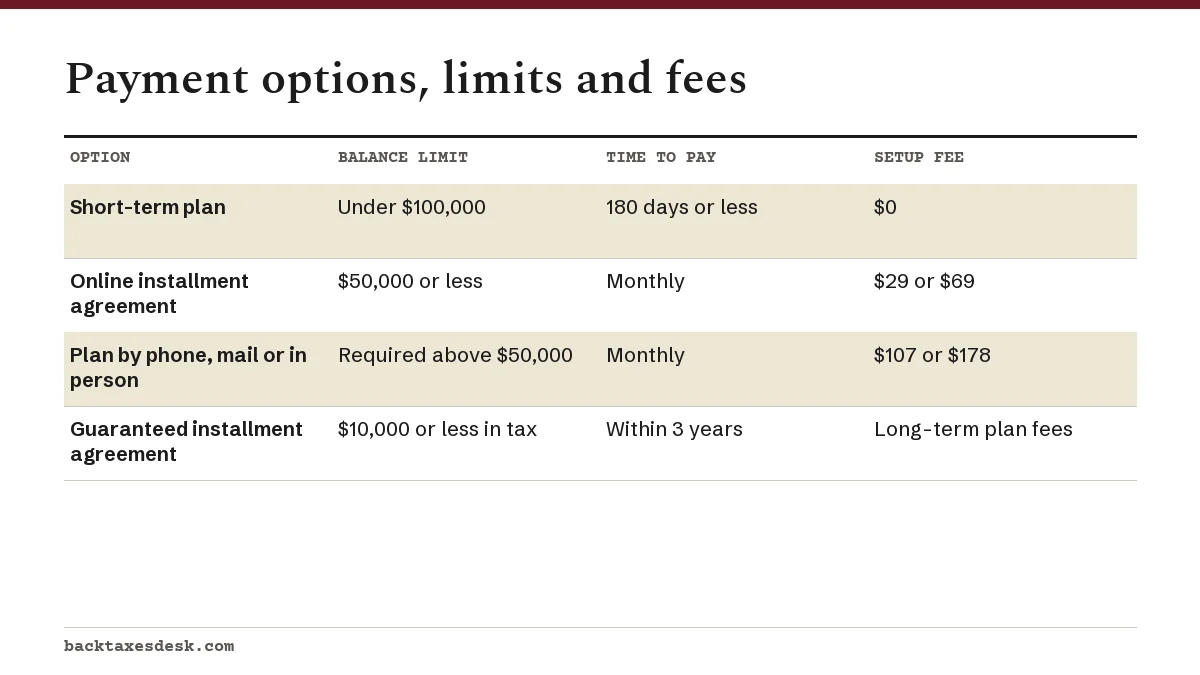
A short-term payment plan costs nothing to set up if your total tax, penalties and interest are under $100,000. You pay on your own schedule within 180 days. A long-term installment agreement suits people who need monthly payments; individuals who owe $50,000 or less can apply online.
Can the IRS refuse a payment plan?
Yes. The most common block is an unfiled return: individuals must be current on filing before an installment agreement is approved. People who owe more than $50,000 cannot apply online and must request a plan by mail on Form 9465, with Form 433-F if the instructions require it, by phone, or in person. A rejected request comes with appeal rights.
Some balances qualify for a guaranteed installment agreement. Under the Form 9465 instructions, the tax owed must be $10,000 or less, you must pay it in full within 3 years, and in the past 5 tax years you must have filed and paid on time and not had another income tax installment agreement. While any plan is active, the IRS applies future refunds to the balance until it is paid.
Offer in Compromise and hardship status
An Offer in Compromise settles the debt for less than the full amount when the IRS agrees you cannot realistically pay it. You file Form 656 with Form 433-A (OIC), pay a $205 application fee, and send either 20% of a lump-sum offer or the first payment of a periodic offer. Low-income applicants skip the fee and payments during review.
Run the free IRS Pre-Qualifier tool before paying anyone to prepare an offer. The IRS warned in its 2026 Dirty Dozen list about offer mills that charge high fees to people who are unlikely to qualify.
Currently Not Collectible status is for people who cannot pay anything without losing the ability to cover basic living costs. The IRS may pause collection, but the debt stays, interest and penalties keep growing, a lien may still be filed, and your finances are reviewed again later. Expect to supply Form 433-F or 433-A with proof of income, expenses and assets.
Comparing the cost of each option when you can't pay a tax bill
| Option | Setup cost | Penalty while active | Interest |
|---|---|---|---|
| Short-term plan (180 days or less) | $0 | Keeps running until paid | Yes, daily |
| Installment agreement, online, direct debit | $29 ($0 for low income) | 0.25% per month if filed on time | Yes, daily |
| Installment agreement, online, other payment | $69 | 0.25% per month if filed on time | Yes, daily |
| Installment agreement by phone, mail or in person | $107 direct debit or $178 other | 0.25% per month if filed on time | Yes, daily |
| Offer in Compromise | $205 plus initial payment, waived if low income | Balance settled if accepted | Settled if accepted |
| Currently Not Collectible | $0 | Keeps growing | Keeps growing |
Putting the bill on a credit card is another route. The card processor charges a percentage fee that the IRS never receives, and your card's own interest rate then applies. Add both together and compare that total against the plan costs above before deciding; the fees are listed on our guide to paying back taxes.
Penalties can sometimes be avoided or removed. Under the Automatic Exemption from Penalty the IRS announced in July 2026, eligible taxpayers with a clean compliance history have late filing and late payment penalties left off during processing, with no request needed. It began with tax year 2025 returns and replaces First Time Abate for returns originally due on or after January 1, 2027. Details on how the late payment charge is figured are on our failure-to-pay penalty page.
Common questions
What happens if I can't pay my taxes by April 15?
The IRS adds a 0.5% monthly late payment penalty and daily interest to the unpaid amount and mails you a bill. As long as you filed on time, you avoid the much larger 5% monthly late filing penalty.
Should I still file if I can't pay?
Yes. Filing on time avoids the failure-to-file penalty, which is ten times the monthly late payment penalty, and it keeps you eligible for an installment agreement.
What is the cheapest way to pay taxes over time?
A short-term plan has no setup fee if you can pay within 180 days. For longer, an online installment agreement with direct debit costs $29 and cuts the late payment penalty to 0.25% per month if you filed on time.
Can I get an extension if I can't pay my taxes?
An extension gives more time to file, not to pay. Estimate what you owe and pay what you can by the April deadline, then use a payment plan for the rest.
Will the IRS take my house if I can't pay taxes?
Seizing property is possible but comes at the end of a long process that includes several notices and a final notice giving you 30 days to request a hearing. Setting up a plan or requesting hardship status early usually keeps a case from reaching that stage.
Sources
- Topic no. 202, Tax payment options irs.gov
- Payment plans; installment agreements irs.gov
- Failure to file penalty irs.gov
- Failure to pay penalty irs.gov
- Offer in Compromise irs.gov
- Temporarily delay the collection process irs.gov
We check figures against these official pages. Rules change; confirm anything that affects a deadline or payment with the agency before you act.
Tell us what happened
Describe your situation and our editors will use it to improve this guide. If you leave your email, we may reply with a pointer to the right page or official contact. We never share your details.
Related guides
 Back Taxes: What to Do When You Owe the IRS Money Now
Back taxes are federal taxes that were due in an earlier year and are still unpaid, plus the penalties and interest added since.…
IRS Short-Term Payment Plan: 180 Days With No Setup Fee
An IRS short-term payment plan gives you up to 180 days to pay your full balance, with no setup fee, if you owe less than $100,00…
Offer in Compromise: How to Settle IRS Debt for Less
An offer in compromise is an agreement to settle IRS tax debt for less than the full balance. The IRS accepts one only when your…
Failure to Pay Penalty: How IRS Late Payment Penalties Work
The IRS failure to pay penalty is 0.5% of your unpaid tax for each month or part of a month after the due date, up to 25%. It fal…
Currently Not Collectible Status: IRS Hardship Explained
Currently not collectible (CNC) is an IRS account status that pauses most collection when paying anything toward your tax debt wo…
IRS Payment Plan Fees: Setup Costs and Low-Income Waivers
IRS installment agreement fees range from $0 to $178. A short-term plan of 180 days or less is free. A long-term plan costs $29 o…