
Owe taxes in 2027? A plan for the April 15 deadline
Short answer
If you owe taxes in 2027 on your 2026 return, the tax is due Thursday, April 15, 2027, even if you get an extension to file. File on time whether or not you can pay: the monthly late-filing penalty (5%) is ten times the late-payment penalty (0.5%). Then pay what you can and set up a short-term or long-term IRS payment plan for the rest.
- 01Tax year 2026 return and payment due
- Thursday, April 15, 2027
- 02Extended filing deadline
- Friday, October 15, 2027 (filing only)
- 03Short-term plan
- Up to 180 days, under $100,000, no setup fee
- 042027 filing season opening date
- Not yet announced (usually January)
Owe taxes in 2027? Key dates for your 2026 return
Most people who owe taxes in 2027 are settling their tax year 2026 return. The deadline is April 15 unless it falls on a weekend or holiday, and April 15, 2027 is a Thursday, so there is no shift this year. Payment is due that day whether you file on time, file late or get an extension.
| Date | What it means |
|---|---|
| Filing season opening day | Not yet announced; the IRS usually announces it in early January |
| Thursday, April 15, 2027 | Tax year 2026 returns due; all tax owed due; last day to request an extension |
| Mid-June 2027 (more than 60 days after April 15) | An unfiled return now faces the minimum failure-to-file penalty |
| Friday, October 15, 2027 | Extended filing deadline; interest and late-payment penalty have been running since April 15 |
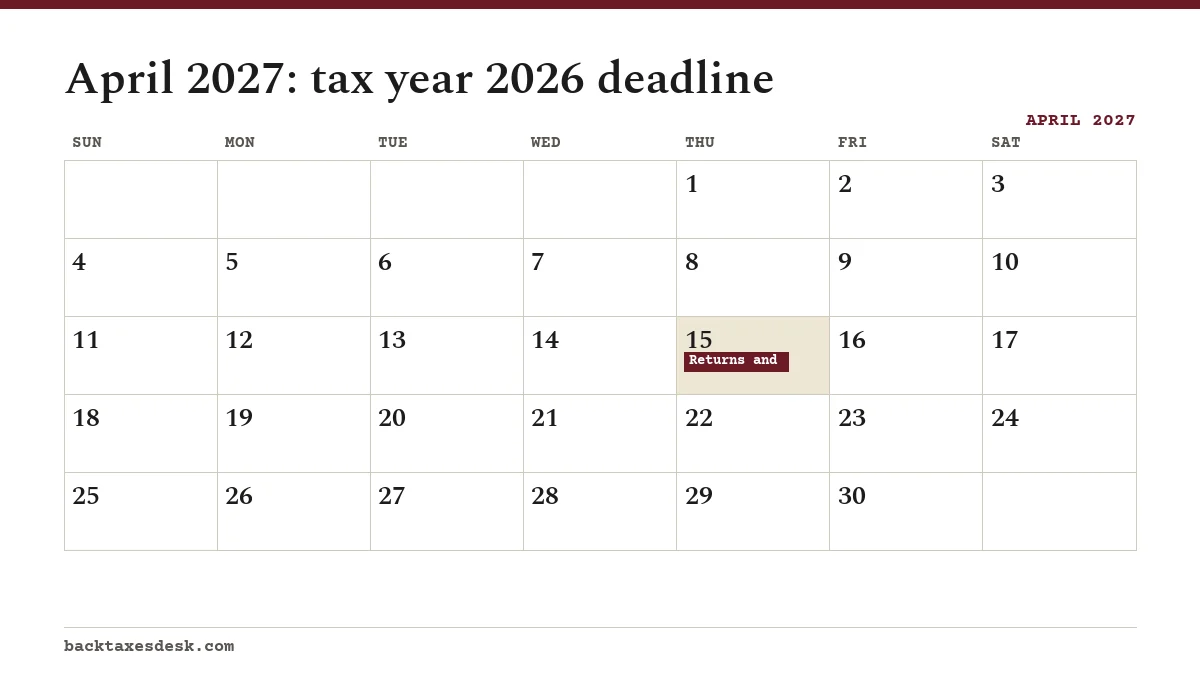
Our 2027 tax deadline calendar lists the other dates in the season. If you live abroad or in a declared disaster area, you may get more time; check the IRS extension page for your situation.
File by April 15, 2027 even if you cannot pay
The single most useful thing you can do when you owe is file on time. The failure-to-file penalty is 5% of the unpaid tax per month, up to 25%. The failure-to-pay penalty is 0.5% per month, up to 25%. Missing the filing deadline costs about ten times more each month than missing the payment deadline.
Worked example: $6,000 owed, paid three months late
| Scenario | Monthly rate | Penalty after 3 months |
|---|---|---|
| Filed April 15, paid in July | 0.5% failure-to-pay | $90 |
| Did not file or pay until July | 5% combined (failure-to-file reduced by failure-to-pay, plus failure-to-pay) | $900 |
Interest is charged in both scenarios on top of these figures. The point is the gap: filing on time with no money attached saved $810 here. Once a return is more than 60 days late, a minimum failure-to-file penalty also applies: $525 or 100% of the tax owed, whichever is less, for returns due after December 31, 2025, which covers returns due April 15, 2027 unless the IRS publishes a new figure.
Penalty and interest figures for the 2027 season
Several figures that affect a 2027 balance are already fixed by law or published. Others, mainly the interest rate for 2027 quarters, have not been released. Treat anything marked not yet announced as unknown rather than guessing.
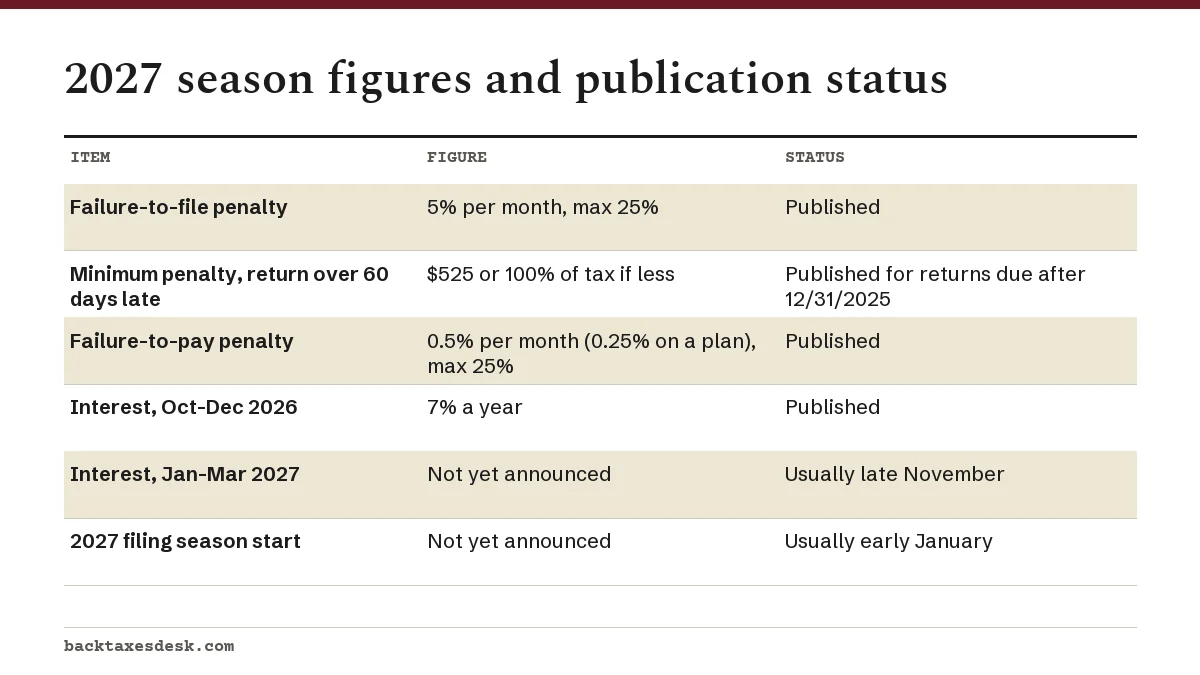
Interest runs from April 15 until you pay in full, compounded daily, and it is also charged on penalties. The rate for October through December 2026 is 7%. For more detail and updates when new rates publish, see IRS penalty rates for 2027 and the 2027 IRS interest rate.
What if I owe taxes in 2027 and can't pay? Payment plan options
You do not need to wait for a bill. You can apply for a payment plan as soon as your return is filed, and individuals must be current on all required returns to get an installment agreement. The main IRS payment options in 2027 are:
| Option | Who qualifies | Setup fee |
|---|---|---|
| Short-term plan | Pay within 180 days; total tax, penalties and interest under $100,000 | None |
| Long-term plan, direct debit, applied online | $50,000 or less in combined tax, penalties and interest | $29 |
| Long-term plan, other payment method, applied online | $50,000 or less | $69 |
| Long-term plan requested by phone, mail or in person | Used when you cannot or do not apply online | $107 direct debit, $178 other |
Applicants with income at or below 250% of the federal poverty guidelines have the direct-debit fee waived, or reimbursed at the end if they pay another way. On a plan filed with an on-time return, the failure-to-pay rate drops from 0.5% to 0.25% a month, but interest keeps running until the balance is paid. The Online Payment Agreement is the fastest way to apply; see the short-term payment plan if you can clear the balance within six months.
Will there be new IRS tax payment rules in 2027?
Paper checks and money orders are still accepted for payments to the IRS. Under Executive Order 14247 the IRS stopped most paper refund checks after September 30, 2025, and the Taxpayer Advocate Service has said an electronic requirement for payments is not expected until 2027 or later. No start date has been published.
One change that is already set: individuals must stop using EFTPS later in 2026. If you used EFTPS for estimated tax, switch to IRS Direct Pay or your IRS online account before the season. Our page on the IRS electronic payment requirement tracks what has been announced.
New automatic penalty relief for good filing history
The IRS's Automatic Exemption from Penalty (AEP), announced July 8, 2026, started in summer 2026 with tax year 2025 returns. For eligible returns with original due dates on or after January 1, 2027, which includes 2026 Form 1040s due April 15, 2027, it replaces First Time Abate.
If your history passes the compliance test (the same return type filed on time for the prior three years and no penalties in that period other than estimated tax penalties, or only penalties removed for reasonable cause or IRS error), failure-to-file and failure-to-pay penalties are not assessed at all, and the IRS mails a notice confirming the relief. Interest still applies to the tax itself, and the estimated tax penalty is not part of this relief. See automatic penalty relief for how the transition works.
Should you file an extension if you owe?
An extension gives you until October 15, 2027 to file, not to pay. If you owe and need more time to finish the return, estimate the tax, pay as much as you can by April 15, and request the extension. Making an electronic payment marked as an extension payment counts as the request, with no Form 4868 needed.
As long as you file by October 15, an extension protects you from the larger failure-to-file penalty, which is why it is worth requesting even with no payment. For the full picture of options once the deadline passes, see the back taxes guide.
Common questions
When is tax due in 2027?
Tax on 2026 income is due Thursday, April 15, 2027. An extension moves only the filing deadline, to Friday, October 15, 2027.
Should I file my 2026 return if I owe and can't pay?
Yes. Filing on time avoids the 5% per month failure-to-file penalty. You then face only the 0.5% per month failure-to-pay penalty plus interest, and you can apply for a payment plan right away.
What is the IRS interest rate for early 2027?
It is not yet announced. The IRS usually releases the January to March rate in late November; the rate for October to December 2026 is 7%.
Can I set up an IRS payment plan before I get a bill?
Yes. Once your return is filed you can apply through the Online Payment Agreement. A short-term plan of up to 180 days has no setup fee if you owe under $100,000.
Will the IRS still take a check in April 2027?
As of September 2026, yes: checks and money orders are still accepted for payments. The IRS has not announced a date for requiring electronic payments.
Sources
- When to file irs.gov
- Failure to file penalty irs.gov
- Failure to pay penalty irs.gov
- Payment plans; installment agreements irs.gov
- Quarterly interest rates irs.gov
- Administrative penalty relief irs.gov
We check figures against these official pages. Rules change; confirm anything that affects a deadline or payment with the agency before you act.
Tell us what happened
Describe your situation and our editors will use it to improve this guide. If you leave your email, we may reply with a pointer to the right page or official contact. We never share your details.
Related guides
 Back Taxes: What to Do When You Owe the IRS Money Now
Back taxes are federal taxes that were due in an earlier year and are still unpaid, plus the penalties and interest added since.…
Tax Deadline 2027: April 15, Plus When Tax Season Opens
The tax filing deadline 2027 is Thursday, April 15, 2027: tax year 2026 federal returns must be filed and any tax owed paid by th…
IRS Automatic Penalty Relief (AEP): What Changes in 2027
IRS automatic penalty relief, called the Automatic Exemption from Penalty (AEP), means the IRS does not assess late filing, late…
IRS Penalty Rates 2027: Late Filing and Payment Figures
IRS penalty rates for 2027 keep the same percentages: 5% a month for filing late and 0.5% a month for paying late, each capped at…
How to Set Up an IRS Payment Plan Online, by Phone or Mail
To set up an IRS payment plan, first make sure every required return is filed, then apply through the Online Payment Agreement to…