
The IRS electronic payment requirement: can you still pay by check?
Short answer
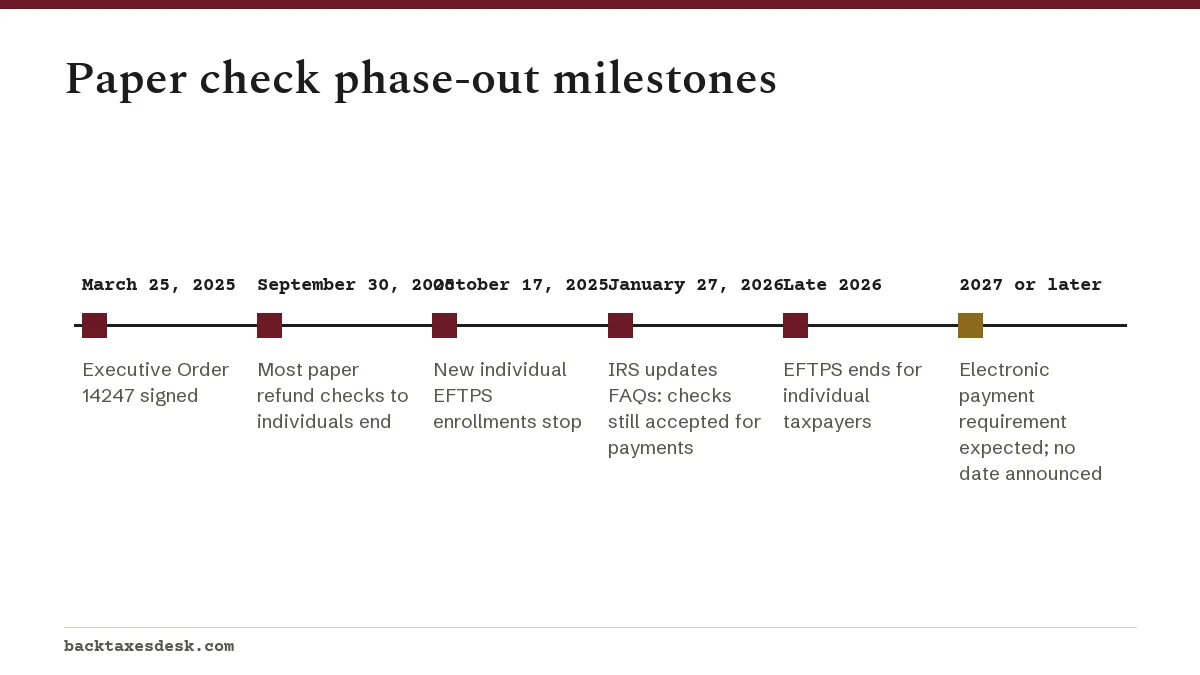
There is no IRS electronic payment requirement for individuals yet. As of September 2026, the IRS still accepts checks and money orders mailed with a return or notice. Executive Order 14247 ended most paper refund checks after September 30, 2025, and the IRS plans to move payments to electronic methods over time, but the Taxpayer Advocate Service expects that requirement no earlier than 2027, and no date has been set.
- 01Executive Order 14247 signed
- March 25, 2025
- 02Paper refund checks for individuals ended
- After September 30, 2025, with limited exceptions
- 03Checks accepted for payments?
- Yes, for now
- 04Date electronic payments become mandatory
- Not yet announced
Is there an IRS electronic payment requirement now?
No. The IRS electronic payment requirement people read about is a plan, not a rule you must follow today. The IRS's own FAQ (updated January 27, 2026) says mailed payments, including checks and money orders, will still be accepted and processed for now. As of September 2026, mailing a check with a Form 1040-V or a notice stub still works.
What has changed is the direction. Executive Order 14247, signed March 25, 2025, told federal agencies to modernize payments both to and from the government. For payments to the IRS, the agency says it will reduce reliance on paper checks and money orders over time and eventually move to electronic methods, with limited exceptions such as hardship.
What changed for refunds and what has not changed for payments
The refund side moved first: the IRS generally stopped issuing paper refund checks to individuals after September 30, 2025, and now asks for bank details when a return has none. Payments to the IRS are a separate track that has barely changed.
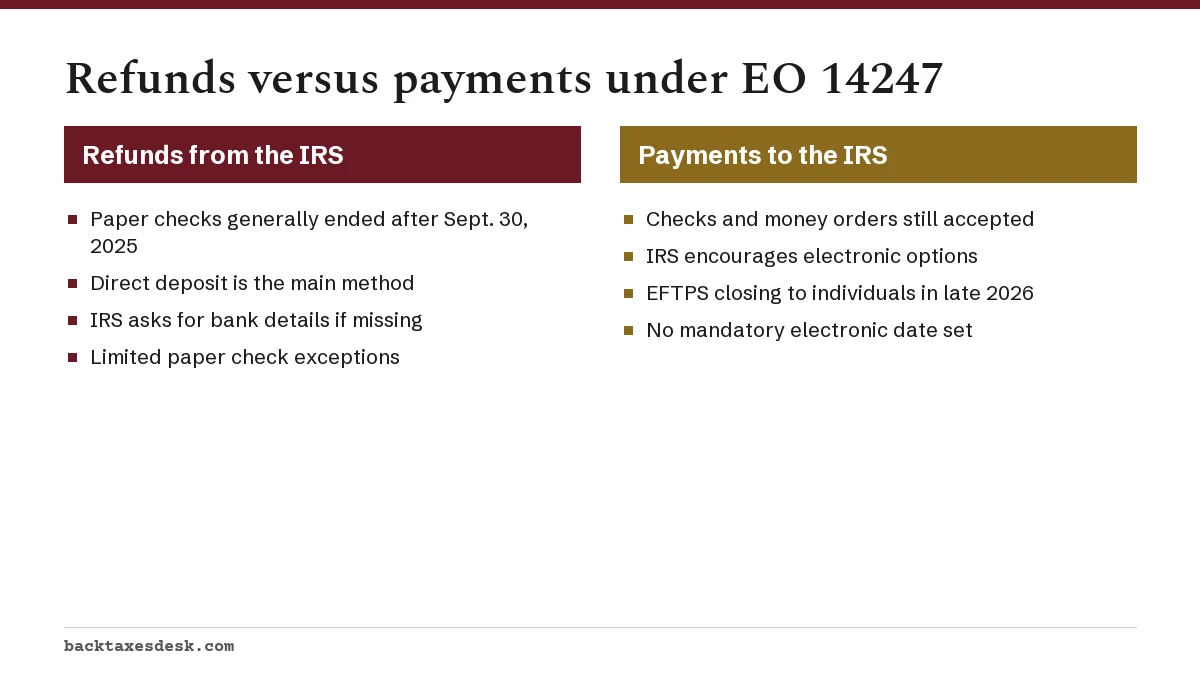
The payment side has changed in only two concrete ways so far. Individuals can no longer enroll in EFTPS (since October 17, 2025), and all individuals must leave EFTPS later in 2026. Businesses also cannot use cash or cards for federal tax deposits, which must already be made electronically.
Will the IRS stop accepting checks? What has been said about 2027
In October 2025, the Taxpayer Advocate Service wrote that the electronic payments requirement is anticipated to take effect in 2027 or later. The IRS FAQ, updated in January 2026, gives no date and says only that the transition will happen over time. Nothing published as of September 2026 sets a cutoff for mailed checks.
Treat any article that gives a firm date for the IRS to stop accepting checks as unverified unless it links to an IRS or Treasury announcement. When a date is set, expect updated form instructions, an exception process for people who cannot pay electronically, and notices that tell you which method to use.
How to pay the IRS electronically if you owe
If you want to pay the IRS electronically now, each option below works for most balance-due payments. Not every option handles every payment type, so check the notice you received for any restriction.
| Method | Cost | Good for |
|---|---|---|
| IRS Direct Pay (bank account) | Free | One-time or scheduled payments; no sign-in needed |
| IRS Individual Online Account | Free from a bank account | Seeing your balance and paying in one place |
| Debit card, credit card or digital wallet | Processor fee applies | Paying when you have no bank payment option |
| Cash at a retail partner | $1.50 per payment | People without a bank account; up to $500 per payment |
| Payment plan with direct debit | $29 setup online | Balances you need to pay monthly |
Direct Pay is the usual choice for a one-off payment; our IRS Direct Pay guide shows which reason and tax year to pick for each notice. If you are spreading the balance out, see how to pay back taxes for how payment plans fit in.
If you do not have a bank account
The cash option is the main electronic route for people without a bank account. You sign up online with one of the IRS's two cash payment processors, enter your tax details, and receive a payment barcode. You then pay in cash at a participating retail store, such as certain pharmacy, dollar-store and convenience-store chains.
- Each cash payment is capped at $500 and costs $1.50; monthly and annual limits also apply.
- The barcode expires 20 days after it is issued.
- Start well before the due date, because setting up the barcode and visiting a store takes time.
The IRS also points people to the FDIC's GetBanked resources and MyCreditUnion.gov for low- or no-cost accounts. If you work directly with an IRS employee on a collection case, the IRS says its representatives still accept paper checks for now.
Can I still pay the IRS by check? How to do it correctly
Yes. If you pay by mail in 2027, a few details keep the payment from being misapplied:
- Make the check, money order or cashier's check payable to U.S. Treasury.
- Write your name, address, daytime phone, SSN or ITIN, the tax year and the form or notice number on it.
- Mail it to the address on your notice, or the address in the form instructions if you are paying with a return and Form 1040-V.
- Use regular mail with Form 1040-V; the IRS says private delivery services may delay processing.
- Never mail cash.
What to watch for before the 2027 season
- An IRS announcement setting a date for electronic-only payments, and the exception process that goes with it.
- Changes to Form 1040-V or notice payment stubs, which would be the first practical sign of a cutoff.
- Your EFTPS access, if you still use it for estimated tax; move to Direct Pay or an online account before it ends for individuals.
- Scam messages claiming checks are no longer accepted and asking you to pay by gift card or to a private account. The IRS does not take payment that way.
If you owe now and cannot pay in full, the payment method matters less than acting quickly. Start with owing the IRS money for a quick overview, or the back taxes guide for the full set of options.
Common questions
Will the IRS stop accepting paper checks?
The IRS says it will move to electronic payments over time, but for now it still accepts checks and money orders. The Taxpayer Advocate Service expects any requirement no earlier than 2027, and no date has been published.
Can I still mail a check with my 2026 tax return?
As of September 2026, yes. Make it payable to U.S. Treasury, include Form 1040-V, and write your SSN, tax year and form number on the check.
What is Executive Order 14247?
It is a March 25, 2025 order directing federal agencies to move payments to and from the government to electronic methods. For the IRS it ended most paper refund checks after September 30, 2025, and will phase down paper payments over time.
How can I pay the IRS without a bank account?
You can pay cash at a participating retail store through the IRS's cash payment partners, up to $500 per payment for a $1.50 fee, or mail a money order payable to U.S. Treasury.
Is paying the IRS by credit card free?
No. Card and digital wallet payments go through payment processors that charge a fee. Paying from a bank account through Direct Pay or your online account is free.
Sources
- Questions and answers about Executive Order 14247 irs.gov
- Modernizing payments to and from America's bank account irs.gov
- Tips on electronic payment options as the IRS phases out paper checks (Taxpayer Advocate Service) taxpayeradvocate.irs.gov
- Pay by check or money order irs.gov
- Pay with cash at a retail partner irs.gov
- Direct Pay with bank account irs.gov
We check figures against these official pages. Rules change; confirm anything that affects a deadline or payment with the agency before you act.
Tell us what happened
Describe your situation and our editors will use it to improve this guide. If you leave your email, we may reply with a pointer to the right page or official contact. We never share your details.
Related guides
 Back Taxes: What to Do When You Owe the IRS Money Now
Back taxes are federal taxes that were due in an earlier year and are still unpaid, plus the penalties and interest added since.…
How to Pay Back Taxes to the IRS: Every Payment Method
The cheapest way to pay back taxes is from a bank account through IRS Direct Pay or your IRS Individual Online Account, which are…
IRS Direct Pay: How to Pay a Tax Balance From Your Bank
IRS Direct Pay is the IRS's free tool for paying a federal tax balance straight from a US checking or savings account. There is n…
Owe IRS Money? What Happens Next and What to Do First
When you owe IRS money, a 0.5% monthly late payment penalty and daily compounding interest (7% a year through December 2026) begi…
Owe Taxes in 2027? What to Do Before the April 15 Deadline
If you owe taxes in 2027 on your 2026 return, the tax is due Thursday, April 15, 2027, even if you get an extension to file. File…