
Tax debt and bankruptcy: what can and cannot be wiped out
Short answer
Tax debt bankruptcy can erase some older IRS income tax, but not all of it. Income tax generally qualifies only if the return was due over three years before the petition, was filed more than two years before it, was assessed more than 240 days before it, and involved no fraud. Filing triggers an automatic stay that pauses most IRS collection, but a lien filed earlier can survive.
- 01Return due date test
- More than 3 years before the petition, including extensions
- 02Late return test
- Filed more than 2 years before the petition
- 03Assessment test
- Assessed more than 240 days before the petition
- 04Collection statute
- Paused during the case, plus 6 months
What tax debt bankruptcy can and cannot do
Bankruptcy is a court process, not an IRS program, and it treats tax debt differently from credit cards or medical bills. Some tax is wiped out by the discharge, some must be paid in full through the case, and some survives no matter what. Whether your tax debt bankruptcy filing helps depends on the age of each tax year and how and when you filed those returns.
IRS Publication 908 sets out the rules the IRS applies. In a Chapter 7 case, these tax debts (with their interest) are not discharged:
- Recent income tax for a year whose return was due, including extensions, within 3 years before the bankruptcy petition.
- Income tax assessed within 240 days before the petition (this period is extended while an offer in compromise was pending, plus 30 days).
- Tax for a year with no return filed.
- Tax on a return filed late and within 2 years before the petition.
- Tax on a fraudulent return, or tax the debtor willfully tried to evade.
- Withholding taxes in any capacity, such as payroll tax withheld from employees by a business owner.
Penalties are more forgiving: in Chapter 7 they are dischargeable unless the event behind the penalty happened within 3 years of the bankruptcy and the penalty relates to a tax that is not discharged.
Can IRS debt be discharged? A worked example
Suppose someone files a bankruptcy petition in October 2026 and owes income tax for three years. The test is run separately for each year.
| Tax year and facts | Return due more than 3 years ago? | Likely treatment |
|---|---|---|
| Return due April 2022, filed on time, assessed in 2022 | Yes | Generally dischargeable if no fraud |
| Return due April 2022, but first filed in March 2026 | Yes | Not dischargeable: late return filed within 2 years of the petition |
| Return due April 2024, filed on time | No | Not dischargeable: priority tax, paid through the case or after it |
The example shows why filing old returns matters before thinking about bankruptcy. A missing return keeps that year's tax alive, and a return filed late starts its own 2-year wait. Our guide to back taxes covers getting unfiled years in order.
Does bankruptcy stop IRS collection? The automatic stay
Yes, for most collection. The moment a petition is filed, an automatic stay takes effect by law. It bars the IRS from acting to collect taxes that arose before the filing, including serving levies or filing a Notice of Federal Tax Lien aimed at pre-bankruptcy debt. It also stops certain Tax Court cases. The stay generally lasts until the court lifts it, the case is closed or dismissed, or you receive a discharge.
What the stay does not stop
- An audit to figure out how much tax you owe.
- A demand that you file tax returns.
- A Notice of Deficiency.
- Assessing the tax and sending a notice and demand for payment.
- Freezing a refund: the IRS generally cannot offset it during the stay but may hold it until the stay lifts, and it can offset a pre-petition refund against a pre-petition income tax debt.
Chapter 7 versus Chapter 13 for back taxes
Chapter 7 is a liquidation that usually takes 90 to 120 days; only individuals, not corporations, receive a Chapter 7 discharge. Chapter 13 is a repayment plan for individuals that the IRS says usually runs 5 years, or 3 years in hardship cases. In Chapter 13, priority taxes must be paid in full under the plan, and completing the plan brings a broad discharge of other debts it covers.
Chapter 13 has a strict filing condition: you must file all required tax returns for tax periods ending within the 4 years before the petition. The same exceptions apply as in Chapter 7 for unfiled returns, late returns filed within 2 years, fraud and withholding tax. Debts the IRS was not notified about in time to file a claim are also excluded.
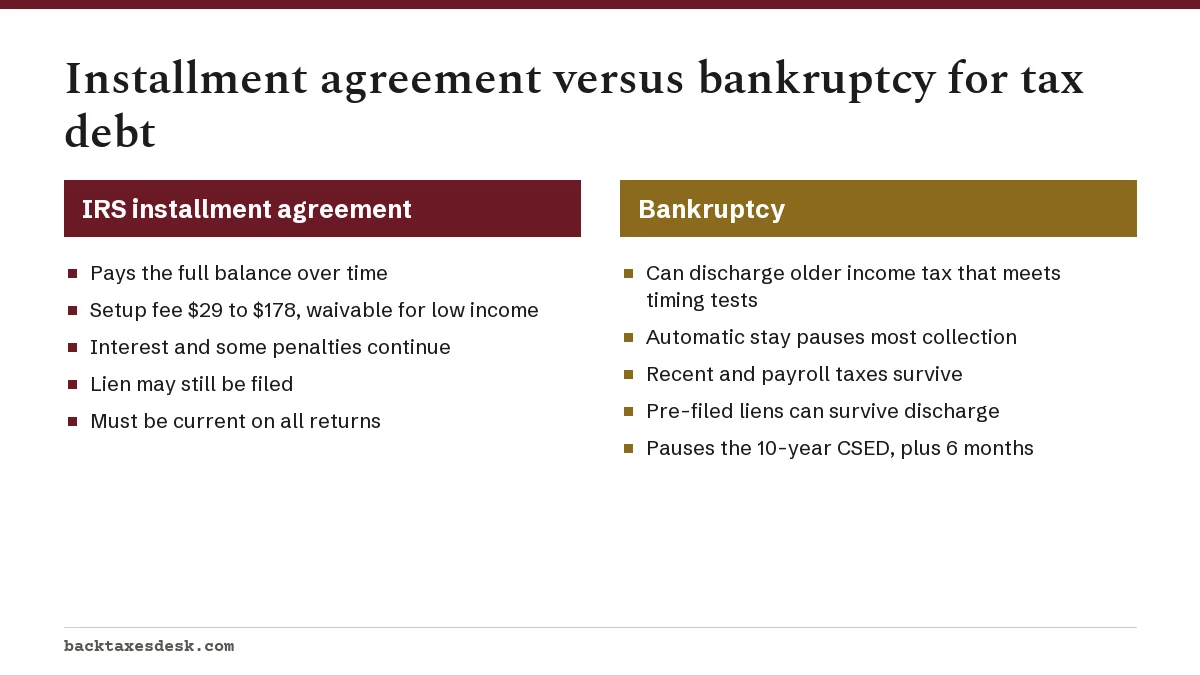
For people who can afford monthly payments but not a lump sum, an IRS payment plan often solves the same problem with less cost. If you truly cannot pay anything, Currently Not Collectible status or an offer in compromise may be worth comparing first.
Tax liens after bankruptcy
A discharge ends your personal liability, but it does not automatically remove a federal tax lien. If the IRS filed a Notice of Federal Tax Lien before the petition, a discharged tax can still be collected from property you owned before the bankruptcy. Liens properly recorded before the case generally pass through it unaffected.
If no lien notice was filed before the petition, the lien is generally removed from pre-bankruptcy property you claimed as exempt. There is an exception: a lien that arose when the tax was assessed may stay on property that was excluded or abandoned from the estate, even without a filed notice. Our page on the IRS tax lien explains lien release and withdrawal.
How bankruptcy affects the 10-year collection statute
The IRS generally has 10 years from assessment to collect, ending on the Collection Statute Expiration Date (CSED). Bankruptcy pauses that clock from the petition date until the case is discharged, dismissed or closed, and the law then adds 6 more months.
So a Chapter 13 case that lasts 5 years pushes the CSED on any surviving tax out by about 5 years and 6 months. Each separate bankruptcy case pauses the clock again. See the IRS collection statute of limitations for the other events that pause the clock.
Talk to a bankruptcy attorney first
The timing tests run to the day, and a filing that is a few weeks early can leave a tax year non-dischargeable that would have qualified later. Only a bankruptcy attorney can advise on the chapter, the exemptions in your state and the right filing date. A tax professional who can pull your IRS account transcripts helps confirm the assessment and return-filed dates for each year.
Our comparison of a tax attorney versus a CPA explains who handles what. If your balance is from the current season, read owing taxes in 2027 first: recent tax is rarely dischargeable, so a payment plan is usually the realistic path.
Common questions
Can you file bankruptcy on IRS debt?
Yes, and some older income tax can be discharged if it meets the 3-year, 2-year and 240-day timing tests and no fraud was involved. Recent tax, unfiled years and payroll tax withheld from employees are not discharged.
Does a tax lien survive bankruptcy?
Often, yes. If the IRS filed a lien notice before the petition, the lien can still be enforced against property you owned before the case even after your personal liability is discharged.
Does filing bankruptcy stop an IRS levy?
The automatic stay blocks new levies on pre-bankruptcy tax while it is in effect. It does not stop the IRS from auditing you, assessing tax or asking you to file missing returns.
How long after filing a tax return can it be discharged in bankruptcy?
A late return must have been filed more than 2 years before the bankruptcy petition. Separately, the return's original due date, including extensions, must be more than 3 years before the petition.
Will bankruptcy stop IRS passport certification?
Tax debt in bankruptcy is not certified as seriously delinquent while the case is open, and existing certification can be reversed.
Sources
- Publication 908, Bankruptcy Tax Guide irs.gov
- Declaring bankruptcy irs.gov
- Understanding a federal tax lien irs.gov
- Time IRS can collect tax irs.gov
- Understanding your CP508C notice irs.gov
We check figures against these official pages. Rules change; confirm anything that affects a deadline or payment with the agency before you act.
Tell us what happened
Describe your situation and our editors will use it to improve this guide. If you leave your email, we may reply with a pointer to the right page or official contact. We never share your details.
Related guides
 Back Taxes: What to Do When You Owe the IRS Money Now
Back taxes are federal taxes that were due in an earlier year and are still unpaid, plus the penalties and interest added since.…
IRS Statute of Limitations on Collection: The 10-Year Rule
The statute of limitations on IRS collection is generally 10 years from the date a tax is assessed, not from the year it was owed…
Tax Attorney vs CPA: When You Need a Lawyer for IRS Debt
In the tax attorney vs CPA decision, both have unlimited rights to represent you before the IRS, so most back-tax, payment plan a…
Owe Taxes in 2027? What to Do Before the April 15 Deadline
If you owe taxes in 2027 on your 2026 return, the tax is due Thursday, April 15, 2027, even if you get an extension to file. File…
IRS Liens Explained: What a Federal Tax Lien Means for You
IRS liens are the government's legal claim against everything you own, created automatically when a tax is assessed, the IRS send…