
What happens if you don't pay taxes: the timeline
Short answer
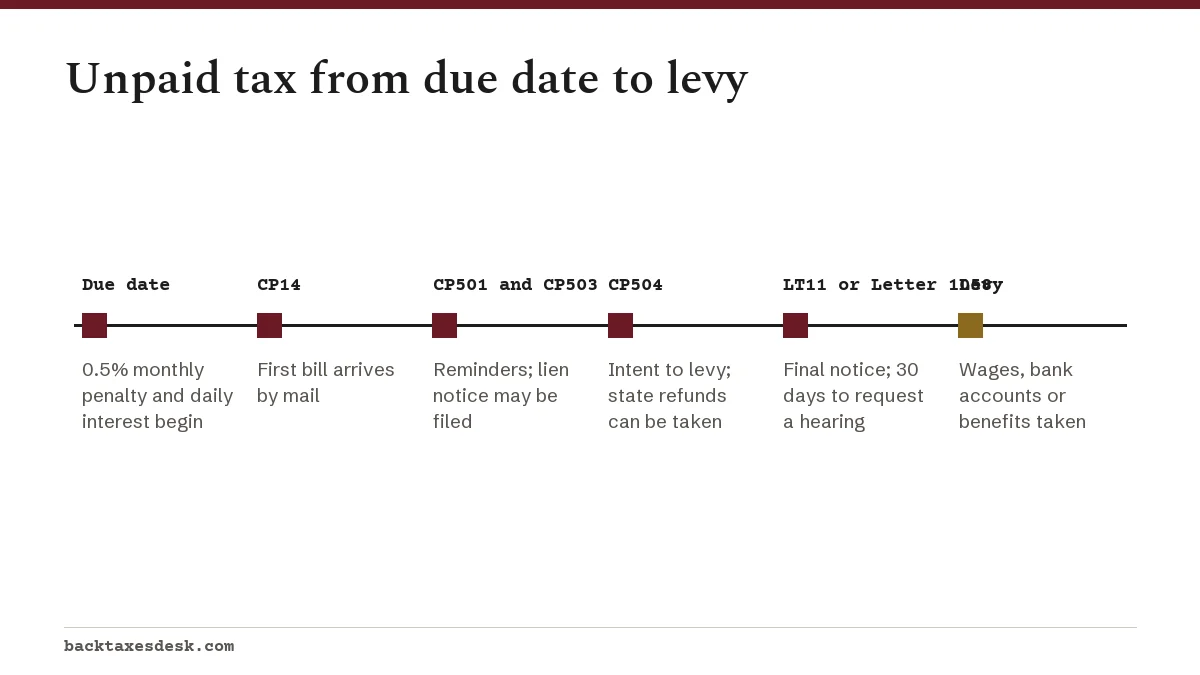
What happens if you don't pay taxes is a slow, predictable escalation. A 0.5% monthly penalty and daily interest start after the due date, then the IRS mails a bill, reminders and a notice of intent to levy. If the balance is still open after the final notice and its 30-day hearing window, the IRS can levy wages and bank accounts, file a lien and, for large debts, block your passport.
- 01Late payment penalty
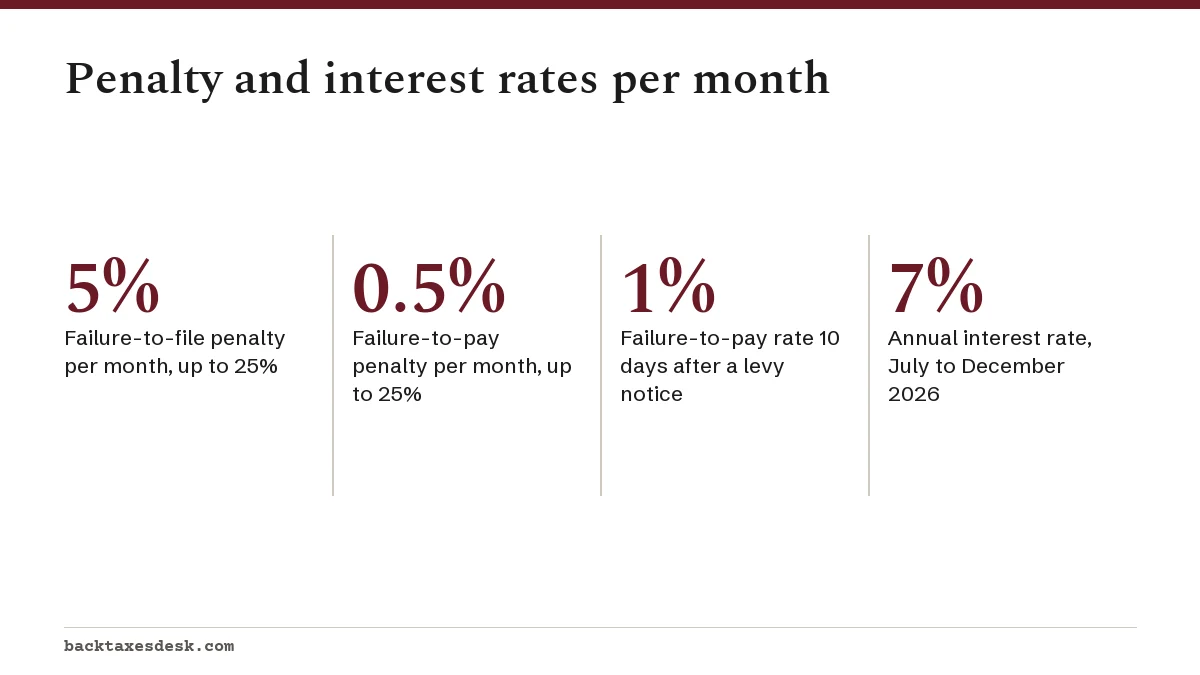
- 0.5% per month, rising to 1% after a levy notice
- 02Interest, second half of 2026
- 7% a year, compounded daily
- 03Warning before a levy
- At least 30 days after the final notice
- 04Passport threshold, 2026
- $66,000 (2027 figure not yet announced)
- 05Collection window
- Generally 10 years from assessment
Month one: what happens if you don't pay taxes on time
Nothing visible happens on the day after the deadline, but the cost starts right away. The failure-to-pay penalty adds 0.5% of the unpaid tax for every month or part of a month, and interest compounds on the balance each day. For tax year 2026, that clock starts after April 15, 2027.
If the return was not filed either, a much larger failure-to-file penalty of 5% per month applies on top, up to 25%. A return more than 60 days late carries a minimum penalty of $525 or the full tax owed, whichever is smaller, for returns due after December 31, 2025.
What happens if you don't pay the IRS: the notice sequence
The IRS escalates by letter, and each letter tells you exactly what comes next. Knowing where you are in the sequence tells you how much time remains before enforcement.
| Notice | What it means | What it allows the IRS to do |
|---|---|---|
| CP14 | First bill for the unpaid balance, with a due date | Nothing yet beyond penalties and interest |
| CP501 | Reminder that the balance is still open | Warns that a lien notice may be filed |
| CP503 | Second reminder; no response received | Warns again of a possible lien |
| CP504 | Notice of Intent to Levy | Take state tax refunds; warns of levies on wages, bank accounts and benefits |
| LT11 or Letter 1058 | Final Notice of Intent to Levy and right to a hearing | Levy other assets once 30 days pass without a hearing request |
The CP504 does not by itself give you Collection Due Process rights. The LT11 or Letter 1058 does: you have 30 days to request a hearing on Form 12153, and if you miss it, an equivalent hearing can still be requested within one year. Our page on the final notice of intent to levy explains how to respond.
Read the video transcript
If you do not pay: what follows
The sequence is slow and predictable. A 0.5% monthly penalty and daily interest start after the due date.
The IRS then mails a bill, reminders, and finally a notice of intent to levy.
You get at least 30 days after that final notice before a levy can happen.
Once a levy notice is issued, the late payment penalty doubles to 1% a month.
A seriously delinquent balance, $66,000 in 2026, can affect your passport.
Every stage has an exit. Payment plans, hardship status and appeals all stop the escalation.
Liens, levies and passport limits
Once a balance is assessed, billed and left unpaid, a federal tax lien arises automatically and attaches to all your property, including property you acquire later. The IRS may also file a public Notice of Federal Tax Lien. See our page on the federal tax lien for release and withdrawal options.
A levy is the actual taking of money or property. Common forms are:
- Bank levy: the bank freezes the funds for 21 days, then sends them to the IRS.
- Wage levy: continues each payday until released. Part of your pay is exempt based on your standard deduction and dependents. Return the Statement of Dependents and Filing Status to your employer within three days; otherwise the exempt amount is figured as married filing separately with no dependents.
- Benefit levy: Social Security benefits and other federal payments can be levied.
- Refund offset: future federal and state tax refunds can be applied to the debt.
If your total debt, including penalties and interest, reaches the seriously delinquent threshold, the IRS can certify it to the State Department with a CP508C notice. The threshold is $66,000 for 2026; the 2027 figure is not yet announced and usually arrives with the inflation adjustments in October or November. A certified debt can lead to passport denial or revocation.
What happens if you don't pay taxes for years?
The late payment penalty stops growing once it reaches 25% of the tax, which takes 50 months at 0.5%. Interest has no cap and keeps compounding for as long as the balance is open.
The IRS generally has 10 years from the assessment date to collect, a deadline called the Collection Statute Expiration Date. The clock pauses during a pending installment agreement request, a pending Offer in Compromise, bankruptcy plus six months, a Collection Due Process hearing, and certain other events. Details are on the IRS collection statute of limitations.
Can you go to jail for not paying taxes?
Criminal charges require willful conduct. Under 26 U.S.C. 7203, willful failure to pay is a misdemeanor punishable by up to one year in prison and a fine of up to $100,000 for individuals. Tax evasion under section 7201 is a felony with up to five years. The collection tools the IRS describes for ordinary unpaid balances, such as penalties, liens and levies, are civil.
Does unpaid tax go on your credit report?
The IRS says that once it files a Notice of Federal Tax Lien, the lien may limit your ability to get credit. The notice is a public record that lenders can find, which is one more reason to resolve a balance before a lien is filed.
How to stop unpaid taxes from getting worse
Most of the damage above can be avoided or reversed at any point before a levy, and much of it after. The actions below are in order of impact.
- File every missing return. It stops the 5% monthly filing penalty and is required before the IRS approves a payment plan.
- Pay what you can now, from a bank account through Direct Pay or your online account.
- Set up a payment plan. If you filed on time, an approved plan cuts the late payment penalty to 0.25% per month, and a plan paid on time keeps a debt from being certified for passport action.
- If you have an LT11 or Letter 1058, request a Collection Due Process hearing within 30 days.
- Ask about penalty relief. Under the Automatic Exemption from Penalty, which began with tax year 2025 returns, the IRS leaves off late filing and late payment penalties during processing for people who meet its compliance history test; it replaces First Time Abate for returns originally due on or after January 1, 2027. Others can still ask for reasonable-cause relief.
For every option in one place, including hardship status and Offers in Compromise, start from our back taxes guide.
Common questions
How long before the IRS takes action if you don't pay?
The IRS must send several notices first, and it cannot levy until at least 30 days after the Final Notice of Intent to Levy. The exact gap between notices varies, so respond to each one rather than counting on a set amount of time.
What happens if you can't pay the IRS at all?
If paying anything would leave you unable to cover basic living expenses, the IRS may place your account in Currently Not Collectible status. Collection pauses, but the debt, interest and penalties remain and your finances are reviewed again later.
Can the IRS take money from my bank account without warning?
No. A bank levy comes only after the notice sequence and a final notice with 30 days to request a hearing. Once the levy reaches the bank, funds are held for 21 days before being sent to the IRS.
Will the IRS take my Social Security if I don't pay taxes?
It can. Social Security benefits are among the payments the IRS lists as subject to levy, and the CP504 notice warns about it.
Does unpaid tax ever expire?
Collection generally ends 10 years after assessment, but that date moves later whenever a suspension event such as a pending payment plan request, an offer or bankruptcy applies.
Sources
- Failure to pay penalty irs.gov
- Quarterly interest rates irs.gov
- Topic no. 201, The collection process irs.gov
- Levy irs.gov
- Time IRS can collect tax irs.gov
- IRM 9.1.3, Criminal statutory provisions and common law irs.gov
We check figures against these official pages. Rules change; confirm anything that affects a deadline or payment with the agency before you act.
Tell us what happened
Describe your situation and our editors will use it to improve this guide. If you leave your email, we may reply with a pointer to the right page or official contact. We never share your details.
Related guides
 Back Taxes: What to Do When You Owe the IRS Money Now
Back taxes are federal taxes that were due in an earlier year and are still unpaid, plus the penalties and interest added since.…
Will the IRS Take My Refund If I Owe Back Taxes?
Yes. The IRS will take your refund if you owe back taxes: it applies the federal refund to the balance and sends you only what is…
 IRS Final Notice of Intent to Levy (LT11 and Letter 1058)
An IRS final notice of intent to levy, sent as LT11 or Letter 1058, is the last letter before the IRS can take wages, bank accoun…
IRS Liens Explained: What a Federal Tax Lien Means for You
IRS liens are the government's legal claim against everything you own, created automatically when a tax is assessed, the IRS send…
IRS Statute of Limitations on Collection: The 10-Year Rule
The statute of limitations on IRS collection is generally 10 years from the date a tax is assessed, not from the year it was owed…
Collection Due Process Hearing: Form 12153 Step by Step
A collection due process hearing is an independent review by the IRS Independent Office of Appeals of a proposed levy or a filed…