
Why do I owe back taxes? How to trace an IRS balance to its cause
Short answer
You owe back taxes because federal tax from an earlier year is still unpaid after its due date, and it almost always traces to one of five sources: tax left unpaid when you filed, an IRS math correction, income a payer reported that your return left out, a change you requested, or an audit. The notice number shows which one, and penalties and daily interest make the balance grow.
- 01First bill for an unpaid balance
- CP14
- 02Income mismatch proposal (not yet a bill)
- CP2000
- 03Late payment penalty
- 0.5% of unpaid tax per month, up to 25%
- 04Interest rate, Oct-Dec 2026
- 7% a year, compounded daily
Why do I owe back taxes? The five usual sources
"Back taxes" simply means federal tax from an earlier year that is still unpaid after its due date. When people ask why do I owe back taxes, the useful first step is to read the notice number printed in the top or bottom right corner of the letter. That code tells you which of the situations below produced the balance, and each one has a different fix.
| What happened | Notice you usually get | What to check first |
|---|---|---|
| You filed but did not pay the full amount shown | CP14, then CP501 and CP503 if still unpaid | Your own return: the "amount you owe" line |
| The IRS fixed a math or calculation error | CP11 | Which line the IRS changed and why |
| An employer, bank or broker reported income your return left out | CP2000 (a proposal, not a final bill) | Your W-2s and 1099s against the IRS list |
| You amended your return and the change raised your tax | CP22A | Your Form 1040-X figures |
| An audit ended with additional tax | CP3219A (Statutory Notice of Deficiency), then a bill | The audit report and your records |
A sixth, less common source is a return you never filed. In that case the IRS may build a substitute return from third-party income data, which often leaves out deductions and credits you could have claimed. Our guide to back taxes basics explains the overall picture if you are dealing with more than one year.
Why do I owe the IRS taxes when I had withholding?
Withholding is an estimate made by your employer from your Form W-4. It only covers the pay that runs through that payroll. When your total income for the year is higher, or taxed differently, than your W-4 assumes, you can end the year short even though tax came out of every check.
Common reasons withholding falls short
- Two jobs, or two working spouses. Each employer withholds as if its paycheck were your only income, so the combined income can land in a higher bracket than either payroll expected.
- Freelance or gig income. Payments reported on a 1099 usually have no tax taken out, and self-employment income can also owe self-employment tax.
- Unemployment benefits. Federal tax is withheld from unemployment compensation only if you ask for it.
- Retirement account or pension withdrawals with little or no withholding elected.
- Investment income such as interest, dividends or capital gains from selling shares.
- A life change mid-year (marriage, divorce, a new job, a new child) that your W-4 was never updated for.
The IRS recommends checking withholding every January and after major life changes. Its Tax Withholding Estimator can generate a pre-filled Form W-4 (or W-4P for pensions) so next year does not repeat the problem. Fixing withholding does not erase the current balance, but it stops a new one from forming.
Mismatched income: the CP2000 case
A CP2000 means the income or payment figures the IRS received from employers, banks and other payers do not match what you reported. It is a proposed change, so nothing is owed until you respond or the deadline passes. You can agree, disagree with documents, or file Form 1040-X marked "CP2000" at the top if you also need other changes to that year.
Because the matching happens after returns are processed, a CP2000 can arrive long after you filed, which is why many people are surprised by a bill for an old year. Common triggers include a forgotten 1099-INT from a savings account, stock sales reported on a 1099-B, or a second W-2 from a short-term job. Our pages on the CP2000 notice and how to answer a CP2000 walk through the response form.
IRS changes to your return
The IRS checks returns for arithmetic and certain eligibility rules while processing them. If it finds an error, it corrects the return and sends a CP11 notice showing the new amount due. The notice lists a date to contact the IRS if you disagree; if you miss that date you lose the formal right to have the change reversed and the right to go to the U.S. Tax Court over it.
A CP22A is different: it follows a change you asked for, usually through an amended return. If you amended to report a missed 1099 and now owe, the balance is expected. Our CP22A notice guide covers what to do if the amount looks higher than your own 1040-X showed.
Why do I owe so much back in taxes? Penalties and interest
The original tax is only part of most balances. Interest runs from the original due date of the return until you pay in full, at the federal short-term rate plus 3 percentage points, compounded daily. The rate is 7% a year for October through December 2026. A failure-to-pay penalty of 0.5% per month (or part of a month) is added on top, up to 25%, and interest is also charged on penalties.
Worked example
Say you filed on time but left $4,000 unpaid, then paid it eight months later. The failure-to-pay penalty is 0.5% x 8 months = 4%, or $160. Interest at 7% compounded daily for about 243 days adds roughly $191 on the tax, assuming the rate stayed at 7% the whole time (interest on the penalty itself adds a few dollars more). Your $4,000 bill is now about $4,351.
If you had not filed at all, the much larger failure-to-file penalty (5% per month, up to 25%) would also apply, which is why unfiled years grow fastest. See what happens if you do not pay for how the notices and penalties escalate over time.
Can the IRS bill me for an old year?
Yes, within limits. The IRS generally audits returns filed within the last three years, can add years when it finds a substantial error, and generally does not go back more than six. Once a tax is assessed, it generally has 10 years from the assessment date to collect it.
A year with no return filed is the exception people miss. The IRS normally has 3 years after a return is due or filed to assess more tax, but that clock only starts when you file, so for an unfiled year it can prepare a substitute return and assess tax at any time. Filing your own return usually replaces those substitute figures with your real deductions.
Disputing a balance you think is wrong
Do not ignore a bill you disagree with, and do not pay it just to make it stop if you think it is wrong. Response deadlines are strict, and the notice type decides how much time you have.
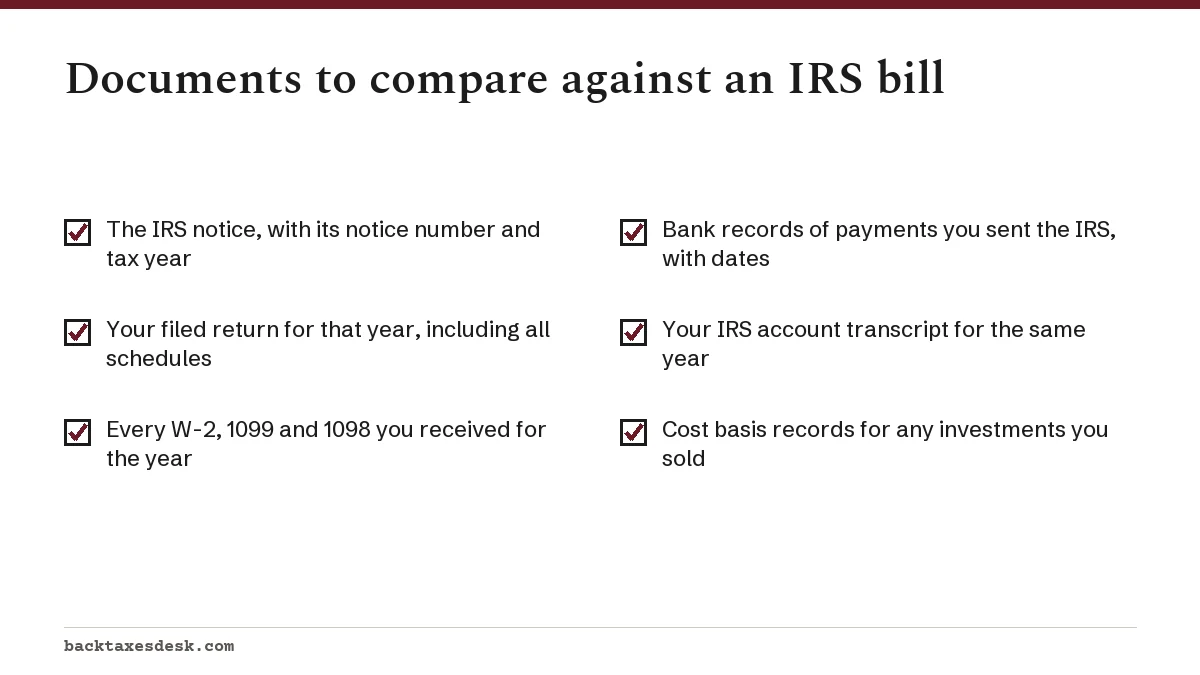
- Find the notice number and tax year, then confirm the balance in your IRS online account, which also shows your payments and certain notices.
- Pull your account transcript for that year to see each assessment, penalty and payment with dates.
- Compare the IRS figures with your copy of the return and every W-2 and 1099 you received.
- Check that all payments you made (including estimated payments and extension payments) were credited to the right year.
- Reply by the date on the notice, in the way the notice asks, with copies (never originals) of your proof.
- If the letter is a CP3219A, you have 90 days (150 if addressed outside the US) to petition the Tax Court, and that deadline cannot be extended.
If the tax is correct but you cannot pay it all, the question changes from "why" to "how." Start with our guide to paying back taxes, and remember that paying what you can now reduces both penalty and interest.
Common questions
Why do I suddenly owe the IRS when I never did before?
The most common causes are a new source of income without withholding (freelance work, unemployment, a retirement withdrawal) or a second job. A CP2000 for a year you thought was settled can also arrive a year or more later.
What does it mean to owe back taxes?
It means tax from a past year is still unpaid after its due date. The balance usually includes the original tax plus failure-to-pay penalties and daily compounded interest.
Why do people owe back taxes after getting a refund in past years?
A refund in one year does not mean withholding is right in the next. Income changes, a missed 1099 or a change in filing status can turn a refund year into a balance-due year.
Is a CP2000 a bill I have to pay right away?
No. A CP2000 is a proposal. You can agree, disagree with documents, or amend, and the IRS only assesses the tax after it reviews your reply or the response date passes.
How can I see why the IRS says I owe?
Log in to your IRS online account to view the balance by year, then pull the account transcript. The transcript lists each tax assessment, penalty, interest charge and payment with dates, so you can see what created the balance.
Sources
- Topic 653, IRS notices and bills, penalties and interest charges irs.gov
- Understanding your CP2000 notice irs.gov
- Understanding your CP11 notice irs.gov
- Understanding your CP22A notice irs.gov
- Quarterly interest rates irs.gov
- Time IRS can assess tax irs.gov
We check figures against these official pages. Rules change; confirm anything that affects a deadline or payment with the agency before you act.
Tell us what happened
Describe your situation and our editors will use it to improve this guide. If you leave your email, we may reply with a pointer to the right page or official contact. We never share your details.
Related guides
 Back Taxes: What to Do When You Owe the IRS Money Now
Back taxes are federal taxes that were due in an earlier year and are still unpaid, plus the penalties and interest added since.…
 CP2000 Notice: IRS Says Your Income Doesn't Match Records
A CP2000 notice is an IRS proposal to change your return because income or payment information from employers, banks or brokers d…
IRS Notice CP22A: You Owe After a Change to Your Return
A CP22A notice means the IRS changed your tax return because you asked it to, usually through an amended return, and the change l…
What Happens If You Don't Pay Taxes: The IRS Timeline
What happens if you don't pay taxes is a slow, predictable escalation. A 0.5% monthly penalty and daily interest start after the…
How to Pay Back Taxes to the IRS: Every Payment Method
The cheapest way to pay back taxes is from a bank account through IRS Direct Pay or your IRS Individual Online Account, which are…
CP11 Notice: IRS Math Error Correction and What You Owe
A CP11 notice means the IRS corrected one or more mistakes it found on your tax return, such as a math error or a missing Social…