
Will the IRS take my refund if I owe back taxes? Offsets and CP49
Short answer
Yes. The IRS will take your refund if you owe back taxes: it applies the federal refund to the balance and sends you only what is left, and it keeps doing so while you are on a payment plan or in hardship status. A CP49 notice explains the offset, and any remainder arrives by check. A hardship request made before the offset is the main way to keep some of the money.
- 01Refund while on a payment plan
- Applied to your tax debt until it is paid in full
- 02Notice you receive
- CP49, refund used to pay a tax debt
- 03Leftover refund
- Check within 3 weeks, unless other taxes or debts apply
- 04Hardship exception
- Offset bypass refund, requested before the offset
- 05Non-tax offsets
- Treasury Offset Program, 800-304-3107
Will the IRS take my refund if I owe back taxes?
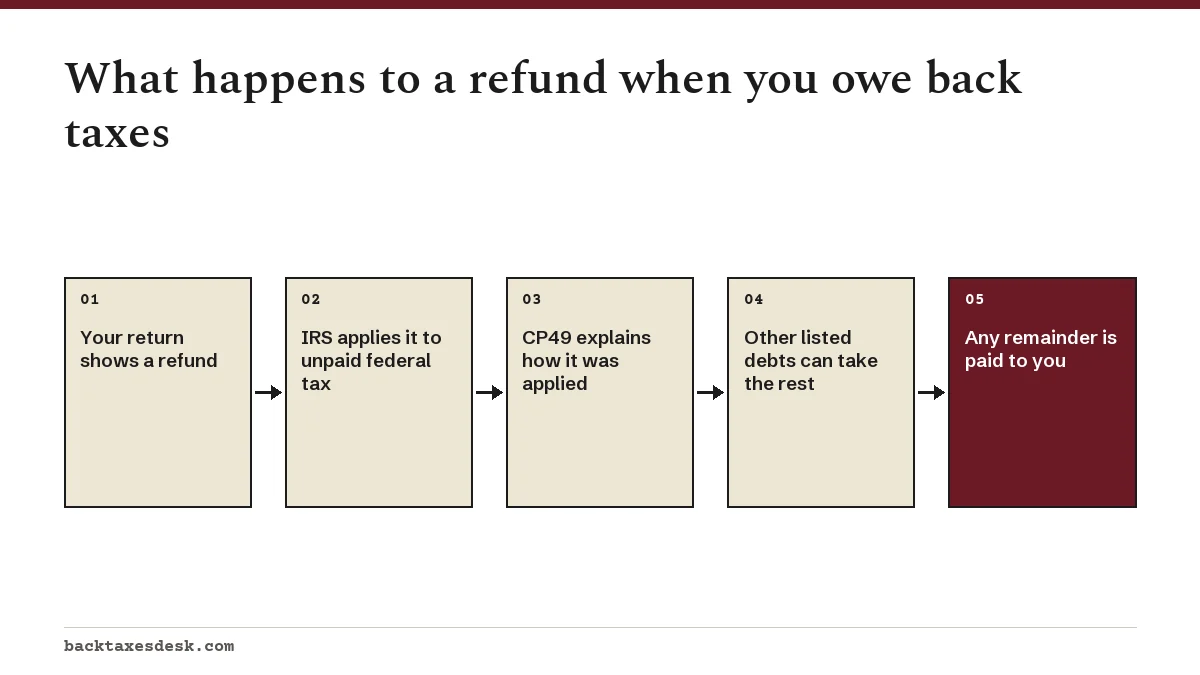
Yes, in almost every case. When your return shows an overpayment and you still owe federal tax for another year, the IRS applies the overpayment to that balance first and sends you only what is left. This happens automatically while the return is processed, and the CP49 notice that explains it arrives afterward.
The IRS states it plainly on its payment plan pages: your future refunds will be applied to your tax debt until it is paid in full. That is true whether you owe for one old year or several, and it continues until the balance, including penalties and interest, reaches zero.
Will the IRS take my refund if I have a payment plan?
Yes. Keeping your refunds is not part of the deal. The IRS applies future refunds to the balance while the plan runs, and it tells you to make all scheduled payments even when a refund has been applied. A refund lowers what you owe; it does not count as a monthly payment or let you skip one.
The same is true in the other arrangements people use for back taxes:
- Currently not collectible status: any federal refund is still applied to the unpaid balance while collection is paused. See currently not collectible.
- Offer in compromise: the IRS keeps refunds for returns assessed before it accepts the offer, and they do not count as offer payments. See offer in compromise.
- Bankruptcy: the automatic stay generally prevents an offset, but the IRS may freeze the refund until the stay is lifted, and it can still offset a pre-petition income tax refund against a pre-petition income tax debt (Publication 908). See tax debt and bankruptcy.
What does a CP49 notice mean?
A CP49 notice is the IRS telling you it used all or part of your refund to pay a tax debt. It explains how the refund was applied. If part of the refund was left over, the IRS says you will receive a check for the remaining amount within 3 weeks, unless you owe other taxes or debts it is required to collect.
What to do next depends on what is still owed:
- Nothing left owing: keep the notice with your tax records and watch for any leftover refund check.
- A balance remains and you already have a payment plan for it: keep making your payments as scheduled, as the notice instructs.
- A balance remains and you have no plan: pay online, or set up a payment plan. If you cannot pay, ask about an offer in compromise or a temporary delay in collection.
- You disagree with the offset: call the number on the notice and have your paperwork ready, such as the tax return or an amended return.
One timing quirk: if you paid your full balance in the 21 days before the notice and your account now shows a credit, the IRS says it will refund that credit as long as you owe no other taxes or debts it must collect.
Can I keep my refund if I owe back taxes and face a hardship?
Sometimes. The IRS has discretion to skip the offset and pay you an offset bypass refund (OBR) when you show economic hardship, such as needing the money for rent to avoid eviction or to keep a utility from being disconnected. The amount is limited to the hardship. In the Taxpayer Advocate Service's example, a $1,000 hardship on a $4,000 refund means $1,000 is paid to you and the remaining $3,000 goes to the tax debt.
Timing decides the outcome. The request must be made before the IRS applies the refund; once the refund has been used to pay the debt, an OBR is no longer available. If you expect a refund and are facing a hardship, gather proof of the hardship and ask as early as you can. The Taxpayer Advocate Service suggests e-filing and making the request right away if you need the money quickly, or filing on paper, which takes longer to process, if you need more time to gather documents.
If the IRS does not act in time, the Taxpayer Advocate Service can help. Send Form 911 with a copy of your completed return to your local TAS office, then call to confirm it was received and assigned. The return itself must still be filed with the IRS; sending it to TAS does not count as filing.
What other debts can take my federal refund?
Federal tax is not the only claim on a refund. The Treasury's Bureau of the Fiscal Service runs the Treasury Offset Program, which can reduce a federal refund for these debts:
- Past-due child support
- Debts owed to other federal agencies, such as a student loan
- State income tax owed
- Certain state unemployment compensation debts
For these offsets, the Bureau of the Fiscal Service mails the notice. It shows the original refund, the amount taken and the agency that received it. The IRS does not receive those details, so questions about the debt go to the agency named on the notice. If no notice arrived, call the Treasury Offset Program at 800-304-3107 (TTY/TDD 800-877-8339). Contact the IRS only if the refund amount on the notice does not match your return.
A state refund is exposed too. After a CP504 notice of intent to levy, the IRS can levy your state tax refund for federal back taxes without offering a hearing first. Our CP504 notice page explains what that letter allows.
How can I protect next year's refund?
The only sure way is to clear the balance. Until then, these steps keep an offset from catching you off guard when you file your 2026 return in early 2027:
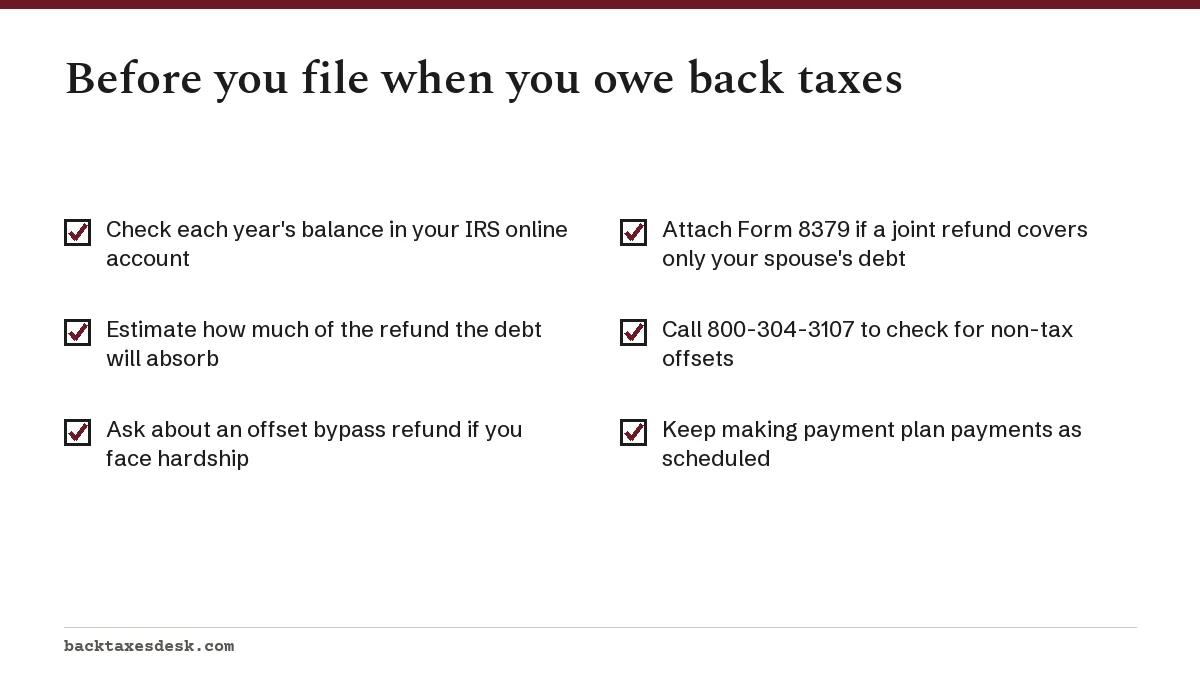
- Check your balance by year in your IRS online account before you file, so you know how much of the refund the debt will absorb. Our owe IRS money page explains how to read it.
- If losing the refund would cause a hardship, ask for an offset bypass refund before the IRS applies it.
- If you file jointly and the debt belongs only to your spouse, attach Form 8379 to the return.
- Keep paying any payment plan as scheduled, whatever happens to the refund.
- File on time even if the whole refund will be taken. The refund still pays down the debt, and an unfiled year can block a payment plan.
The IRS has not yet announced when the 2027 filing season opens; it usually begins in late January. The offset rules above do not change with the season. For ways to pay down what is left after an offset, see how to pay back taxes.
Step by step
Check your balance
Look up what you owe by tax year in your IRS online account before you file.
Ask about hardship early
If losing the refund would cause a hardship, request an offset bypass refund before the IRS applies it.
Protect a spouse's share
On a joint return where the debt is only your spouse's, attach Form 8379.
Read the CP49
Check how the refund was applied and keep paying any payment plan as scheduled.
Common questions
Will the IRS take my refund if I am on a payment plan?
Yes. The IRS applies future refunds to your tax debt until it is paid in full, and you must keep making your monthly payments even after a refund has been applied.
How do I know if my refund was taken for back taxes?
The IRS mails a CP49 notice saying it used all or part of your refund to pay a tax debt and explaining how it was applied. Offsets for child support, student loans or state debts come with a notice from the Bureau of the Fiscal Service instead.
Can I get my refund back after the IRS applied it to back taxes?
Generally not, if the debt is valid. An offset bypass refund has to be requested before the offset happens. If the debt belonged only to your spouse on a joint return, Form 8379 can recover your share, and if you think the balance is wrong, call the number on the CP49.
Will I get a refund if I owe back taxes?
Only the part left after the debt is paid. If the refund is larger than everything you owe, the IRS sends the remainder by check, generally within 3 weeks of the CP49, unless other taxes or debts take it.
Can the IRS take my state refund for federal back taxes?
Yes. After a CP504 notice of intent to levy, the IRS can levy a state tax refund for federal tax debt without first offering a hearing.
Sources
- Payment plans; installment agreements irs.gov
- Understanding your CP49 notice irs.gov
- Topic no. 203, Reduced refund irs.gov
- Taxpayer Advocate Service: how to prevent a refund offset if you are experiencing economic hardship taxpayeradvocate.irs.gov
- Injured spouse relief irs.gov
- Understanding your CP504 notice irs.gov
- Form 656-B, Offer in Compromise Booklet irs.gov
- Publication 908, Bankruptcy Tax Guide irs.gov
We check figures against these official pages. Rules change; confirm anything that affects a deadline or payment with the agency before you act.
Tell us what happened
Describe your situation and our editors will use it to improve this guide. If you leave your email, we may reply with a pointer to the right page or official contact. We never share your details.
Related guides
 IRS Payment Plan: How It Works, Costs and Who Qualifies
An IRS payment plan lets you pay a tax bill over time: up to 180 days with no setup fee if you owe less than $100,000, or monthly…
Currently Not Collectible Status: IRS Hardship Explained
Currently not collectible (CNC) is an IRS account status that pauses most collection when paying anything toward your tax debt wo…
How to Pay Back Taxes to the IRS: Every Payment Method
The cheapest way to pay back taxes is from a bank account through IRS Direct Pay or your IRS Individual Online Account, which are…
What Happens If You Don't Pay Taxes: The IRS Timeline
What happens if you don't pay taxes is a slow, predictable escalation. A 0.5% monthly penalty and daily interest start after the…