
IRS installment agreement fees: what a payment plan costs to set up and change
Short answer
IRS installment agreement fees range from $0 to $178. A short-term plan of 180 days or less is free. A long-term plan costs $29 online with direct debit, $69 online without it, $107 by phone, mail or in person with direct debit, and $178 otherwise. Low-income taxpayers get the direct-debit fee waived. Interest usually costs far more than the fee.
- 01Short-term plan (180 days or less)
- $0
- 02Cheapest long-term plan
- $29, online with direct debit
- 03Most expensive setup
- $178, phone, mail or in person without direct debit
- 04Low-income threshold
- AGI at or below 250% of federal poverty guidelines
IRS installment agreement fees by method
IRS installment agreement fees, which the IRS calls user fees, depend on two choices: how you apply and how you pay each month. Applying online and paying by direct debit is the cheapest combination. Applying by phone, mail or in person and paying by check or card is the most expensive.
| Plan and method | Standard fee | Low-income fee |
|---|---|---|
| Short-term plan, 180 days or less, any method | $0 | $0 |
| Long-term, online, direct debit | $29 | Waived |
| Long-term, online, other payment method | $69 | $43, may be reimbursed |
| Long-term, phone, mail or in person, direct debit | $107 | Waived |
| Long-term, phone, mail or in person, other method | $178 | $43, may be reimbursed |
| Payroll deduction (Form 2159) | $178 | Not listed separately; ask the IRS |
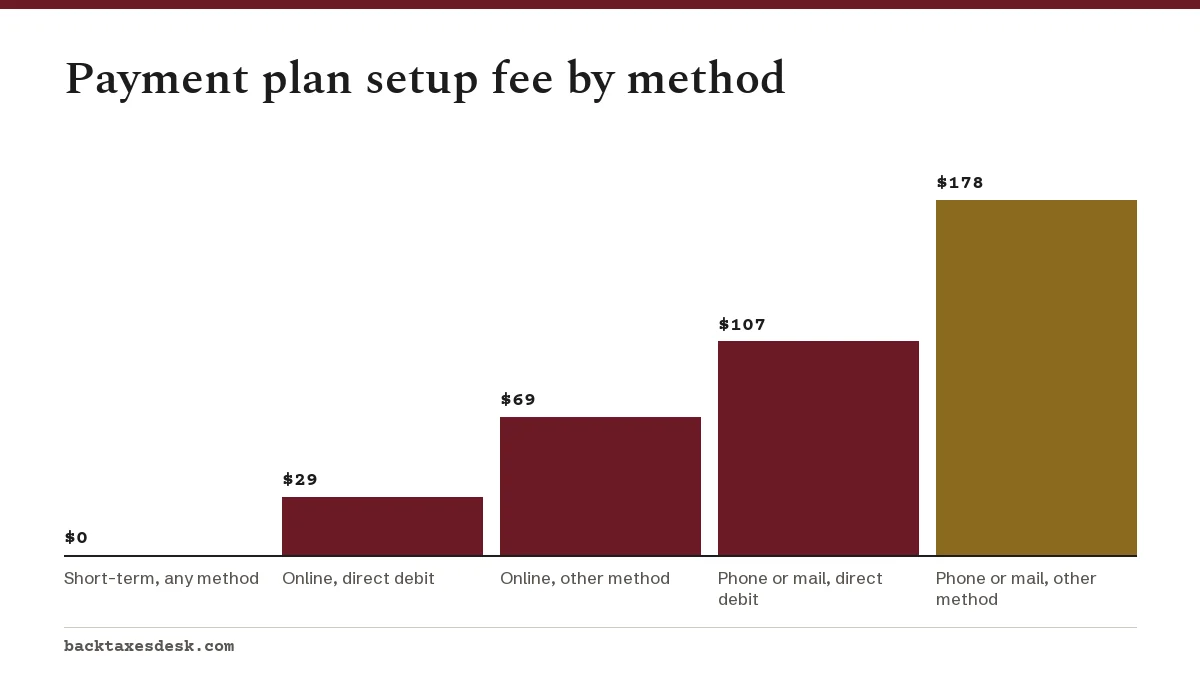
The gap between the cheapest and most expensive long-term setup is $149. For most people, switching to the online application and agreeing to direct debit is the single easiest cost cut. The Online Payment Agreement works for individuals who owe $50,000 or less in combined tax, penalties and interest.
Is there a fee for a short-term plan?
No. A short-term plan gives you up to 180 days to pay a balance under $100,000, and the IRS charges no setup fee no matter how you apply. Interest and the failure-to-pay penalty still apply until the balance is paid.
If you are close to the line, it can be cheaper to stretch your budget for six months than to take a long-term plan and pay a setup fee. Our short-term payment plan page explains how to request one.
The IRS payment plan fee waiver for low-income taxpayers
You count as low-income for this purpose if your adjusted gross income for the most recent year the IRS has on file is at or below 250% of the federal poverty guidelines for your household size. The IRS checks this when you apply.
- With direct debit: the setup fee is waived entirely, whether you apply online or by phone or mail.
- Without direct debit: you pay a reduced $43 fee. The IRS reimburses it when you finish the plan, if you meet the conditions. On Form 9465, checking line 13c asks for that reimbursement.
- If the IRS does not flag you as low-income: file Form 13844, Application for Reduced User Fee for Installment Agreements, to ask for a review.
Installment agreement user fee for changes and reinstatement
Once a plan is running, some changes cost money and some do not. The IRS online account lets you change the monthly amount, change the due date, convert to direct debit, update bank details and reinstate a plan after a default.
| Change | Online | Phone, mail or in person |
|---|---|---|
| Revise the plan (amount, date, reinstatement) | $6 | $89 |
| Revise, low-income | $6, may be reimbursed | $43, may be reimbursed |
| Change to or update direct debit | $0 | $0 |
A default notice such as CP523 warns that reinstatement may carry a fee. Fixing the problem online before the termination date is the lowest-cost path. If you let the plan terminate and apply for a new one, you may face a new setup fee instead.
How interest compares to fees
The setup fee is paid once. Interest and the failure-to-pay penalty are charged every month the balance is open, and they keep running on every plan until you pay in full.
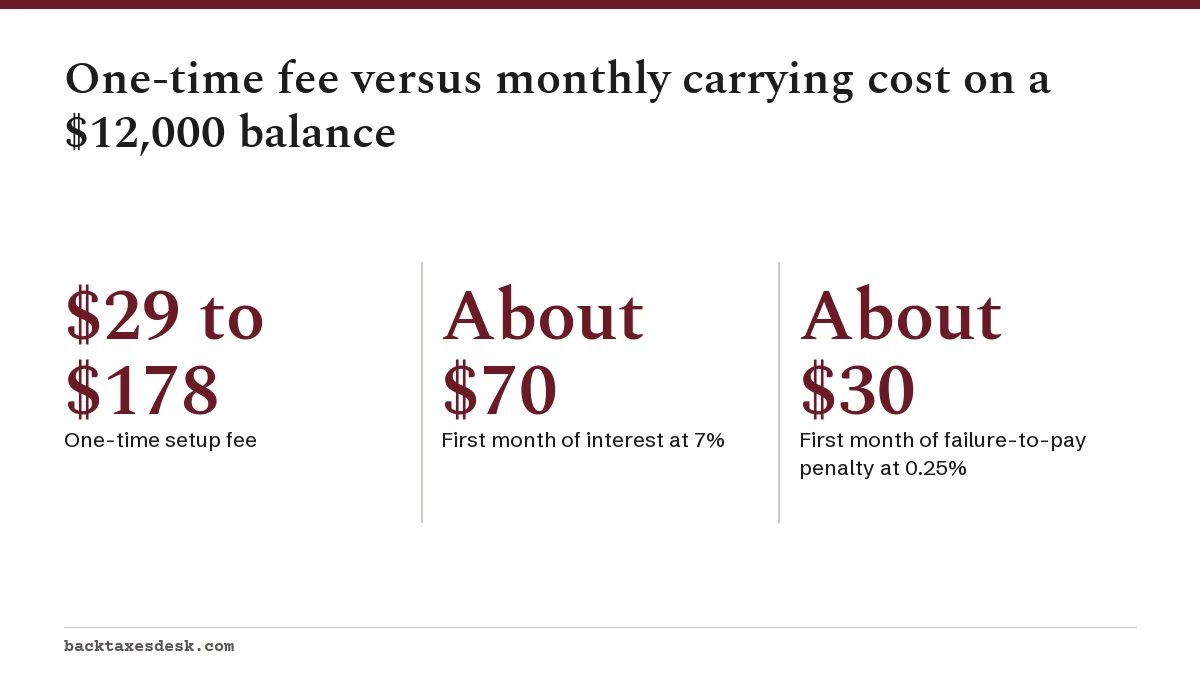
Take a $12,000 balance. At the 7% underpayment rate in effect for the fourth quarter of 2026, compounded daily, the first month of interest is roughly $70. If you filed on time and have an approved plan, the failure-to-pay penalty drops to 0.25% a month, about $30 on that balance. That is around $100 in the first month alone, compared with a one-time fee of $29 to $178.
The takeaway: a lower fee helps, but paying the balance down faster saves more. Every extra dollar you pay early stops interest on that dollar. The rate for January to March 2027 has not been announced yet; the IRS usually publishes the next quarter's rate in late November. Our underpayment interest rate page tracks each quarter, and the payment plan calculator estimates your total cost.
How much does an IRS payment plan cost in total?
Add three pieces: the setup fee, the interest on the declining balance, and the failure-to-pay penalty on the unpaid tax. The fee is fixed. The other two depend on how much you owe and how fast you pay.
- Choose the shortest term you can keep up with. A 36-month plan costs less in interest than a 72-month plan on the same balance.
- Apply online and choose direct debit to get the $29 fee.
- File every return on time while the plan is active, which keeps the 0.25% penalty rate and avoids default.
- Make extra payments whenever you can; there is no penalty for paying early.
- If a penalty was charged for a year with a clean history, ask whether first-time or automatic relief applies, because removing a penalty also removes the interest on it.
The IRS payment plan guide compares the plan types in full.
Common questions
How much does an IRS payment plan cost to set up?
Nothing for a short-term plan of 180 days or less. A long-term plan costs $29 to $178, depending on whether you apply online and whether you pay by direct debit.
Can the IRS installment agreement fee be waived?
Yes, for low-income taxpayers who agree to direct debit. Low-income taxpayers who cannot use direct debit pay $43, which may be reimbursed when the plan is completed.
Is there a fee to reinstate an IRS payment plan?
Usually. Revising or reinstating a plan costs $6 online or $89 by phone, mail or in person; low-income taxpayers pay $6 online or $43 otherwise, which may be reimbursed.
Is the installment agreement user fee higher if I mail Form 9465?
Yes. A mailed Form 9465 falls in the phone, mail or in-person bracket: $107 with direct debit or $178 without. The same plan requested online costs $29 or $69.
Does it cost anything to switch my plan to direct debit?
No. Converting an existing plan to direct debit, or updating the bank account on file, has no fee.
Sources
- Payment plans, installment agreements irs.gov
- Instructions for Form 9465 irs.gov
- Quarterly interest rates irs.gov
- Failure to pay penalty irs.gov
We check figures against these official pages. Rules change; confirm anything that affects a deadline or payment with the agency before you act.
Tell us what happened
Describe your situation and our editors will use it to improve this guide. If you leave your email, we may reply with a pointer to the right page or official contact. We never share your details.
Related guides
 IRS Payment Plan: How It Works, Costs and Who Qualifies
An IRS payment plan lets you pay a tax bill over time: up to 180 days with no setup fee if you owe less than $100,000, or monthly…
IRS Payment Plan Calculator: Estimate Your Monthly Payment
This IRS payment plan calculator estimates your monthly payment from your balance, the number of months and the charges that keep…
IRS Interest Rate on Underpayment: How the Daily Rate Is Set
The IRS interest rate on underpayments for individuals is the federal short-term rate plus 3 percentage points, reset each quarte…
IRS Short-Term Payment Plan: 180 Days With No Setup Fee
An IRS short-term payment plan gives you up to 180 days to pay your full balance, with no setup fee, if you owe less than $100,00…
How to Set Up an IRS Payment Plan Online, by Phone or Mail
To set up an IRS payment plan, first make sure every required return is filed, then apply through the Online Payment Agreement to…