
Partial payment installment agreement: paying what you can until the IRS deadline runs out
Short answer
A partial payment installment agreement (PPIA) is an IRS payment plan for people who cannot pay their full tax debt before the 10-year collection period ends. You pay the most you can afford each month; whatever is still unpaid when the collection statute expires is no longer collectible. It requires full financial disclosure, and the IRS reviews your finances about every two years.
- 01Who it is for
- People who cannot pay in full before the collection statute expiration date (CSED)
- 02Financial statement
- Full collection information statement required
- 03Payment amount
- The maximum you can pay based on ability to pay
- 04Reviews
- Financial review about every two years
What a partial payment installment agreement is
A partial payment installment agreement is a monthly plan in which the payments, added together, will not cover the whole debt before the IRS runs out of time to collect. The IRS generally has 10 years from the date a tax is assessed to collect it. That end point is the collection statute expiration date, or CSED.
Congress allowed this kind of agreement in 2004 by amending section 6159 of the Internal Revenue Code. Before that, an installment agreement had to pay the balance in full. A PPIA accepts that full payment is not realistic and sets the payment at what your budget can bear.
It is not a settlement. The full debt stays on the books, interest and penalties keep accruing, and the IRS can raise your payment if your income improves. What you gain is a formal agreement that generally keeps levies on hold while you comply, and a finish line set by the CSED.
Who qualifies for a PPIA
The IRS partial payment installment agreement requirements come down to two tests: you cannot pay the debt in full by the CSED, and you have no reasonable way to raise the money from assets. The Internal Revenue Manual (IRM 5.14.2) spells out both.
- Current on filing. As with any installment agreement, all required returns must be filed.
- Full financial disclosure. The IRM requires a complete collection information statement for every PPIA, usually Form 433-A (or Form 433-F in some cases), with proof of income, expenses and assets.
- Equity addressed first. Before approving a PPIA, the IRS expects you to use equity in assets, such as selling or borrowing against property, when that is realistic.
- Maximum payment. You must agree to pay the most you can afford each month, based on the financial analysis.
When you do not have to sell or borrow
The IRM lists situations where a PPIA can be granted even though you own something with equity. These include equity that is minimal, equity you cannot legally reach, an asset nobody would buy, an asset you need to earn a living, a sale that would cause economic hardship, and a loan whose payment would be more than the income you have left over. Otherwise, you will normally be asked to make a good-faith attempt to use the equity first.
How to request a partial pay installment agreement
There is no separate PPIA application. You ask for an installment agreement and offer a payment that will not clear the balance by the CSED. The IRS then reviews it as a partial payment request.
- Find your CSED for each tax year. Our CSED date page explains how to get it from your account transcript.
- Complete a collection information statement. See our Form 433-F guide; the IRS may also ask for Form 433-A.
- Gather proof: pay stubs, bank statements, rent or mortgage statements, vehicle loans and medical bills.
- Submit the request with Form 9465 by mail, by phone, or through the Revenue Officer assigned to your case. The Form 9465 instructions note that a payment that will not pay in full by the CSED may be considered for a PPIA.
- Respond quickly to any request for more information, since the review cannot finish without it.
Because every PPIA needs a full financial statement and an ability-to-pay analysis, expect it to be handled by IRS staff rather than approved automatically online. Our Form 9465 instructions cover the paper request.
Does a PPIA let the collection statute expire?
Yes, that is the point of it. If you keep the agreement and your finances do not improve, the unpaid remainder becomes uncollectible when the CSED passes. A worked example shows the effect.
Two details can move the finish line. First, the CSED is suspended while an installment agreement request is pending, and for 30 days after a rejection, so the clock pauses while the IRS reviews your request. Second, in limited situations the IRS may ask you to sign Form 900 to extend the CSED; the IRM caps such extensions at five years beyond the original CSED plus up to one year. Read any Form 900 carefully before signing. Our collection statute of limitations page covers the other events that pause the clock.
Will the IRS review my PPIA?
Yes. The IRM sets a financial review cycle of about two years for partial payment agreements. The IRS will ask for updated income, expense and asset details.
- If your ability to pay has not changed significantly, the payment stays the same until the statute expires.
- If your income rises or you acquire assets, the IRS can raise the payment, and in some cases the plan may move toward full payment.
- If your income falls, you can ask for a lower payment, or the IRS may consider hardship status instead.
PPIA versus an offer in compromise
Both options can leave part of the debt unpaid, but they work differently. An offer in compromise settles the debt now for a set amount; a PPIA lets the clock run out while you pay monthly.
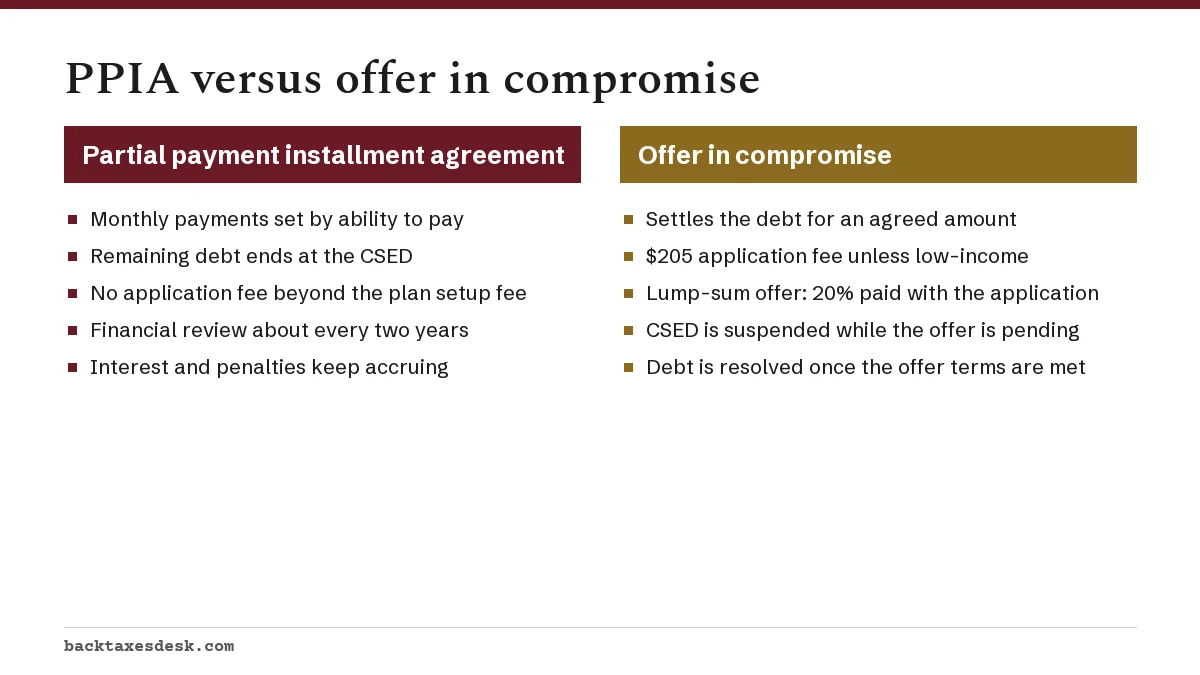
A PPIA tends to suit people with steady but limited income and several years left on the CSED. An offer may suit people who can raise a lump sum from family or a loan and want a clean end date. If you cannot afford any payment at all, Currently Not Collectible status is the other route to compare.
Living with a PPIA
The plan has the same basic conditions as any installment agreement. Pay on time, file every return on time, and pay each new year's tax in full. Breaking those terms can lead to a default notice and the loss of the plan.
Some benefits come with staying current. The failure-to-pay penalty drops to 0.25% a month if you filed on time, and debt in a timely paid installment agreement is not certified to the State Department for passport action. If the plan starts to slip, our payment plan not working page explains how to ask for changes before a default. The IRS payment plan guide compares PPIAs with the standard plans.
Common questions
What is a partial payment installment agreement with the IRS?
It is a monthly payment plan that will not pay the full tax debt before the IRS collection period ends. You pay the maximum you can afford, and the remaining balance becomes uncollectible when the collection statute expires.
How much do you have to pay on a PPIA?
There is no fixed minimum. The IRS sets the payment from your collection information statement, and you must agree to pay the maximum your budget allows after allowable living expenses.
Does the IRS file a tax lien with a PPIA?
It can. The IRM tells IRS staff to decide on filing a Notice of Federal Tax Lien for PPIA cases above certain balance levels, so expect that a lien may be filed.
Is a PPIA better than an offer in compromise?
It depends on your cash and your CSED. An offer settles the debt sooner but needs money up front and a $205 application fee; a PPIA needs no lump sum but lasts until the statute expires and is reviewed every two years.
Can I get a PPIA online?
Plan on handling it with IRS staff. A PPIA requires a full collection information statement and a review of your finances, which happens by mail, by phone or with a Revenue Officer.
Sources
- IRM 5.14.2, Partial Payment Installment Agreements and the Collection Statute irs.gov
- Instructions for Form 9465 irs.gov
- Time IRS can collect tax irs.gov
- Taxpayer Advocate Service: installment agreements taxpayeradvocate.irs.gov
- Offer in compromise irs.gov
We check figures against these official pages. Rules change; confirm anything that affects a deadline or payment with the agency before you act.
Tell us what happened
Describe your situation and our editors will use it to improve this guide. If you leave your email, we may reply with a pointer to the right page or official contact. We never share your details.
Related guides
 IRS Payment Plan: How It Works, Costs and Who Qualifies
An IRS payment plan lets you pay a tax bill over time: up to 180 days with no setup fee if you owe less than $100,000, or monthly…
Offer in Compromise: How to Settle IRS Debt for Less
An offer in compromise is an agreement to settle IRS tax debt for less than the full balance. The IRS accepts one only when your…
IRS Statute of Limitations on Collection: The 10-Year Rule
The statute of limitations on IRS collection is generally 10 years from the date a tax is assessed, not from the year it was owed…
IRS Payment Plan Not Working Online? Fixes and Alternatives
When an IRS payment plan is not working online, the cause is usually one of five things: a missing tax return, a balance above th…
Form 433-F: IRS Collection Information Statement Guide
Form 433-F is the IRS Collection Information Statement, a short financial snapshot the IRS uses to decide how much you can pay ea…
Currently Not Collectible Status: IRS Hardship Explained
Currently not collectible (CNC) is an IRS account status that pauses most collection when paying anything toward your tax debt wo…