
Can the IRS garnish wages from Social Security benefits?
Short answer
Can the IRS garnish wages from Social Security? Yes. Through the Federal Payment Levy Program the IRS can generally take up to 15% of each Social Security retirement, survivor or disability payment until a tax debt is paid, released or expires. Supplemental Security Income (SSI) is exempt by law, and a final notice with hearing rights must come first.
- 01Maximum automatic levy on benefits
- 15% of each payment, or the amount owed if less
- 02Benefits exempt from levy
- Supplemental Security Income (SSI)
- 03Final notice before the levy
- CP90 or CP297, with 30 days to request a hearing
- 04How long it lasts
- Until paid, released or the 10-year collection period ends
Which Social Security benefits are protected from an IRS levy?
Supplemental Security Income is protected from IRS levy. Section 6334(a)(11) of the tax code exempts public assistance paid under title XVI of the Social Security Act, which is the SSI program for aged, blind and disabled people with limited income.
Benefits paid under title II are different. Publication 594 names Social Security benefits under title II (Old-Age, Survivors and Disability Insurance, or OASDI) as payments the FPLP can reach. That means retirement benefits, survivor benefits and Social Security Disability Insurance (SSDI) can all be levied, even though SSI cannot.
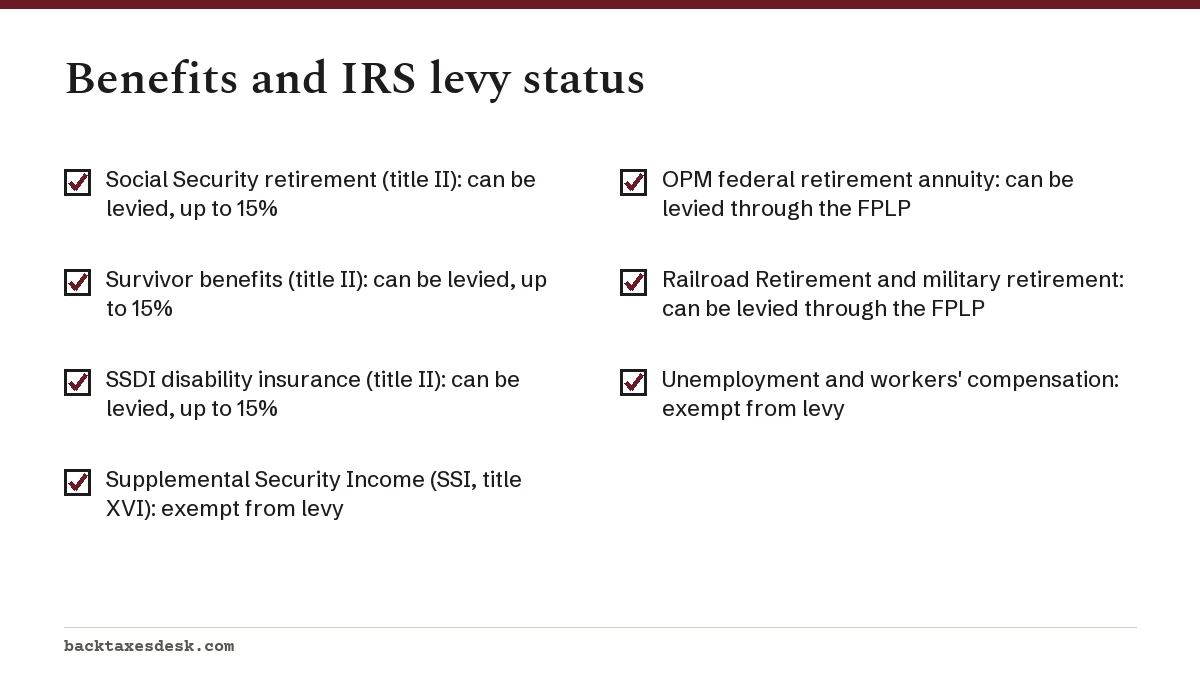
Other income sources have their own rules. Federal retirement annuities from the Office of Personnel Management, Railroad Retirement Board benefits and military retirement pay are on the FPLP list. Unemployment benefits, workers' compensation and certain service-connected disability payments are exempt under Publication 594, as explained in our overview of what an IRS levy is.
Which notices come before the IRS takes Social Security?
The IRS must send a final notice with hearing rights before the FPLP levy starts. The IRS says the notice for this program is the Final Notice, Notice of Intent to Levy and Notice of Your Right to a Hearing, issued as CP90 or CP297. Earlier balance-due bills usually arrive first.
- CP14, the first bill, showing the balance and a due date.
- CP501 and CP503, reminders that the balance is still unpaid.
- CP504, a notice of intent to levy that lists Social Security benefits among the income the IRS may take.
- CP90 or CP297, the final notice for federal payment levies, which starts a 30-day window to request a Collection Due Process hearing on Form 12153.
- About a month or more later, the Social Security payment arrives smaller, and the Social Security Administration payment notice may show the reduction.
Our CP90 notice page explains that final notice in detail. The IRS collection process hub shows where the benefit levy fits among liens, bank levies and other tools.
Some people also receive a CP91 notice. The IRS uses it to say it intends to levy up to 15% of your Social Security benefits for unpaid taxes. Its advice is to pay the balance or request a payment plan by the date on the notice, and to call the IRS number on the notice rather than the Social Security Administration, which cannot stop the levy or resolve the tax debt.
Common questions
Can the IRS take my entire Social Security check?
No. Under the Federal Payment Levy Program the IRS takes generally up to 15% of each Social Security payment, or the remaining balance if that is smaller. The other 85% or more is still paid to you.
Can the IRS levy SSDI for back taxes?
Yes. Social Security Disability Insurance is paid under title II of the Social Security Act, which Publication 594 lists as reachable by the Federal Payment Levy Program. SSI, which is paid under title XVI, is exempt.
Does the Social Security Administration decide the levy?
No. The IRS decides whether a levy applies and how long it runs. The Treasury's Bureau of the Fiscal Service withholds the amount from the payment, so questions about the tax debt should go to the IRS, not to Social Security.
Will the IRS give back Social Security it already took?
Money already levied is usually applied to the debt and not refunded. The IRS may return levied money in limited cases, such as a levy issued in error or against exempt SSI, and a request for return is generally due within 9 months.
Does a payment plan stop the Social Security levy?
Usually. Making an alternative payment arrangement is one of the IRS's listed reasons to exclude a payment from the FPLP, and Publication 594 says the IRS must release a levy when an agreement's terms do not allow it to continue.
Can the IRS take Social Security if I am over 65?
Age alone does not protect benefits. What matters is the type of benefit and your finances: SSI is exempt, and a hardship finding can stop a levy on retirement benefits for people who cannot cover basic living expenses.
What is a CP91 notice?
A CP91 is an IRS notice saying it intends to levy up to 15% of your Social Security benefits for unpaid taxes. Pay or request a payment plan by the date on the notice, and call the IRS number on it, because the Social Security Administration cannot stop the levy.
Sources
- Federal Payment Levy Program irs.gov
- Publication 594, The IRS Collection Process irs.gov
- 26 U.S. Code 6334, Property exempt from levy uscode.house.gov
- Understanding your CP504 notice irs.gov
- Temporarily delay the collection process irs.gov
- Understanding your CP91 notice irs.gov
- SSA fact sheet: 2027 cost-of-living adjustment ssa.gov
We check figures against these official pages. Rules change; confirm anything that affects a deadline or payment with the agency before you act.
Tell us what happened
Describe your situation and our editors will use it to improve this guide. If you leave your email, we may reply with a pointer to the right page or official contact. We never share your details.
Related guides
 IRS Collection Process: Liens, Levies and Your Rights
The IRS collection process starts with a bill (usually Notice CP14) and escalates through reminder notices to a Final Notice of I…
IRS Levy: What the IRS Can Take and How to Stop It
An IRS levy is the legal seizure of your property or rights to property, such as wages, bank balances, Social Security payments o…
Currently Not Collectible Status: IRS Hardship Explained
Currently not collectible (CNC) is an IRS account status that pauses most collection when paying anything toward your tax debt wo…
IRS Seizure of Property: Can the IRS Take Your House or Car?
An IRS seizure of property is a levy that takes a house, car or other asset and sells it to pay unpaid federal tax. It can happen…
IRS Notice CP90: Final Levy Notice and Your Hearing Rights
A CP90 notice from the IRS is a final notice of intent to levy that also tells you of your right to a Collection Due Process hear…