
Innocent spouse relief: who qualifies and how to file Form 8857
Short answer
Innocent spouse relief lets you avoid tax, interest and penalties caused by a spouse or former spouse's errors on a joint return. You apply on Form 8857, and the IRS checks you for all three types: innocent spouse relief, separation of liability and equitable relief. The first two generally must be requested within 2 years of the IRS's first collection attempt against you.
- 01Form
- Form 8857, Request for Innocent Spouse Relief
- 02Deadline, innocent spouse and separation of liability
- Generally 2 years after the first IRS collection attempt against you
- 03Deadline, equitable relief on a balance due
- While the 10-year collection period is still open
- 04Typical review time
- About 6 months, sometimes longer
- 05Appeal a determination
- Within 30 days of the determination letter
- 06Tax Court petition
- Within 90 days of the final determination letter
What innocent spouse relief covers
When you sign a joint return, both spouses are each responsible for the full tax, even after a divorce. Innocent spouse relief is the IRS process that can release you from tax, interest and penalties that trace back to your spouse or former spouse. A divorce decree that says your ex will pay does not bind the IRS, so this is the federal route.
You make one request on Form 8857, and the IRS weighs it under all three types of relief. You do not have to pick the right type yourself, but knowing which one fits helps you explain your case clearly.
The three types of relief and innocent spouse relief requirements
Innocent spouse relief
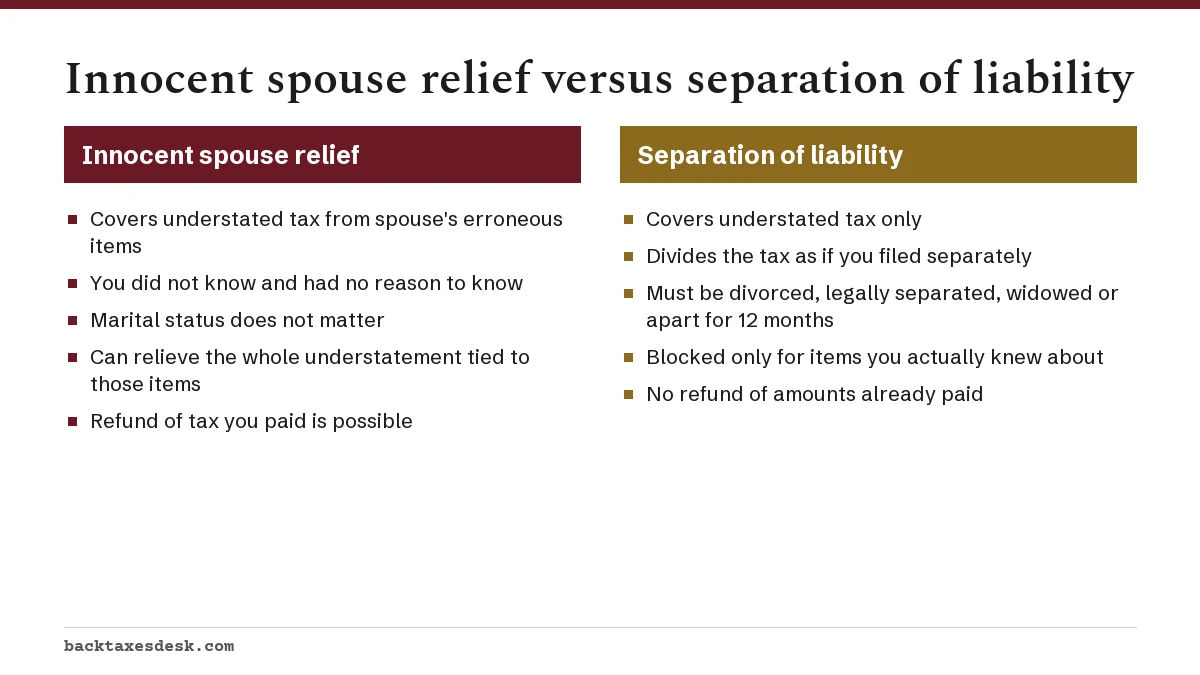
This type removes tax added because your spouse left out income or claimed deductions or credits wrongly. The Form 8857 instructions list four innocent spouse relief requirements, and you must meet all of them.
- You filed a joint return for the year.
- The return understated the tax because of erroneous items of your spouse or former spouse.
- When you signed, you did not know and had no reason to know the tax was understated.
- Considering all the facts, it would be unfair to hold you liable.
Separation of liability relief
Separation of liability relief splits the understated tax between you and your spouse as if you had filed separately, so you pay only the part tied to your own items. You qualify only if you are divorced, legally separated, widowed, or have lived apart for the full 12 months before you file Form 8857. It does not cover items you actually knew about when you signed.
Equitable relief from the IRS
Equitable relief is the fallback when you do not qualify for the other two. It is the only type that can cover an underpayment, meaning tax that was correctly shown on the return but never paid, as well as an understatement. The test is whether, given all the facts, it would be unfair to hold you responsible.
Form 8857 asks detailed questions about your marriage, finances and what you knew, and your answers are the evidence the IRS weighs. Be specific and consistent. Our tax debt relief options page covers other routes if relief is denied.
Can I get relief if I knew about the error?
Usually not under innocent spouse relief. You are shut out if you had actual knowledge of the error, or if a reasonable person in your position would have known. Separation of liability likewise does not reach items you actually knew about.
There is an important exception. If you were a victim of spousal abuse or domestic violence before signing the return, and you did not challenge the items because you feared retaliation, the IRS may grant relief even though you knew. Describe what happened on Form 8857 and include any documents you have, such as protective orders, police reports or statements from a counselor.
Relief is also not available for years where you already signed an offer in compromise or a closing agreement covering the same tax. If you are weighing an offer in compromise, note that the IRS asks you to resolve any open innocent spouse claim before it will look at an offer.
Deadlines to file Form 8857
The deadline depends on the type of relief and on whether you want money back or want a balance removed. Missing the 2-year window does not always end your case, because equitable relief has longer limits.
| Type of relief | Deadline |
|---|---|
| Innocent spouse relief | No later than 2 years after the first IRS attempt to collect the tax from you |
| Separation of liability | No later than 2 years after the first IRS attempt to collect the tax from you |
| Equitable relief, unpaid balance | Any time the IRS can still collect, generally within the 10-year collection period |
| Equitable relief, refund of tax paid | Within 3 years after the return was filed or 2 years after the tax was paid, whichever is later |
The Form 8857 instructions count as collection activity a section 6330 notice (the pre-levy notice of your right to a hearing), an offset of your refund against a joint debt from another year, a suit against you, or an IRS claim in a court case. Check the dates on letters addressed to you, not just to your former spouse. Separate rules apply to relief from community property laws: file no later than 6 months before the assessment period ends, or within 30 days of IRS contact about an examination.
The community property states are Arizona, California, Idaho, Louisiana, Nevada, New Mexico, Texas, Washington and Wisconsin. If you lived in one of them and did not file jointly, you may still ask for relief on Form 8857 from how state law divided income.
Filing Form 8857 step by step
- Get the current Form 8857 and its instructions from IRS.gov, and list each tax year you want relief for.
- Answer the questions about your marriage, education, finances, your involvement in household money matters, and what you knew when you signed.
- Explain in your own words why it would be unfair to hold you liable, and describe any abuse along with whatever records you have.
- Attach supporting papers: divorce or separation decree, proof of a separate address, and records showing who handled the finances.
- Mail it to Internal Revenue Service, P.O. Box 120053, Covington, KY 41012, or fax it to the number in the instructions. Do not attach it to your tax return or send it to the Tax Court.
- Keep a copy and proof of the mailing date.
How long the IRS takes and what happens while you wait
The IRS says a review can take about 6 months, and sometimes longer. It first confirms the form is complete, then sends a questionnaire to the other spouse and gathers records. Answer any letter by its deadline, since missing information is a common cause of delay.
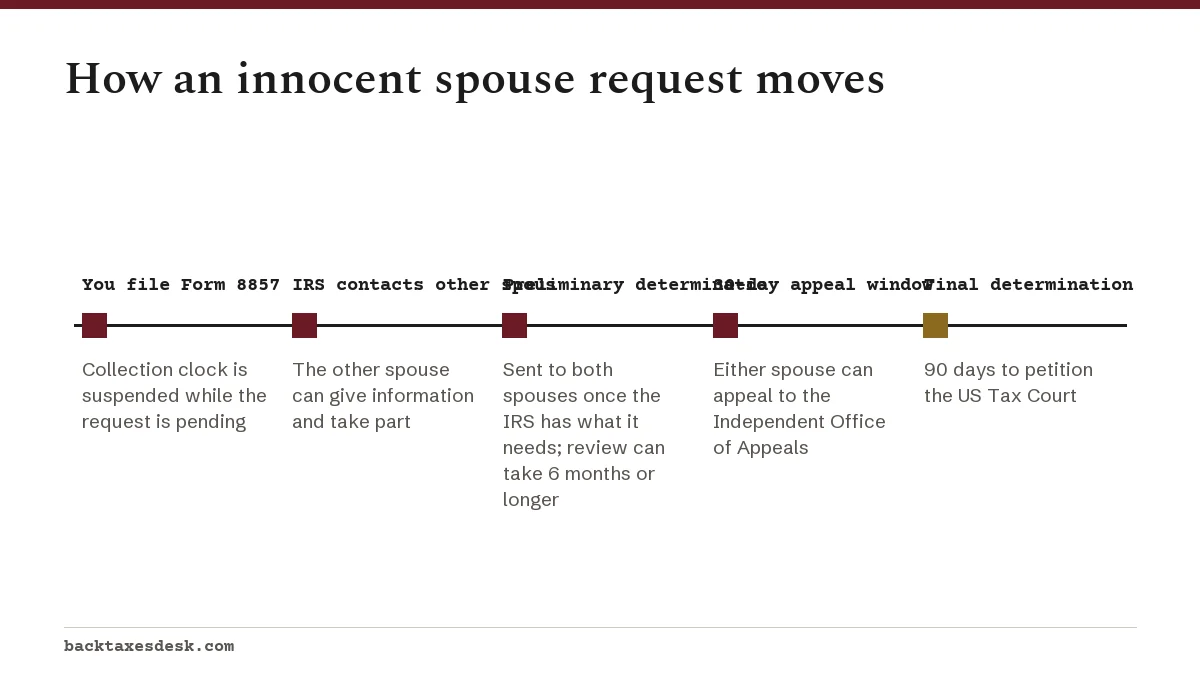
While the request is pending, the 10-year collection clock is suspended, as explained on our IRS collection statute of limitations page. Interest keeps growing on any balance that is not relieved, so paying undisputed amounts can still make sense.
Review, appeal and Tax Court
Once the IRS has the information it needs, it sends a preliminary determination letter to both of you. Either spouse can appeal to the IRS Independent Office of Appeals within 30 days of the date on that letter. After that you receive a final determination letter.
If you disagree with the final determination, you can petition the US Tax Court no later than the 90th day after the IRS mails that letter. You can also petition if you have not received a final determination within 6 months of filing Form 8857. The filing fee is $60 and can be waived; see our Tax Court petition guide.
Free help is available. A Low Income Taxpayer Clinic represents people below certain income levels in disputes with the IRS for free or a small fee, and the Taxpayer Advocate Service can step in if the request stalls and causes hardship.
Step by step
Check the type of problem
Decide whether the issue is understated tax from your spouse's items or tax that was reported but not paid.
Check the deadline
Find the date of the first IRS collection attempt against you and confirm you are within 2 years, or within the equitable relief limits.
Complete Form 8857
Answer every question and explain why holding you liable would be unfair, including any history of abuse.
Attach documents
Include divorce or separation papers, proof of separate residence, and records of who managed household finances.
Send it to the IRS
Mail or fax Form 8857 to the address in the instructions, not with your return or to the Tax Court, and keep proof of sending.
Respond and appeal if needed
Answer IRS letters on time, appeal a preliminary determination within 30 days, and petition the Tax Court within 90 days of a final determination if you disagree.
Common questions
Who qualifies for innocent spouse relief?
Someone who filed a joint return that understated tax because of the other spouse's erroneous items, who did not know or have reason to know about them, and for whom it would be unfair to be held liable. Those who do not meet this may still get separation of liability or equitable relief.
Can I file Form 8857 if I am still married?
Yes. Innocent spouse relief and equitable relief do not require divorce. Separation of liability relief does require that you are divorced, legally separated, widowed, or have lived apart for the 12 months before filing.
Will my ex find out I filed for innocent spouse relief?
Yes. The IRS is required by law to contact the other spouse or former spouse and allow them to take part, with no exceptions. The IRS does not disclose your current name, address, phone number, employer, income or assets to them.
Does innocent spouse relief cover unpaid tax that was shown on the return?
Only equitable relief can cover an underpayment of tax that was reported correctly but not paid. Innocent spouse and separation of liability relief apply to understated tax from erroneous items.
Can I get a refund through innocent spouse relief?
Refunds are possible under innocent spouse relief and equitable relief if you paid the tax, as long as you file within the refund time limits. Separation of liability relief does not produce refunds of amounts already paid.
Sources
- Innocent spouse relief irs.gov
- Instructions for Form 8857 irs.gov
- Time IRS can collect tax irs.gov
- US Tax Court: starting a case ustaxcourt.gov
- Form 656-B, Offer in Compromise Booklet irs.gov
We check figures against these official pages. Rules change; confirm anything that affects a deadline or payment with the agency before you act.
Tell us what happened
Describe your situation and our editors will use it to improve this guide. If you leave your email, we may reply with a pointer to the right page or official contact. We never share your details.
Related guides
 How to File a Tax Court Petition: Deadline, Fee and Steps
A Tax Court petition asks the US Tax Court to review an IRS determination before you pay. For a notice of deficiency it must be f…
Low Income Taxpayer Clinic: Free IRS Representation Guide
A Low Income Taxpayer Clinic (LITC) is an independent, IRS-funded organization that represents low-income people in audits, appea…
Offer in Compromise: How to Settle IRS Debt for Less
An offer in compromise is an agreement to settle IRS tax debt for less than the full balance. The IRS accepts one only when your…
Taxpayer Advocate Service: Free Help When the IRS Is Stuck
The Taxpayer Advocate Service (TAS) is a free, independent organization within the IRS that steps in when a federal tax problem i…