
LT16 IRS notice: unpaid tax, missing returns and your next steps
Short answer
An LT16 from the IRS is a collection letter saying you have unpaid tax, unfiled returns, or both, and asking you to file and pay. It is not a final notice of intent to levy, but the IRS warns that levies and liens can follow. File any listed returns first, since you must be current on filing to get a payment plan.
- 01What it covers
- Balances due, missing returns, or both
- 02Is it a final notice
- No; the final levy notice with hearing rights comes separately
- 03Needed before a plan
- All required returns filed
- 04Online plan limit
- $50,000 or less owed
- 05Resend a return if
- More than 10 weeks have passed since you sent it
- 06Refund window on old returns
- 3 years from the return due date
What does the LT16 IRS letter mean?
An LT16 IRS letter is a collection notice. It tells you the IRS shows unpaid tax on your account, returns it expected but never received, or both, and it asks you to deal with them. The IRS says acting on it helps you avoid enforcement, which can include a levy or the filing of a notice of federal tax lien.
Unlike the CP501 and CP503 reminders, which deal only with a balance, an LT16 can also list returns you have not filed. That changes the order of what you must do first.
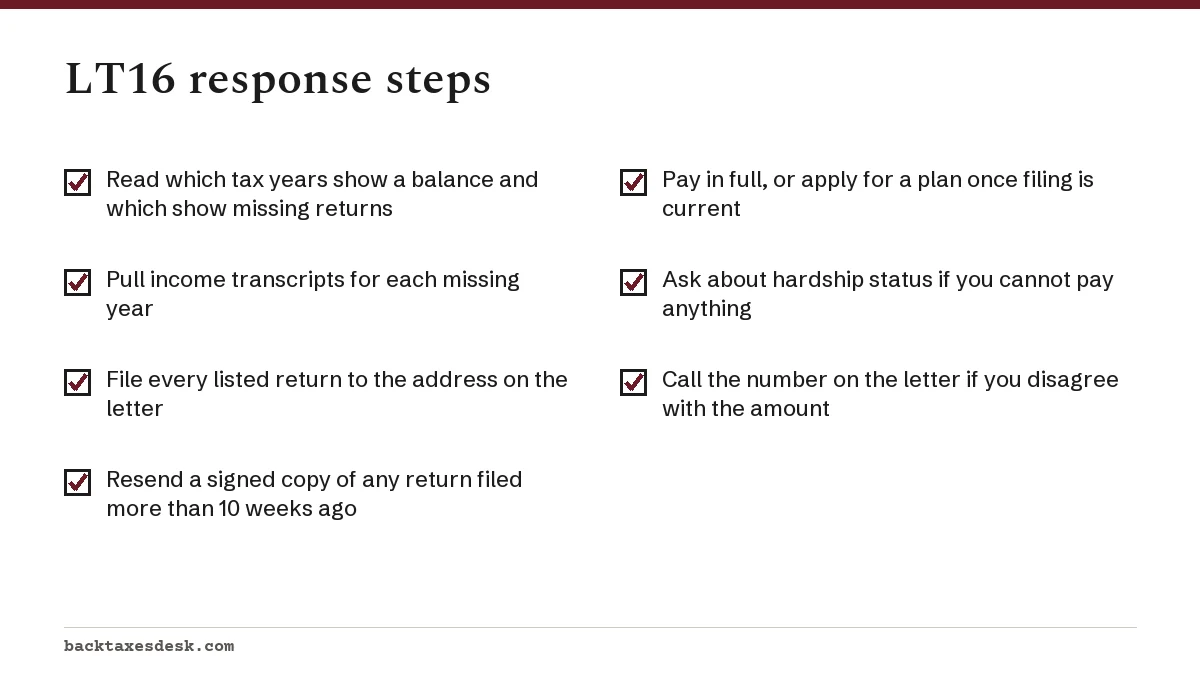
Missing returns listed on the LT16 IRS notice
If the letter lists missing returns, file them before anything else. The IRS will not set up an installment agreement for an individual who is behind on filing, so unfiled years block the cheapest way to pay.
- Get your income records for each listed year with Get Transcript online or Form 4506-T, which shows W-2 and 1099 data the IRS already has.
- Prepare each return on that year's forms. Past-due returns are filed the same way as on-time returns.
- Send them to the address on the LT16, not the usual filing address, so they reach the unit handling your case.
- If you already filed a listed return and more than 10 weeks have passed, send a signed copy of it to the IRS again.
- If you believe you did not have to file for a year, call the number on the letter to explain before the IRS acts on it.
Filing old returns can also reduce what you owe. If the IRS has already prepared a substitute return from third-party data, your own return with deductions and credits usually replaces those figures. Our guide on how to file unfiled tax returns covers the process for several years at once, and a refund on any of them is only allowed within 3 years of the return due date.
Paying or setting up a plan after an LT16
Once every required return is on file, choose how to pay. The table below shows the main official options and what each costs.
| Option | Who qualifies | Setup cost |
|---|---|---|
| Pay in full | Anyone | None |
| Short-term plan | Pay within 180 days, total under $100,000 | None |
| Extra 60 to 120 days | People filing past-due returns, by phone or Online Payment Agreement | None |
| Online long-term plan | Owe $50,000 or less | $29 with direct debit, $69 otherwise |
| Plan by phone or mail | Owe more or cannot apply online | $107 with direct debit, $178 otherwise |
Low-income applicants can have the direct-debit fee waived or reimbursed. Penalties and interest keep running on any plan until the balance is paid. Our IRS installment agreement page covers how monthly amounts are set.
Hardship options if you cannot pay
If paying anything would leave you unable to cover basic living costs, ask the IRS to delay collection. After reviewing a financial statement, usually Form 433-F, with proof of income, expenses and assets, it may mark the account Currently Not Collectible. The debt remains, interest continues, and a lien can still be filed, but active collection pauses.
If your income and assets make full payment unrealistic even over time, an offer in compromise settles the debt for less. It costs $205 to apply unless you meet the low-income certification, and the IRS only considers offers from people who have filed all required returns and made required estimated payments.
Is the IRS LT16 the same as a final notice
No. An LT16 does not give Collection Due Process hearing rights, and the IRS must still send a final notice of intent to levy, such as an LT11, Letter 1058 or CP90, at least 30 days before it levies.
If the tax is in doubt, you dispute the amount, or you cannot settle a disagreement, the IRS LT16 page says you can ask for a hearing with the Independent Office of Appeals; Publication 1660 explains the routes. Other letters that can arrive alongside an LT16 are listed in the IRS notices guide.
Common questions
What is an LT16 letter from the IRS?
It is a collection letter saying you have unpaid tax, unfiled returns or both. It asks you to file, pay or contact the IRS to avoid enforcement such as levies.
Is an LT16 a final notice?
No. It does not carry Collection Due Process rights. The IRS must still send a final notice of intent to levy at least 30 days before levying.
What if my LT16 lists returns I already filed?
If more than 10 weeks have passed since you sent the return, mail a signed copy to the address on the letter. Keep proof of mailing.
Can I get a payment plan after an LT16?
Yes, once all required returns are filed. Individuals who owe $50,000 or less can apply online; short-term plans cover balances under $100,000 paid within 180 days.
Can an LT16 lead to wage garnishment?
It can if you do nothing. After the final levy notice and its 30-day window, the IRS can levy wages, and a wage levy continues each pay period until released.
Sources
- Understanding your LT16 notice irs.gov
- Filing past due tax returns irs.gov
- Payment plans; installment agreements irs.gov
- Temporarily delay the collection process irs.gov
- Offer in compromise irs.gov
We check figures against these official pages. Rules change; confirm anything that affects a deadline or payment with the agency before you act.
Tell us what happened
Describe your situation and our editors will use it to improve this guide. If you leave your email, we may reply with a pointer to the right page or official contact. We never share your details.
Related guides
 How to File Unfiled Tax Returns: Step-by-Step Guide
To file unfiled tax returns, confirm which years are missing, download your IRS wage and income transcripts, prepare each year on…
Currently Not Collectible Status: IRS Hardship Explained
Currently not collectible (CNC) is an IRS account status that pauses most collection when paying anything toward your tax debt wo…
IRS Notice CP90: Final Levy Notice and Your Hearing Rights
A CP90 notice from the IRS is a final notice of intent to levy that also tells you of your right to a Collection Due Process hear…
IRS Installment Agreement Types: Which One Fits Your Debt
An IRS installment agreement is a long-term monthly payment plan whose type depends mostly on how much you owe. Tax of $10,000 or…
 IRS Notices and Letters: What Each One Means and Next Steps
An IRS notice is a letter the IRS mails when it needs something from you: payment of a balance, a reply to a proposed change, a m…