
Reasonable cause penalty abatement: reasons the IRS accepts and how to prove them
Short answer
Reasonable cause penalty abatement is IRS relief that removes a penalty when you took ordinary care but events beyond your control, such as a serious illness, a death in the family, a disaster or missing records, kept you from filing or paying on time. The IRS decides case by case, so dates and documents decide most requests.
- 01Penalties it can remove
- Failure to file, failure to pay, accuracy-related, information return
- 02Not available for
- The estimated tax penalty
- 03How to ask
- Call the number on the notice, or send Form 843 or a signed letter
- 04Form 843 box to check
- Line 7, box c: reasonable cause
- 05Appeal deadline after a denial
- Generally 30 days from the rejection letter
What does reasonable cause mean to the IRS?
Reasonable cause means you used ordinary business care and prudence to meet your tax obligations but still could not comply because of circumstances outside your control. The IRS weighs all the facts of your situation, case by case, and asks two questions: what stopped you, and what did you do once the obstacle was gone (IRS, Penalty relief for reasonable cause).
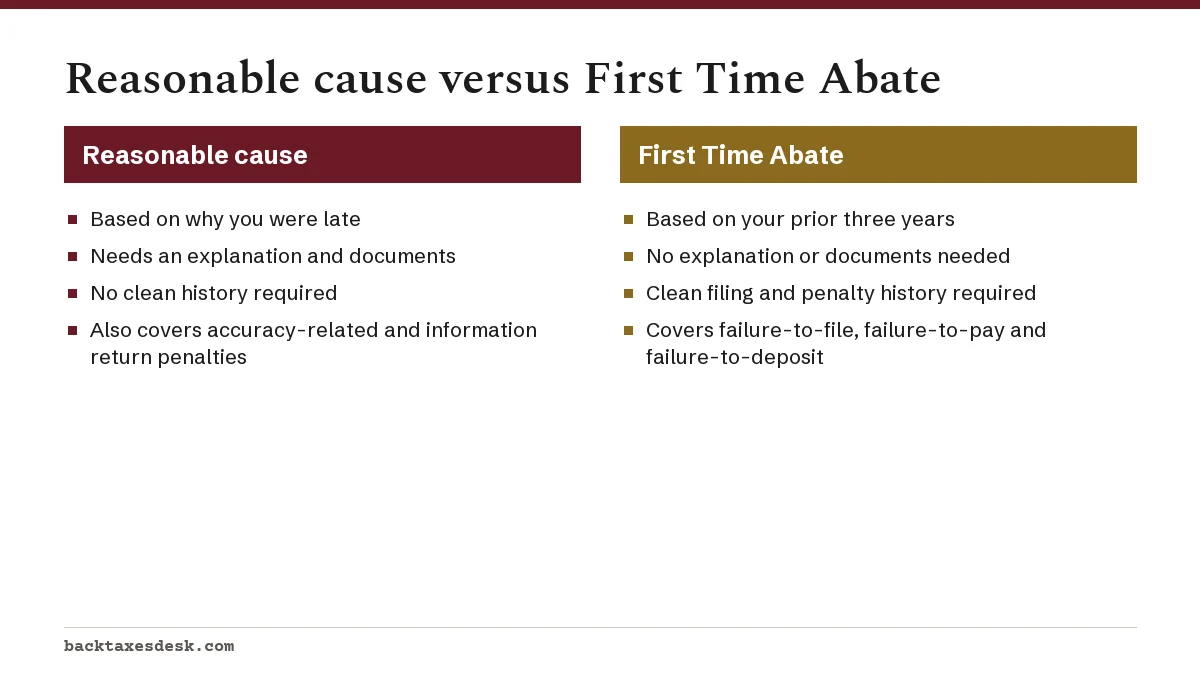
Reasonable cause penalty abatement differs from the history-based waivers. First time penalty abatement and the new automatic relief look only at your past record. A reasonable cause request looks at the reason for this one failure, so it is the route for people whose record is not clean or who have a strong explanation.
Which reasonable cause penalty abatement reasons does the IRS accept?
The IRS lists four kinds of events that can support reasonable cause. Each works only if it explains the timing of your failure and you acted promptly afterward.
| Event | What the IRS wants to see | Weak version of the same claim |
|---|---|---|
| Fire, natural disaster or civil disturbance | Date of the event, damage to home, office or records, and when you recovered | A storm in a month far from the deadline |
| Inability to get records | Your attempts to obtain them, who held them, and why they were unavailable | Records you could have requested but did not |
| Death, serious illness or unavoidable absence of you or immediate family | Hospital or care dates that overlap the due date, and a death certificate if relevant | An illness that ended well before the deadline, followed by months of silence |
| System issues that delayed an e-file or electronic payment | Rejection notices, payment confirmations, screenshots with dates | A payment scheduled the evening of the deadline with no record of the error |
Reasons the IRS usually rejects
- Relying on a tax preparer or other professional to file or pay for you. The duty to meet the deadline stays with you.
- Not knowing about the requirement or the due date.
- An honest mistake or oversight with nothing else behind it.
- Lack of money on its own. The IRS says a shortage of funds may count when combined with other facts, such as a medical crisis that drained your savings.
What documents support a reasonable cause request?
Documents that pin dates to the deadline carry the most weight. A request that says you were sick is weak; a hospital discharge summary showing admission on April 3 and release on May 20 is strong.
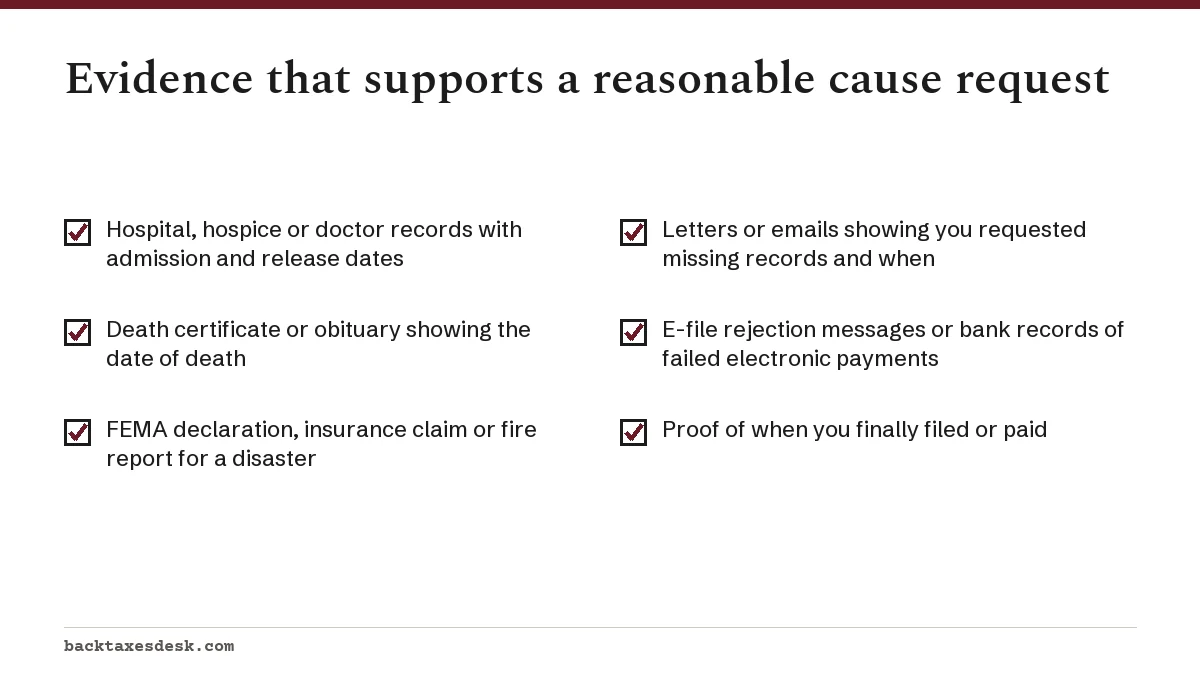
Keep copies of everything you send and write the tax year and notice number on each page. Send copies, not originals.
How to write a reasonable cause penalty abatement letter
A reasonable cause penalty abatement letter is a short, factual statement signed by you. It should read like a timeline with evidence, not like an appeal to sympathy. Use this structure:
- Identify the account. Your name, SSN (last four digits in the body is enough if the full number is on Form 843), tax year, form type, notice number and notice date.
- Name the penalty and amount. For example, the failure-to-pay penalty of $412 on the 2025 Form 1040.
- State what happened, with dates. The event, when it started, and how it overlapped the filing or payment deadline.
- Explain why you could not comply. Connect the event to the missed deadline; do not assume the reader will infer it.
- Show what you did once able. When you filed or paid, and how quickly after the obstacle ended.
- List the attachments. Number each document and refer to it by number in the letter.
- Sign and date it. If the request is on Form 843, check line 7, box c, and put the explanation on line 8 or an attached sheet.
You can also call the number on the notice and make the request by phone with your documents in front of you. For the paper route, our Form 843 guide covers each line of the form.
Is reasonable cause the same as first time abate?
No. They are separate grounds for relief, and you can raise both. First Time Abate is an administrative waiver that needs no explanation, only a clean three-year record. Reasonable cause needs an explanation and proof but no clean record.
One detail matters for planning. A penalty removed for reasonable cause does not count against you when the IRS later checks your history for First Time Abate. So if you have a well-documented reason, asking for reasonable cause first can keep the history-based waiver available for a future year. Starting with eligible returns due on or after January 1, 2027, the IRS applies its automatic penalty relief during processing; people who do not qualify for it can still ask for reasonable cause relief.
Can I appeal a reasonable cause denial?
Yes. You can appeal a denied request for removal of a failure-to-file or failure-to-pay penalty if you asked in writing, the IRS turned you down, and the denial letter explains your appeal rights. You generally have 30 days from the date of the rejection letter to ask for an appeal (IRS, Penalty appeal).
- Read the denial letter for the stated reason. Many denials say the evidence did not cover the deadline or that you waited too long to act afterward.
- Fill that specific gap with new documents instead of repeating the original letter.
- Follow the appeal instructions in the letter and send the request within the 30 days.
- Keep paying or arrange a payment plan meanwhile, because interest keeps running on any unpaid balance.
To estimate how much is at stake before you write, use the IRS penalty calculator. For how all penalty types relate, see the IRS penalties guide.
Common questions
What is the most common reasonable cause for IRS penalty abatement?
The IRS does not publish a ranking. The situations it names are fire, disaster or civil disturbance; inability to get records; death, serious illness or unavoidable absence; and system problems that delayed an electronic filing or payment.
Does relying on my accountant count as reasonable cause?
Generally no. The IRS says relying on a tax professional to file or pay for you is not by itself reasonable cause, because the responsibility to meet the deadline stays with the taxpayer.
How long after the event can I still ask for reasonable cause relief?
The IRS looks at whether you acted promptly once the obstacle ended. A long unexplained gap between recovery and filing or paying weakens the request, even if the original event was serious.
Can I request reasonable cause relief over the phone?
Yes. Call the number on your penalty notice and have your supporting documents ready. If the phone agent cannot approve it, send a written request or Form 843.
Does reasonable cause work for the underpayment of estimated tax penalty?
No. Reasonable cause relief does not apply to the estimated tax penalty; that penalty has its own waiver rules on Form 2210.
Sources
- Penalty relief for reasonable cause irs.gov
- Penalty relief due to First Time Abate or other administrative waiver irs.gov
- Penalty appeal irs.gov
- Interest irs.gov
- Administrative penalty relief irs.gov
We check figures against these official pages. Rules change; confirm anything that affects a deadline or payment with the agency before you act.
Tell us what happened
Describe your situation and our editors will use it to improve this guide. If you leave your email, we may reply with a pointer to the right page or official contact. We never share your details.