
How to request first time penalty abatement: phone, letter or Form 843
Short answer
To request first time penalty abatement, call the toll-free number in the top right corner of your IRS penalty notice, or mail a written request or Form 843, Claim for Refund and Request for Abatement. You do not have to name First Time Abate or attach documents; the IRS checks your three-year record itself and tells you its decision.
- 01Ways to ask
- Phone call, written statement or Form 843
- 02Phone number to use
- The toll-free number on your notice
- 03Documents needed
- None for First Time Abate
- 04Form 843 mailing rule
- Service center where you would file a current-year return for that tax
- 05If denied
- Request relief for reasonable cause
Before you ask: three quick checks
Spend ten minutes confirming three things before you contact the IRS. It makes the request faster and tells you which route to use.
- The penalty type. First Time Abate covers failure-to-file, failure-to-pay and failure-to-deposit penalties only. Find the penalty lines on your notice (often a CP14 or later bill) and note the tax year and amount of each.
- Your three-year record. For the tax year on the notice, list the three years before it. Each return of the same type should have been filed on time, with no penalties other than an estimated tax penalty. Your IRS online account shows past-year balances and transcripts if you are unsure.
- Whether relief already happened. For eligible returns with original due dates on or after January 1, 2027, the IRS applies the Automatic Exemption from Penalty during processing and mails a confirming notice. If you have that notice, there is nothing to request.
Not sure you meet the test? The eligibility rules, with examples, are on our first time penalty abatement page.
Can I request abatement by phone?
Yes. A phone call is often the quickest way to request first time penalty abatement, because the representative can review your account while you are on the line. Use the toll-free number printed in the top right corner of your notice, not a number from an ad or an unsolicited call.
What to have ready
- The notice itself, including the notice number and the tax year
- Your Social Security number or ITIN and the name exactly as shown on the return
- A copy of the return for that year
- The penalty amounts you want removed
- A pen and paper to note the date, the representative's name or ID number, and what was agreed
What to say
Keep it short: you received a notice for a penalty on a given tax year, you have filed and paid on time in the past, and you would like the penalty removed. You do not need to say First Time Abate, although it does no harm. If the representative grants relief, ask them to confirm which penalties and which tax year the removal covers.
How to write a first time penalty abatement letter
A first time penalty abatement letter is a short written statement mailed to the IRS asking it to remove a penalty based on your compliance history. It suits people who cannot get through by phone or who want a paper record. Plain language is fine; there is no required wording.
What the request letter should contain
- Your name, address and Social Security number or ITIN, as shown on the return.
- The notice number and date, and the tax form and tax year it relates to.
- The penalty or penalties you want removed, with the amounts from the notice.
- One or two sentences stating that you filed and paid on time in the three prior years and are asking for administrative penalty relief.
- If you also have a reason for being late, such as a hospital stay, a brief note of it, so the IRS can consider reasonable cause if the history test fails.
- Your signature, the date and a daytime contact number.
Include a copy of the notice so the IRS can match the letter to your account, and keep a copy of everything you send. Mail it to the address on the notice or to the address the Form 843 instructions give for penalty requests, and consider certified mail so you have proof of the date.
Sample outline
Re: [Notice number], tax year [year], Form 1040, SSN ending [last four digits]. I am writing to request removal of the failure-to-file penalty of $[amount] and the failure-to-pay penalty of $[amount] shown on the notice dated [date]. I filed my returns on time for the three prior years and had no penalties in those years. Please remove these penalties under your administrative relief procedures. A copy of the notice is enclosed.
Do I need a letter or Form 843?
Either works. The IRS accepts a written statement or Form 843, Claim for Refund and Request for Abatement. Form 843 is useful when you have already paid the penalty and want the money back, because the form handles refunds as well as abatements, and its structure makes sure the IRS gets every detail it needs.
First time penalty abatement on Form 843, line by line
| Line | What to enter |
|---|---|
| 1 | The tax period, for example January 1 to December 31, 2024 |
| 2 | The dollar amount of the penalty you want removed or refunded |
| 3 | Payment dates, only if you already paid the penalty and want a refund |
| 4 | The type of tax: check income |
| 5 | The type of return: check 1040 |
| 6 | The Internal Revenue Code section: 6651(a)(1) for failure to file, 6651(a)(2) for failure to pay |
| 7 | The box that best fits your reason for the request |
| 8 | Your explanation: timely filing and payment in the three prior years, plus any reasonable cause facts |
Generally you file a separate Form 843 for each tax period. The instructions say to mail a penalty request to the service center where you would file a current-year return for that tax. More detail on each line, including the reason boxes, is on our Form 843 penalty abatement page.
What happens after you ask
The IRS reviews your account and tells you its decision. If relief is granted by phone, the representative can usually make the adjustment during the call, and a notice showing the reduced balance follows by mail. Written requests and Form 843 take longer because they go through paper processing.
While you wait, interest keeps running on any unpaid tax. Pay the tax portion if you can, or set up a plan through our IRS payment plan guide. If relief is granted after you paid the penalty, the IRS credits or refunds the removed amount along with the related interest.
What if the IRS says no?
If the IRS finds you do not qualify for first time relief, you can ask for penalty relief based on reasonable cause instead. That means explaining what stopped you from filing or paying on time, when it happened, and what you did once it was resolved, with records that back it up. Our page on reasonable cause penalty abatement lists the kinds of events the IRS considers.
- Check the reason given. A denial based on a prior-year penalty may be wrong if that penalty was later removed for reasonable cause or IRS error.
- Read the decision letter for your appeal rights and the deadline to use them.
- Keep paying the tax. A denial does not change what you owe in tax and interest.
For how this request fits with every other penalty option, see the IRS penalties guide. For returns due in 2027 and later, check first whether the automatic penalty relief program already handled it.
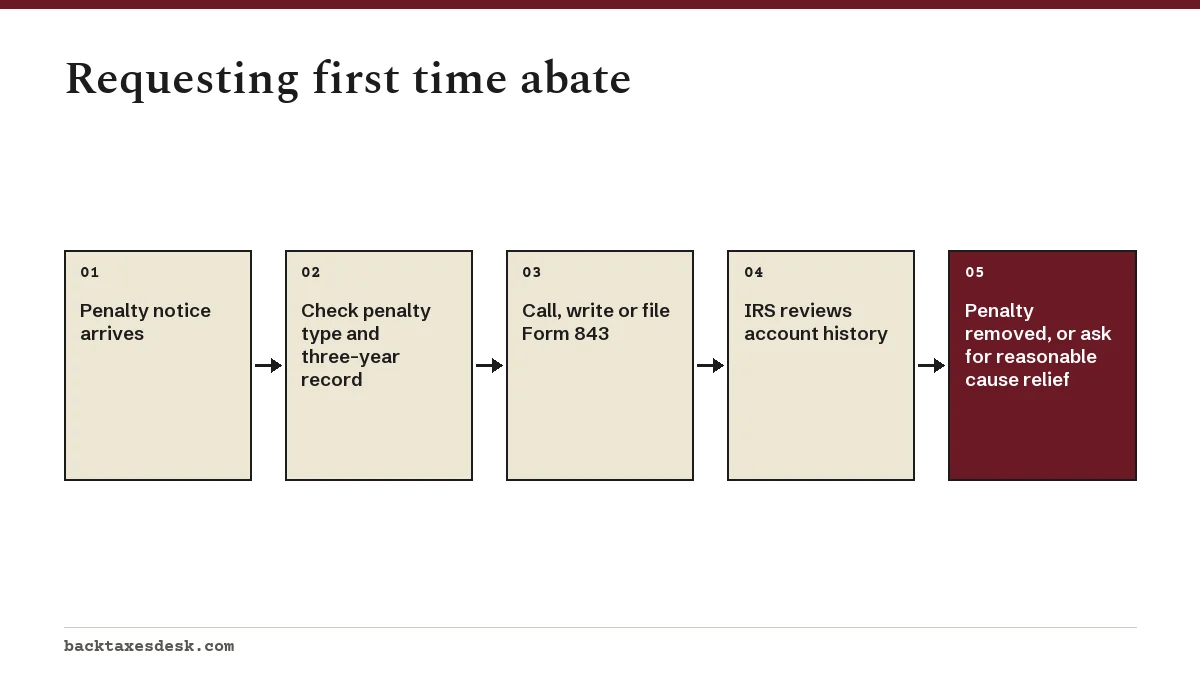
Step by step
Confirm the penalty type
Check that the notice shows a failure-to-file, failure-to-pay or failure-to-deposit penalty and note the tax year and amount.
Check your three-year record
Confirm the same return type was filed on time for the three prior years with no penalties other than estimated tax penalties.
Choose how to ask
Call the number on the notice, mail a short letter, or file Form 843, Claim for Refund and Request for Abatement.
Make the request
Name the penalty and tax year and state your clean history. No documents are required.
Keep records and pay the tax
Note the date and outcome, keep copies, and pay or arrange to pay the tax while the request is reviewed.
If denied, request reasonable cause relief
Explain what prevented timely filing or payment and provide supporting records.
Common questions
How do I ask the IRS for first time abatement?
Call the toll-free number on your penalty notice, or mail a written statement or Form 843. Say which penalty and tax year you want removed and that your prior three years were filed and paid on time.
Do I need to mention First Time Abate by name?
No. The IRS says you do not have to name it; it reviews your account for eligibility when you ask for penalty relief.
What documents do I need for first time penalty abatement?
None. The IRS decides from its own records of your filing and penalty history. Keep a copy of the notice handy for reference.
Can a tax professional request first time abate for me?
Yes, if you give them authority to act for you. Enrolled agents, CPAs and attorneys can represent taxpayers before the IRS, but the request itself is simple enough to make on your own.
Should I use Form 843 if I already paid the penalty?
Form 843 is designed for both refunds and abatements, so it fits well when you want a paid penalty returned. Enter the payment dates on line 3.
Sources
- Penalty relief due to First Time Abate or other administrative waiver irs.gov
- About Form 843, Claim for Refund and Request for Abatement irs.gov
- Instructions for Form 843 irs.gov
- Administrative penalty relief irs.gov
We check figures against these official pages. Rules change; confirm anything that affects a deadline or payment with the agency before you act.
Tell us what happened
Describe your situation and our editors will use it to improve this guide. If you leave your email, we may reply with a pointer to the right page or official contact. We never share your details.