
Can you go to jail for not filing taxes?
Short answer
Yes, you can go to jail for not filing taxes, but only if the failure is willful: you knew you had to file and chose not to. Willful failure to file is a federal misdemeanor under IRC 7203, punishable by up to one year in prison. Most late filers face civil penalties instead, and hiding income or assets is what turns a case into a felony.
- 01Willful failure to file (IRC 7203)
- Misdemeanor: up to 1 year in prison
- 02Fine under 7203
- Up to $25,000 in the statute; up to $100,000 for individuals under 18 USC 3571
- 03Tax evasion (IRC 7201)
- Felony: up to 5 years in prison
- 04False return (IRC 7206(1))
- Felony: up to 3 years in prison
- 05Time limit to charge failure to file
- Generally 6 years
Can you go to jail for not filing taxes? The short answer
Jail is possible, but it is reserved for willful conduct. Section 7203 of the Internal Revenue Code makes it a crime to willfully fail to file a required return, pay tax, or keep required records. It is a misdemeanor carrying up to one year in prison, a fine, or both, plus the costs of prosecution.
For the typical person who fell behind because of illness, job loss, disorganization or fear of a balance they could not pay, the consequences are civil: penalties, interest, a substitute return and collection. Those are covered in our page on what happens if you don't file taxes.
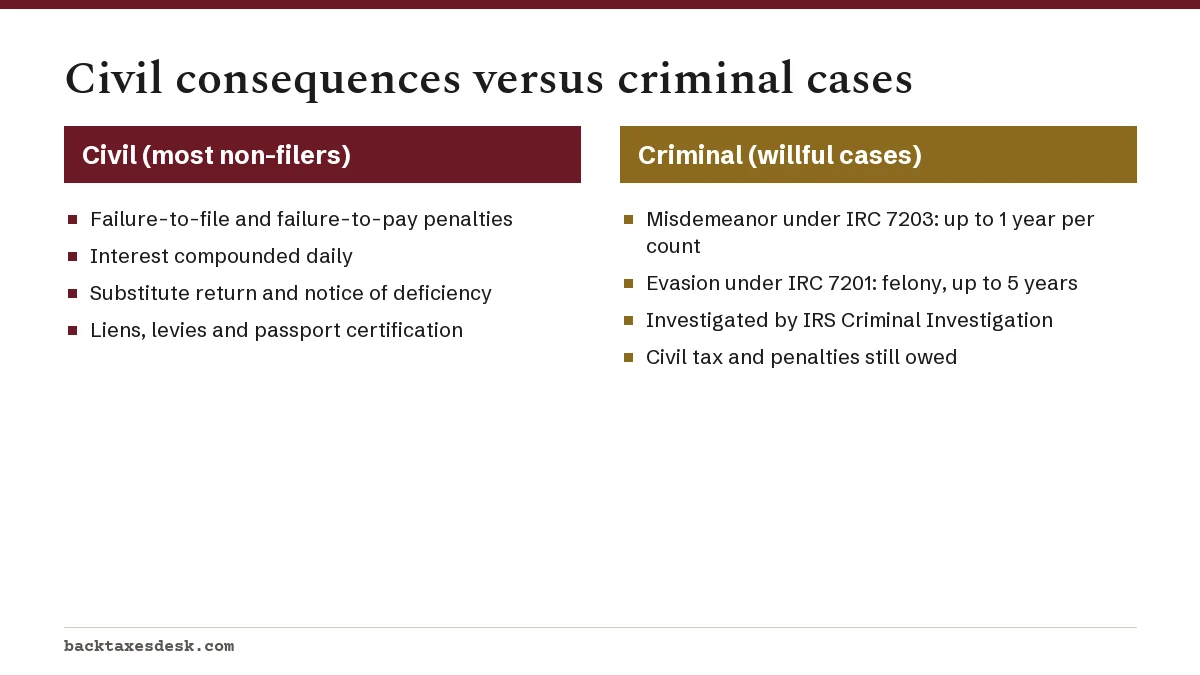
Civil penalties versus criminal cases
Civil and criminal consequences run on separate tracks. The civil side is handled by IRS examination and collection staff and aims to get the returns filed and the tax paid. The criminal side is handled by IRS Criminal Investigation and the Department of Justice and aims to punish.
| Offense | Code section | Classification | Maximum prison term |
|---|---|---|---|
| Willful failure to file, pay or keep records | IRC 7203 | Misdemeanor | 1 year |
| Willfully making a false return | IRC 7206(1) | Felony | 3 years |
| Attempt to evade or defeat tax | IRC 7201 | Felony | 5 years |
Fines are higher than the Code alone suggests. The IRS manual on criminal provisions explains that 18 USC 3571 raises the maximum fine for a 7203 misdemeanor to $100,000 for individuals, and for evasion to $250,000. A conviction does not replace the civil bill: the tax, civil penalties and interest are still owed.
What makes non-filing willful
Willful failure to file means voluntarily and intentionally violating a legal duty you knew about. According to the IRS criminal statutes manual, the government does not have to prove you meant to evade tax; it is enough to show the failure was voluntary, purposeful and deliberate rather than accidental, inadvertent or negligent.
Facts that can suggest willfulness
- A history of filing, then stopping once income rose.
- Ignoring repeated IRS letters and in-person contacts about the missing returns.
- Moving income into cash, nominee accounts or other people's names.
- Relying on frivolous arguments that wages are not income or that filing is voluntary.
- Filing false W-4s or giving false statements to IRS employees.
Facts that tend to suggest a civil matter
- Serious illness, a death in the family or other disruption during the missed years.
- Income that was fully reported by employers, with tax withheld.
- Coming forward and filing before the IRS contacts you.
- Honest confusion about whether a return was required.
Criminal charges for willful failure to file must generally be brought within six years. That limit does not protect you from civil tax, which can be assessed for a year with no return at any time, as explained on our unfiled tax returns statute of limitations page.
Jail for not paying taxes: is it a crime to owe?
Simply owing tax you cannot afford is not a crime. People with filed returns and unpaid balances are handled through bills, liens, levies, payment plans and hardship status. The criminal line is crossed when someone willfully refuses to pay while able to, or takes steps to hide money and assets from the IRS.
Hiding assets, using false documents or lying to a revenue officer can turn a collection case into an evasion case, which is a felony. Filing an honest return and asking for an installment agreement is the opposite of that conduct, and it is the safest thing a person with a balance can do.
Why filing now matters
The IRS treats non-filers seriously. In February 2024 (FS-2024-06) it described more than 125,000 cases of high-income taxpayers who had not filed for tax years 2017 through 2021, and it warned that people who do not respond can face substitute returns, levies, liens, additional penalties and criminal prosecution.
Filing accurate returns before the IRS escalates shows the opposite of willfulness and ends the growing civil penalties. Follow our steps on how to file unfiled tax returns, and see the unfiled tax returns overview for how many years to include.
When to talk to a tax attorney
Most people catching up on missed years can work with an enrolled agent or CPA. Talk to a tax attorney before filing or speaking with the IRS if any of these apply:
- An IRS special agent from Criminal Investigation has contacted you, rather than a revenue agent or revenue officer.
- Income was deliberately kept off the books or held in someone else's name.
- Several years of large income are unfiled and you had earlier filed regularly.
- You have unreported foreign accounts or income.
Conversations with an attorney are covered by attorney-client privilege in ways that other advisers may not be. Our comparison of a tax attorney vs CPA explains when each makes sense.
Common questions
Is not paying taxes a crime?
Not by itself. Being unable to pay is handled with civil collection. It becomes criminal when the failure to pay is willful or involves hiding income or assets.
What is willful failure to file?
It is knowingly and deliberately not filing a return you were legally required to file. It is a misdemeanor under IRC 7203 with up to one year in prison.
Does filing late protect you from criminal charges?
It does not erase a past crime, but filing accurate returns before the IRS contacts you is strong evidence against willfulness and stops the civil penalties from growing. Anyone with signs of fraud should get legal advice first.
How many years can you go to jail for not filing taxes?
Up to one year for each count of willful failure to file. Separate counts can be charged for separate years, and evasion or false-return charges carry up to five and three years.
How often does the IRS prosecute non-filers?
Criminal cases are reserved for willful conduct; the usual IRS response to non-filing is civil penalties, substitute returns and collection. Treat any specific odds of prosecution quoted online with caution unless they cite an official source.
Sources
- IRM 9.1.3 Criminal Statutory Provisions and Common Law irs.gov
- Filing past due tax returns irs.gov
- What to expect after receiving a non-filer compliance alert notice irs.gov
- IRM 4.12.1 Nonfiled Returns irs.gov
We check figures against these official pages. Rules change; confirm anything that affects a deadline or payment with the agency before you act.
Tell us what happened
Describe your situation and our editors will use it to improve this guide. If you leave your email, we may reply with a pointer to the right page or official contact. We never share your details.
Related guides
 How to File Unfiled Tax Returns: Step-by-Step Guide
To file unfiled tax returns, confirm which years are missing, download your IRS wage and income transcripts, prepare each year on…
Unfiled Tax Returns Statute of Limitations: How Far Back
There is no statute of limitations on unfiled tax returns for assessing tax: under IRC 6501(c)(3) the IRS can assess a year with…