
Unfiled tax returns for a deceased person: an executor's guide
Short answer
Unfiled tax returns for a deceased person are filed by the personal representative: the executor, the court-appointed administrator, or whoever is in charge of the person's property. The representative files the missing prior years as well as the final return, pays any tax from estate assets before distributing them, and can be personally liable if heirs are paid first. Heirs are not personally liable unless they received estate property.
- 01Who files
- Personal representative (executor, administrator, or person in charge of the property)
- 02Form to notify the IRS
- Form 56, Notice Concerning Fiduciary Relationship
- 03Final return due date
- April 15 of the year after death (April 15, 2027 for a 2026 death)
- 04Refund claim form
- Form 1310, unless a surviving spouse files jointly or a court-appointed representative attaches the court certificate
- 05Records for the deceased
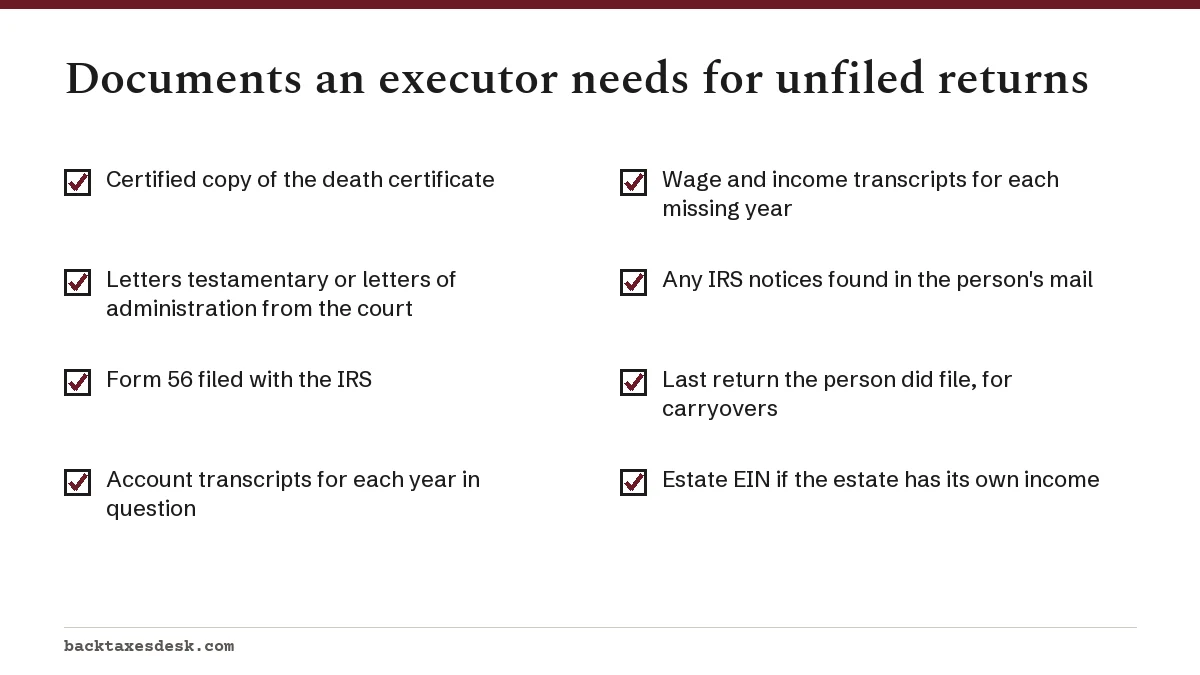
- Form 4506-T (transcripts) or Form 4506 (copies) with death certificate and court letters
Unfiled tax returns for deceased person estates: who is responsible
When someone dies with unfiled tax returns, the duty to file does not die with them. It passes to the personal representative. IRS Publication 559 defines that role broadly: an executor named in the will, an administrator appointed by a court when there is no will, or, if neither exists, anyone in actual or constructive possession of the person's property.
Publication 559 says the personal representative must file any returns the person did not file for earlier years, not just the final one. The IRS page on final returns of a deceased person makes the same point: if returns for years before death were never filed, you may have to file them.
Tell the IRS you are acting for the estate
File Form 56, Notice Concerning Fiduciary Relationship, once you have the information it asks for, including the estate's employer identification number if one was obtained. The notice stays in effect until you file another Form 56 ending the relationship.
Getting a deceased taxpayer's records and transcripts
The IRS releases a deceased person's transcripts and return copies to the executor, administrator or personal representative who sends the right paperwork.
| What you need | Form | Attach |
|---|---|---|
| Wage and income or account transcripts | Form 4506-T | Death certificate, plus court-approved letters testamentary, or Form 56 with those letters |
| A full copy of a filed return | Form 4506 (fee applies) | Same as above |
Account transcripts show which years have no return, or a substitute for return the IRS already assessed. Wage and income transcripts then list the W-2s and 1099s for each missing year.
Filing the final tax return and the missed years
Each missing year is prepared on that year's own Form 1040 or 1040-SR, exactly as the person would have filed it while alive. The final return covers January 1 through the date of death and is due on the normal April deadline of the following year. For someone who died in 2026, that is April 15, 2027.
Signing and marking the returns
- Write DECEASED, the person's name and the date of death across the top of the final return.
- A court-appointed representative signs the return. If there is none, a surviving spouse filing jointly signs and writes "Filing as surviving spouse."
- If there is no court appointment and no surviving spouse, the person in charge of the property signs as personal representative.
- A surviving spouse who did not remarry before the end of the year of death can file a joint return for that year; both the spouse and any court-appointed representative sign it.
Claiming refunds on the missing years
A refund is claimed with Form 1310, Statement of a Person Claiming Refund Due a Deceased Taxpayer. Publication 559 lists two exceptions: a surviving spouse filing a joint return, and a court-appointed representative who attaches a copy of the court certificate of appointment.
The ordinary refund deadline still applies. A refund is lost if the return is not filed within three years of its original due date, so a tax year 2023 refund must be claimed by April 15, 2027. Our page on filing old tax returns lists the deadline for each recent year, and how to file unfiled tax returns covers forms and mailing.
A worked example for an executor
Suppose a parent died in June 2026 with no returns filed for 2023, 2024 or 2025, and pension withholding in every year. The executor might order the 2027 work like this.
| Tax year | Deadline that matters | Filing method in 2027 | Priority |
|---|---|---|---|
| 2023 | Refund lost after April 15, 2027 | Paper only | First, mailed early with Form 1310 or court certificate |
| 2026 (final return) | Due April 15, 2027 | E-file or paper | Second |
| 2024 | Refund window open until April 15, 2028 | E-file or paper | Third |
| 2025 | Refund window open until April 15, 2029 | E-file or paper | Fourth |
If a year shows a balance instead, set estate money aside for it before paying inheritances. The IRS can apply a refund from one year against a balance on another.
Back taxes after death: paying from the estate
Tax owed for the missing years, with its penalties and interest, is a debt of the estate. If the estate cannot pay every creditor, federal tax claims generally come first under the federal priority statute, 31 USC 3713. Publication 559 warns that a representative who distributes estate assets before paying debts owed to the United States can become personally liable for the unpaid tax.
The IRS manual on decedents' estates, IRM 5.17.13, adds two limits: the representative must have known facts that would put a reasonably prudent person on notice of the tax debt, and the liability is capped at the value of the assets paid out in violation of the priority. A federal tax lien that arose before death continues to attach to the property after death, so a house the person owned can carry the lien into probate until the debt is paid.
Two forms that protect the executor
- Form 4810, Request for Prompt Assessment: shortens the time the IRS has to assess more income tax on returns you filed from three years to 18 months from the request. It does not apply to estate tax.
- Form 5495, Request for Discharge From Personal Liability: filed after the returns are in. The IRS has nine months to tell you what is owed; once that amount is paid, or if the IRS does not respond in time, you are discharged from personal liability.
If the estate earns $600 or more of gross income after death, such as interest or rent, it files its own income tax return on Form 1041. That is separate from the person's missing Form 1040s.
Does the IRS forgive tax debt from a deceased person?
No. Death does not cancel federal tax; the balance is collected from the estate. Heirs and beneficiaries are not personally liable for it simply because they are family.
The exception is property. The IRS manual explains that people who receive property from an insolvent estate can face transferee liability, limited to the value of what they received. Assets that pass outside probate, such as property held jointly with right of survivorship, go straight to the survivor, though a lien that already attached to the property can still follow it.
When a surviving spouse is on the hook
A spouse who signed joint returns with the deceased person is generally responsible for the full tax on those joint years, because joint filers are jointly and severally liable. A spouse who believes the debt belongs only to the deceased partner can ask for relief on Form 8857; see innocent spouse relief. Tax on years the deceased person filed, or failed to file, alone is generally not the spouse's personal debt.
Time limits still apply the usual way. A year with no return can be assessed at any time, and assessed tax is collectible for 10 years from assessment, as our page on the unfiled tax returns statute of limitations explains.
Penalties on the missing years and when to get help
Failure-to-file and failure-to-pay penalties apply to the missed years just as they would have while the person was alive. The IRS lists death or serious illness of the taxpayer or immediate family among the circumstances it considers for reasonable cause relief, so explain in writing when illness before death kept the returns from being filed.
Criminal exposure for willful non-filing, covered on our page about jail for not filing taxes, concerns the person who failed to file. An executor who finds missing years and files them is carrying out the duty Publication 559 describes.
Consider professional help when there are several years of self-employment income, an estate that may not cover all its debts, property that must be sold, or a possible estate tax return on Form 706. Enrolled agents, CPAs and attorneys can all represent an estate before the IRS; our comparison of an enrolled agent vs CPA explains the differences. The wider catch-up process is in our unfiled tax returns guide.
Common questions
Who files back tax returns for someone who died?
The personal representative: the executor named in the will, the administrator appointed by a court, or, if neither exists, the person in charge of the deceased person's property. A surviving spouse can sign a joint return for the year of death.
Do children have to pay a parent's back taxes?
Not from their own money. The tax is paid from the parent's estate. Children who received property from an estate that could not pay its debts can be liable up to the value of what they received.
How do I get a deceased parent's W-2s and 1099s?
Send Form 4506-T for wage and income transcripts, with a copy of the death certificate and court-approved letters testamentary, or Form 56 with those letters attached. The transcripts show what employers and payers reported for each year.
Can an executor be held responsible for a deceased person's taxes?
Yes, if the executor pays other debts or distributes inheritances before paying federal tax when they knew facts that would alert a reasonably prudent person to the debt. The liability is limited to the value of the assets paid out that way, and Form 5495 can be used to request a discharge.
Is there a deadline to file a deceased person's unfiled returns?
There is no deadline for filing a missing year, but refunds are only paid if the return is filed within three years of its original due date. The final return is due April 15 of the year after death.
Sources
- Publication 559, Survivors, Executors, and Administrators irs.gov
- File the final income tax returns of a deceased person irs.gov
- Deceased taxpayers: getting information from the IRS irs.gov
- IRM 5.17.13 Insolvencies and Decedents' Estates irs.gov
- Time you can claim a credit or refund irs.gov
- Penalty relief for reasonable cause irs.gov
We check figures against these official pages. Rules change; confirm anything that affects a deadline or payment with the agency before you act.
Tell us what happened
Describe your situation and our editors will use it to improve this guide. If you leave your email, we may reply with a pointer to the right page or official contact. We never share your details.
Related guides
 How to File Unfiled Tax Returns: Step-by-Step Guide
To file unfiled tax returns, confirm which years are missing, download your IRS wage and income transcripts, prepare each year on…
Filing Old Tax Returns: Deadlines, Refunds and Right Forms
Filing old tax returns is allowed for any year, but refunds are only paid if you file within three years of the original due date…
Enrolled Agent vs CPA: Who Should Handle Your IRS Problem
In the enrolled agent vs CPA choice, both credentials carry unlimited rights to represent you before the IRS in audits, collectio…
Innocent Spouse Relief: Form 8857 and Who Qualifies
Innocent spouse relief lets you avoid tax, interest and penalties caused by a spouse or former spouse's errors on a joint return.…
Can You Go to Jail for Not Filing Taxes? The Real Risk
Yes, you can go to jail for not filing taxes, but only if the failure is willful: you knew you had to file and chose not to. Will…